
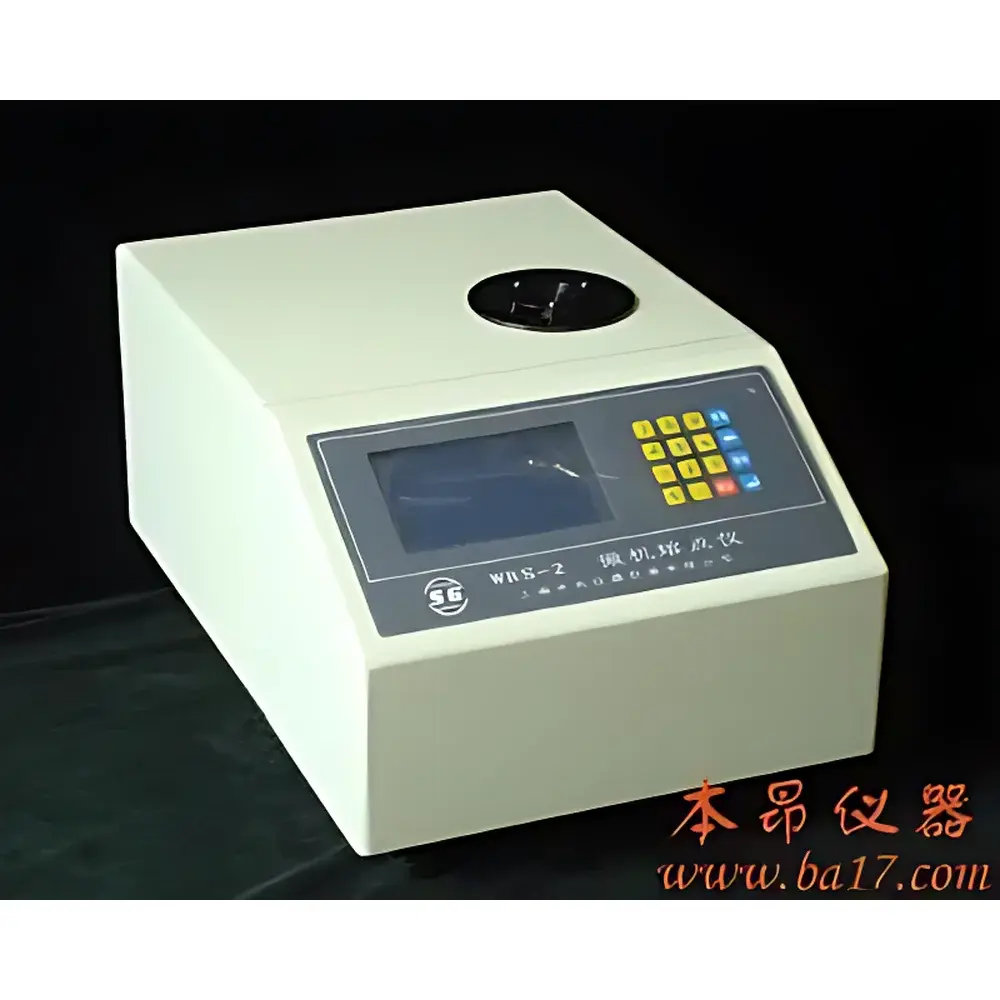
BenAng WRS-2 Digital Melting Point Apparatus
| Brand | BenAng |
|---|---|
| Model | WRS-2 |
| Origin | Shanghai, China |
| Category | Thermal Analysis Instrument |
| Temperature Range | Ambient to 300 °C |
| Minimum Display Resolution | 0.1 °C |
| Programmable Heating Rates | 0.2, 0.5, 1.0, 1.5, 2.0, 3.0, 4.0, 5.0 °C/min |
| Accuracy | ±0.5 °C below 200 °C |
| Dimensions | 398 × 280 × 170 mm |
| Weight | 11 kg |
| Interface | RS232 |
| Output | Automatic onset/melting end calculation and mean value reporting |
| Display | Backlit LCD with real-time melting curve visualization |
Overview
The BenAng WRS-2 Digital Melting Point Apparatus is a precision thermal analysis instrument engineered for the accurate determination of melting point ranges in crystalline organic compounds. It operates on the principle of controlled linear heating combined with optical detection of phase transition—specifically, the visual disappearance of crystal structure under defined thermal conditions. Designed for routine quality control and purity assessment in pharmaceutical, fine chemical, agrochemical, and academic research laboratories, the WRS-2 delivers reproducible results aligned with pharmacopoeial methodologies (e.g., USP , EP 2.2.17, and JP 2.60). Its integrated photodetection system monitors light transmission through the sample capillary in real time, enabling objective identification of both onset (initial softening) and endpoint (complete liquefaction) temperatures without subjective operator interpretation.
Key Features
- Eight selectable linear heating rates (0.2–5.0 °C/min), allowing method optimization per compound thermal stability and regulatory requirement.
- High-resolution backlit LCD display showing real-time temperature, elapsed time, and dynamic melting curve—enabling immediate visual confirmation of transition behavior.
- Digital keypad input for precise parameter entry, eliminating mechanical dials and associated calibration drift.
- Automatic calculation and display of onset, endpoint, and arithmetic mean values—reducing manual transcription errors and improving workflow efficiency.
- RS232 serial interface for external data logging or integration into LIMS environments, supporting traceable recordkeeping in GLP- and GMP-compliant settings.
- Robust aluminum alloy housing and thermally stabilized heating block ensure mechanical stability and thermal uniformity across repeated runs.
- Capillary-based sample introduction compatible with standard 1.0 mm OD glass tubes (1–3 mm sample height), minimizing material consumption and cross-contamination risk.
Sample Compatibility & Compliance
The WRS-2 is validated for use with solid, dry, crystalline organic substances—including active pharmaceutical ingredients (APIs), intermediates, reference standards, dyes, fragrances, and polymer additives. Samples must be homogeneous, free of solvents or moisture, and packed consistently to avoid air gaps that compromise heat transfer. The instrument meets general requirements for thermal analysis instrumentation as outlined in ISO 11357-3 (Plastics — Differential Scanning Calorimetry — Part 3: Determination of melting and crystallization temperatures and enthalpies) and supports compliance with pharmacopoeial monographs requiring melting point verification. While not a regulated device under FDA 21 CFR Part 11, its RS232 output enables audit-trail-capable data capture when paired with compliant software systems adhering to ALCOA+ principles.
Software & Data Management
The WRS-2 operates as a standalone instrument with embedded firmware—no proprietary PC software is required for basic operation. All parameters, results, and curve metadata are stored locally in non-volatile memory for up to 100 test records. The RS232 port supports ASCII-formatted output (temperature, time, status flags) at 9600 baud, facilitating direct import into spreadsheet applications or laboratory information management systems (LIMS). Users may configure data export intervals and trigger logic via hardware-level DIP switches. For regulated environments, third-party validation packages (IQ/OQ documentation templates) are available upon request to support installation and operational qualification under GxP frameworks.
Applications
- Pharmaceutical QC: Identity confirmation and purity screening of APIs and excipients per USP/EP monographs.
- Chemical synthesis monitoring: Verification of product crystallinity and batch-to-batch consistency during process development.
- Academic teaching labs: Instructional tool for introducing thermal transitions, polymorphism, and eutectic behavior in organic chemistry curricula.
- Regulatory submission support: Generation of documented melting profiles for inclusion in DMF, ANDA, or CMC sections.
- Stability studies: Tracking melting point shifts indicative of degradation, hydration, or polymorphic conversion over storage time.
FAQ
What sample preparation is required prior to analysis?
Samples must be finely powdered, dried, and tightly packed into standard 1.0 mm OD capillaries to a height of 3–5 mm. Excess air voids or moisture will distort thermal response and reduce measurement repeatability.
Can the WRS-2 distinguish between polymorphs?
While it does not provide structural identification, distinct melting point ranges or multiple endothermic events observed across replicate runs may indicate polymorphic variation—further characterization would require complementary techniques such as XRD or DSC.
Is calibration traceable to national standards?
Yes—users may perform two-point calibration using certified reference materials (e.g., pure indium, tin, or phenacetin) with NIST-traceable certificates. Calibration verification should be conducted before each analytical session in regulated workflows.
Does the instrument support GLP-compliant electronic signatures?
No—the WRS-2 lacks built-in user authentication or electronic signature functionality. However, its RS232 output allows integration with validated external systems that enforce 21 CFR Part 11 controls.
What maintenance is recommended for long-term accuracy?
Annual verification of heating block uniformity and photodetector sensitivity is advised. Cleaning of optical windows and capillary chamber with lint-free swabs and isopropanol prevents signal attenuation due to residue buildup.



