
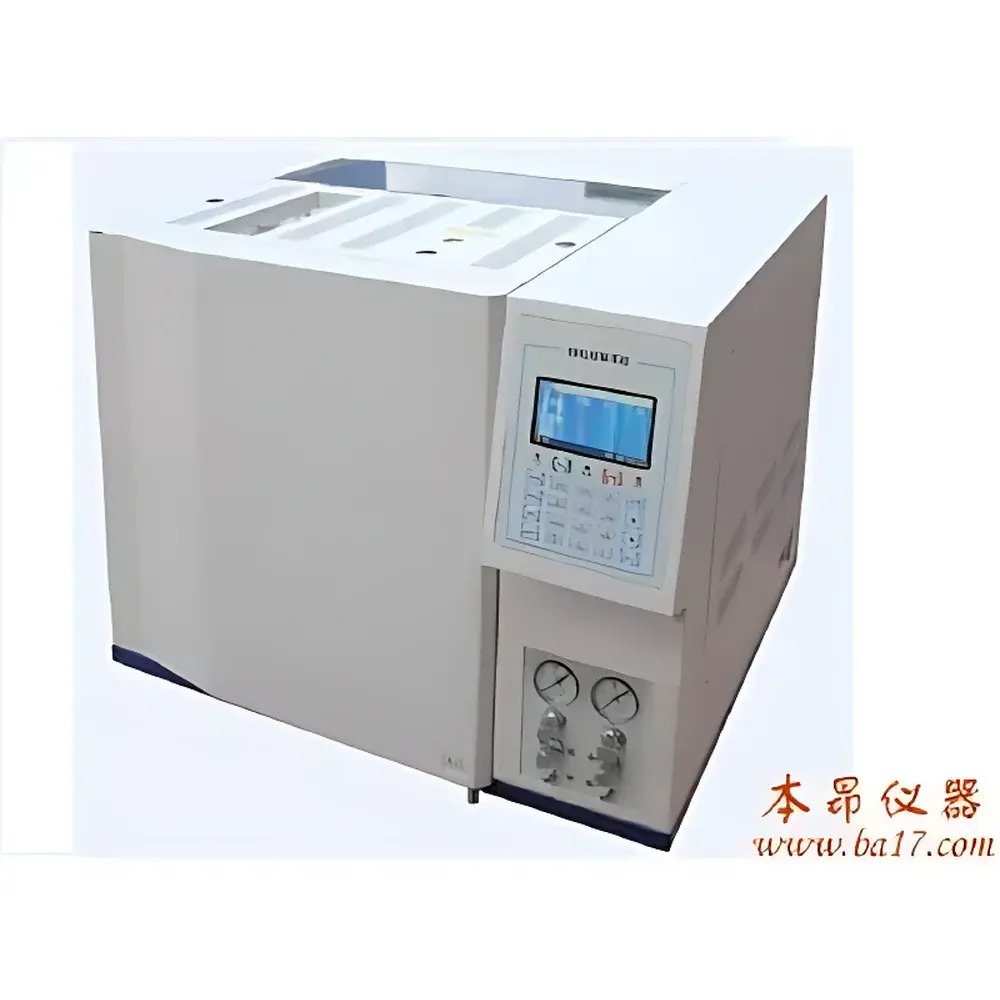
BenAng GC9217II Intelligent Networked Gas Chromatograph
| Brand | BenAng |
|---|---|
| Origin | Shanghai, China |
| Model | GC9217II |
| Display | 192×64 dot-matrix Chinese-character LCD |
| Temperature Control Zones | 6 |
| Temperature Range | 8 °C above ambient to 450 °C (1 °C increment, ±0.1 °C accuracy) |
| Programmed Temperature Ramp | 8 steps |
| Ramp Rate | 0.1–39 °C/min (standard), 0.1–80 °C/min (high-speed option) |
| External Events | 4 inputs |
| Auxiliary Outputs | 4 |
| Injection Options | Packed column, capillary column, 6-port gas valve, auto headspace (configurable) |
| Detector Capacity | Up to 3 simultaneous detectors |
| Detector Options | FID, TCD, ECD, FPD, NPD |
| FID Detection Limit | ≤3×10⁻¹² g/s (n-hexadecane) |
| Noise | ≤5×10⁻¹⁴ A |
| Drift | ≤1×10⁻¹³ A/30 min |
| Linear Range | ≥10⁶ |
| Max Operating Temp | 450 °C |
| TCD Sensitivity | ≥4000 mV·mL/mg (n-hexadecane, selectable gain ×1/×2/×4/×8) |
| Noise | ≤10 μV |
| Baseline Drift | ≤30 μV/30 min |
| ECD Detection Limit | ≤1×10⁻¹⁴ g/s |
| Linear Range | 10⁴ |
| Radioisotope Source | ⁶³Ni |
| Communication Interface | IEEE 802.3 Ethernet |
Overview
The BenAng GC9217II Intelligent Networked Gas Chromatograph is a robust, modular benchtop instrument engineered for high-reproducibility separation and quantitative analysis of volatile and semi-volatile organic compounds across diverse sample matrices. Based on classical gas-liquid partition chromatography principles, the system employs carrier gas (helium, hydrogen, or nitrogen) to transport vaporized analytes through temperature-controlled columns—either packed or fused-silica capillary—where differential partitioning between stationary and mobile phases achieves resolution. Its six independently programmable temperature zones—including oven, injector(s), and detector(s)—enable precise thermal management critical for method transfer, multi-detector operation, and complex gradient elution protocols. Designed for laboratory environments requiring regulatory traceability and networked workflow integration, the GC9217II conforms to foundational chromatographic performance criteria aligned with ASTM D3612, ISO 10380, and USP , supporting method validation under GLP and GMP frameworks.
Key Features
- Six-zone independent temperature control with ±0.1 °C stability and 1 °C programmable resolution, enabling reproducible retention time alignment across instruments and labs.
- Eight-step programmable temperature ramp capability with dual ramp rate options (0.1–39 °C/min standard; 0.1–80 °C/min high-speed), accommodating both fast screening and high-resolution separations.
- Modular detector architecture supporting up to three simultaneously installed detectors—FID, TCD, ECD, FPD, or NPD—with plug-and-play electrical and gas interface compatibility.
- Four configurable external event inputs and four auxiliary TTL-level outputs for synchronized integration with autosamplers, thermal desorption units, or process monitoring systems.
- IEEE 802.3-compliant Ethernet interface enabling remote instrument control, real-time data streaming, and centralized fleet management via standard TCP/IP networks—no proprietary drivers required.
- 192×64 dot-matrix Chinese-character LCD with intuitive menu navigation, eliminating dependency on PC-based software for routine operation and diagnostic checks.
Sample Compatibility & Compliance
The GC9217II accommodates a broad spectrum of sample introduction modalities: split/splitless capillary injection, packed-column direct injection, 6-port gas sampling valves for permanent gases, and optional integration with third-party headspace autosamplers for aqueous or solid-phase volatile analysis. Its detector suite meets sensitivity and linearity requirements for environmental testing (e.g., EPA Method 8021B, 8260D), food safety residue analysis (AOAC 2007.01), and pharmaceutical impurity profiling (ICH Q2(R2)). The FID’s 10⁶ linear range and sub-pg/s detection limit support trace hydrocarbon quantification; the TCD’s adjustable gain and low noise floor enable universal detection of inorganics and light gases; the ⁶³Ni-source ECD delivers femtogram-level sensitivity for halogenated pesticides and PCB congeners. All thermal and electronic subsystems comply with IEC 61010-1 safety standards and electromagnetic compatibility per EN 61326-1.
Software & Data Management
While the GC9217II operates autonomously via its embedded controller, it is fully compatible with industry-standard chromatography data systems (CDS) such as OpenLab CDS, Chromeleon, or custom LabVIEW-based platforms via its native Ethernet API. Audit trail functionality—including user login logs, method change history, run sequence metadata, and detector calibration records—is maintained in non-volatile memory. Raw signal data (voltage vs. time) is streamed in real time using ASCII-encoded .CSV format, ensuring interoperability with statistical analysis tools (e.g., MATLAB, Python pandas) and LIMS interfaces. For regulated environments, the system supports 21 CFR Part 11-compliant electronic signatures when paired with validated CDS software—though standalone instrument firmware does not include built-in e-signature modules.
Applications
- Environmental laboratories: Quantification of BTEX, PAHs, chlorinated solvents, and pesticide residues in soil, water, and air samples per EPA SW-846 methods.
- Petrochemical QA/QC: Hydrocarbon group-type analysis (PIONA), simulated distillation (ASTM D2887), and natural gas composition (ASTM D1945).
- Food & beverage: Residual solvent testing (ICH Q3C), flavor compound profiling, and ethanol content verification.
- Pharmaceutical R&D: Assay of residual solvents in APIs (ICH Q3C Class 2/3), stability-indicating assays, and extractables/leachables screening.
- Academic research: Reaction monitoring, polymer degradation product identification, and metabolite profiling in biological matrices.
FAQ
Is the GC9217II compliant with 21 CFR Part 11?
The instrument itself provides audit-ready data export and user-access logging; however, full Part 11 compliance—including electronic signatures and role-based access control—requires integration with a validated third-party CDS.
Can I upgrade from GC9217I to GC9217II hardware?
No—the GC9217II features revised mechanical layout, updated electronics architecture, and enhanced thermal insulation; it is not a field-upgradable variant of the GC9217I.
What column types are supported?
Both packed stainless-steel columns (2–4 mm ID, up to 4 m) and fused-silica capillary columns (0.1–0.53 mm ID, up to 60 m) are supported, with compatible inlet liners, septa, and ferrules supplied per configuration.
Does the system support unattended overnight operation?
Yes—via Ethernet-triggered sequence execution, automatic shutdown after final run, and real-time fault detection with email/SNMP alerting when integrated into a networked lab infrastructure.
Is technical documentation available in English?
Full English-language operation manuals, detector maintenance guides, and regulatory compliance white papers are provided upon purchase and accessible via secure customer portal.





