
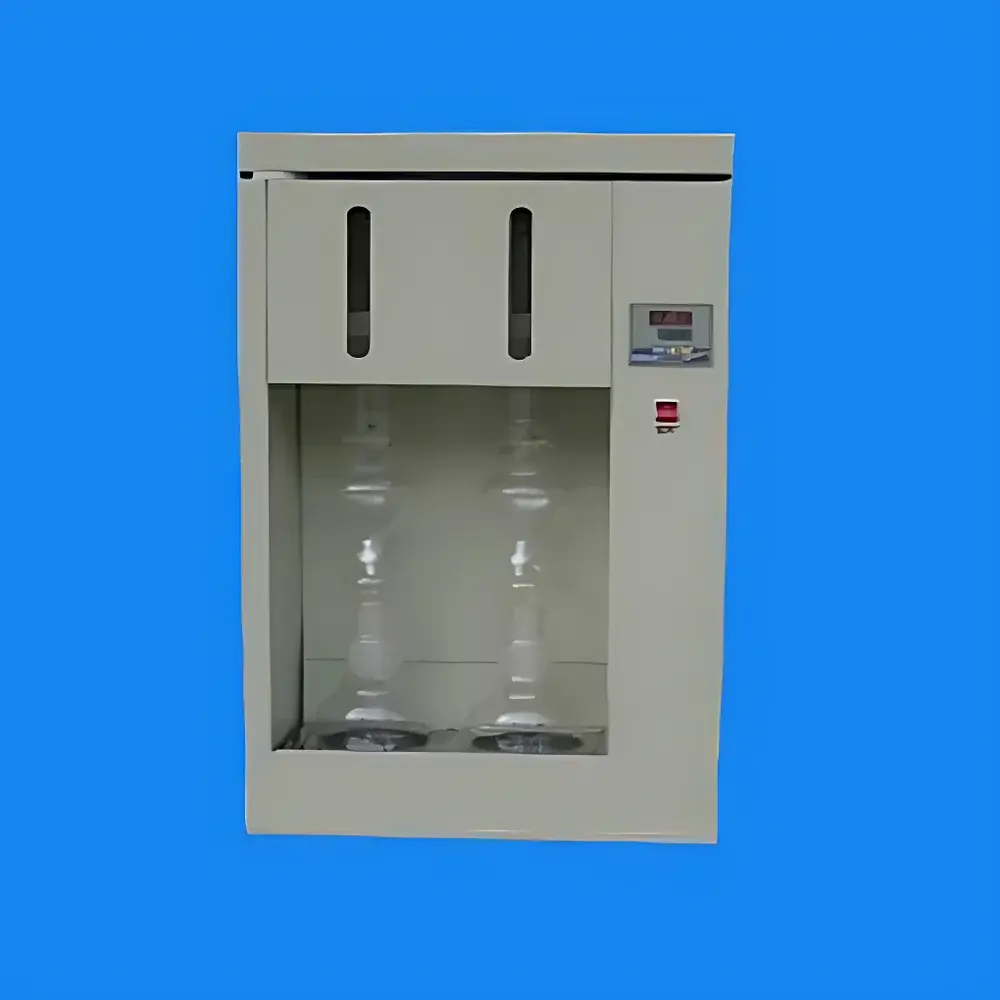
BenAng SXT-02 Soxhlet Extractor
| Brand | BenAng |
|---|---|
| Origin | Shanghai, China |
| Manufacturer Type | Authorized Distributor |
| Country of Origin | China |
| Model | SXT-02 |
| Extraction Capacity | 2 samples per batch |
| Sample Mass Range | 0.5–20 g per sample |
| Extraction Flask Volume | 500 mL per flask |
| Temperature Control Range | Ambient +5 °C to 100 °C |
| Heating Power | 300 W |
| Voltage/Frequency | 220 V ±10 V / 50 Hz |
| Dimensions (W×D×H) | 750 × 360 × 550 mm |
| Net Weight | 16 kg |
| Solvent Recovery | Automated |
| Timer with Audible Alarm | Yes |
| Application Scope | Cereals, feedstuffs, oilseeds, soil, and other solid matrices |
Overview
The BenAng SXT-02 Soxhlet Extractor is a benchtop laboratory instrument engineered for classical continuous solvent extraction based on the Soxhlet principle—a gravimetric technique widely standardized in food, agricultural, environmental, and quality control laboratories. It operates by cyclically percolating hot solvent through a solid sample contained in a thimble, followed by condensation and return of the enriched solvent to the extraction chamber. This closed-loop process ensures high extraction efficiency, reproducibility, and minimal solvent consumption relative to simple maceration or reflux methods. Designed for routine fat, lipid, wax, or other soluble analyte determination, the SXT-02 supports method compliance with established protocols including AOAC Official Method 920.39, ISO 6496:1999 (Animal feeding stuffs — Determination of ether extract), and GB/T 5009.6–2016 (Chinese national standard for fat determination in foods). Its modular architecture integrates heating, reflux condensation, and automated solvent recovery into a single compact unit, minimizing manual intervention and operator exposure to volatile organic solvents.
Key Features
- Dual-sample configuration enables parallel processing of two independent samples—optimizing throughput without cross-contamination.
- 500 mL extraction flasks accommodate up to 20 g of solid matrix per run, supporting high-mass applications such as coarse-ground oilseeds or homogenized soil composites.
- Precise digital temperature control (ambient +5 °C to 100 °C) allows optimization for diverse solvents—including petroleum ether (bp ~40–60 °C), diethyl ether (bp 34.6 °C), and chloroform (bp 61.2 °C)—while preventing thermal degradation of thermolabile analytes.
- Integrated solvent recovery system condenses and returns evaporated solvent directly to the flask, reducing net solvent usage by >90% compared to open reflux setups and lowering operational costs and fume hood load.
- Programmable extraction timer with audible end-of-cycle alarm ensures consistent dwell time across batches—critical for method validation and inter-laboratory comparability.
- Robust stainless-steel heating mantle and borosilicate glassware (flasks, condensers, thimbles) ensure chemical resistance, thermal stability, and long-term dimensional integrity under repeated thermal cycling.
Sample Compatibility & Compliance
The SXT-02 is validated for use with heterogeneous solid matrices requiring exhaustive lipid or non-polar compound isolation. Compatible sample types include milled cereals (e.g., wheat, rice), pelleted animal feed, crushed oilseeds (soybean, rapeseed), dried botanicals, and air-dried soil cores. Sample preparation follows standardized drying (e.g., 105 °C for 2 h) and particle size reduction (< 1 mm) per AOAC guidelines. The instrument meets general safety requirements for Class I, Division 1 laboratory electrical equipment (IEC 61010-1) and supports GLP-compliant documentation when paired with lab notebook entries recording batch ID, solvent lot number, extraction duration, and final flask weight. While not inherently 21 CFR Part 11–compliant (as it lacks electronic audit trail functionality), its operation aligns with GMP-aligned workflows where manual logs are retained with controlled document management.
Software & Data Management
The SXT-02 operates via an embedded microcontroller interface with LED display and tactile push-button controls—no external PC or proprietary software is required. All operational parameters (set temperature, elapsed time, alarm status) are locally viewable and manually recorded. For laboratories implementing LIMS integration, weight data from analytical balances used pre- and post-extraction can be imported via CSV or direct serial output. No firmware updates or cloud connectivity are supported; maintenance relies on mechanical calibration checks (e.g., thermometer verification against NIST-traceable reference) performed at user-defined intervals (recommended semiannually).
Applications
- Routine crude fat quantification in nutritional labeling of packaged foods and animal feeds per FDA 21 CFR §101.9(c)(1) and EU Regulation (EC) No 1169/2011.
- Soil organic matter assessment in environmental monitoring programs adhering to EPA Method 9071B (n-hexane extractable material).
- Quality control of edible oils and biodiesel feedstocks via residual oil content in press cakes.
- Extraction of waxes, resins, or alkaloids from plant tissues during natural product screening.
- Educational demonstrations of mass transfer kinetics and solvent–matrix interaction principles in undergraduate chemistry and food science curricula.
FAQ
What solvents are compatible with the SXT-02?
Petroleum ether, diethyl ether, chloroform, and n-hexane are commonly used. Always consult solvent safety data sheets (SDS) and verify compatibility with borosilicate glass and PTFE seals before operation.
Is the SXT-02 suitable for moisture-sensitive samples?
Yes—provided samples are pre-dried to constant weight and handled under low-humidity conditions prior to loading; the sealed extraction circuit minimizes ambient moisture ingress during operation.
Can extraction time be extended beyond factory presets?
The timer is user-adjustable up to 99 hours and 59 minutes; extended durations are permissible for recalcitrant matrices but require verification of solvent stability and thermal degradation thresholds.
Does the unit include extraction thimbles or flasks?
Standard delivery includes two 500 mL round-bottom extraction flasks, one condenser assembly per channel, and two reusable glass thimbles; cellulose thimbles (Whatman Grade 41 or equivalent) must be ordered separately.
What maintenance is required?
Monthly inspection of condenser water connections, quarterly cleaning of heating mantle surface with non-abrasive cloth, and annual verification of temperature sensor accuracy using a calibrated reference thermometer.
Related Products



