
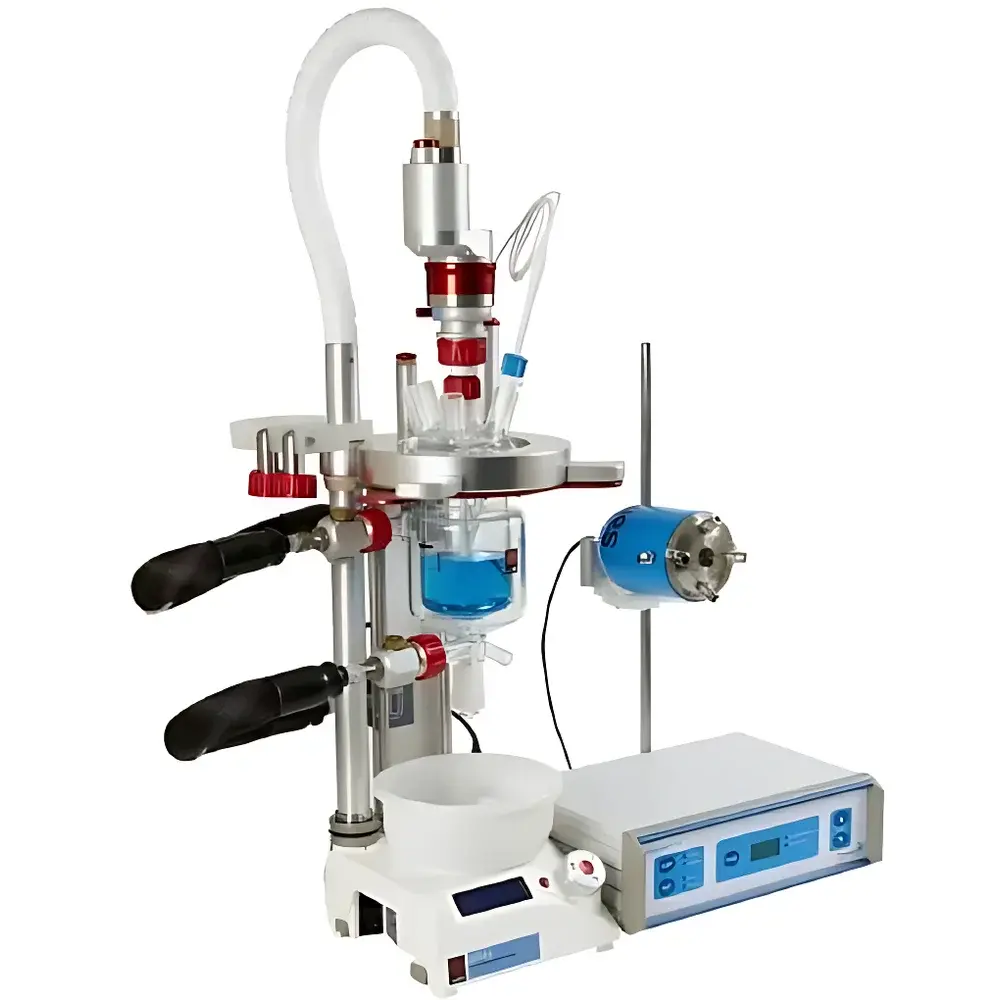
Syrris Atlas SonoLab Ultrasonic Crystallization Reactor
| Brand | Syrris |
|---|---|
| Origin | United Kingdom |
| Manufacturer Type | Authorized Distributor |
| Origin Category | Imported |
| Model | Atlas SonoLab |
| Usable Volume | Small-scale |
| Construction Material | Borosilicate Glass |
| Operating Pressure | Low-pressure (up to 1 bar gauge) |
| Capacity Range | 50 mL – 2 L |
| Vacuum Capability | Down to 50 mbar |
| Integrated Ultrasound System | Prosonix Flow Cell + Generator + Peristaltic Pump |
| Optional Sensors | Atlas Turbidity Probe, FBRM Particle Size Probe |
| Control Software | Atlas Platform (Windows-based, GLP-compliant) |
Overview
The Syrris Atlas SonoLab Ultrasonic Crystallization Reactor is a purpose-engineered laboratory-scale platform that integrates high-frequency ultrasonic energy into a precisely controlled jacketed reaction environment. Based on the established Syrris Atlas modular reactor architecture, the SonoLab variant incorporates Prosonix’s proprietary ultrasound technology—specifically a flow-through sonication cell, matched RF generator, and integrated peristaltic recirculation pump—to deliver spatially uniform, reproducible acoustic energy directly into the crystallizing solution. Unlike batch sonication probes prone to localized hotspots and erosion, the flow-cell design ensures consistent cavitation intensity across the entire process volume while maintaining full compatibility with glass reaction vessels. The system operates on the principle of controlled acoustic cavitation: transient microbubble collapse generates localized extreme temperatures (>5000 K) and pressures (>1000 atm), accelerating nucleation kinetics, suppressing agglomeration, and enabling deterministic manipulation of solid-phase formation pathways—including polymorph selection, particle size distribution (PSD) narrowing, and crystal habit modification.
Key Features
- Modular integration with the Syrris Atlas platform: fully compatible with temperature-controlled jackets, automated reagent dosing, pH/pressure monitoring, and gas sparging modules.
- Prosonix ultrasound subsystem: 20–40 kHz tunable frequency range, digitally regulated power output (0–100% in 1% increments), and real-time amplitude feedback for closed-loop stability.
- Glass-walled reaction vessel (Duran® or Pyrex®): chemically inert, optically transparent, and rated for operation under vacuum (down to 50 mbar) and low positive pressure (≤1 bar).
- Scalable geometry: standardized vessel configurations from 50 mL to 2 L enable direct parameter transfer from lab to pilot scale using identical ultrasound energy density (W/mL) and residence time protocols.
- Automated synchronization: ultrasound activation can be triggered by user-defined events—e.g., supersaturation threshold (via turbidity probe), cooling ramp rate, or dosing completion—ensuring temporal precision in nucleation induction.
Sample Compatibility & Compliance
The Atlas SonoLab accommodates a broad spectrum of solvent systems—including aqueous, polar aprotic (e.g., DMSO, DMF), and chlorinated media—without degradation of the glass wetted path or ultrasound transducer interface. All electronic modules comply with IEC 61000-6-3 (EMC emission standards) and IEC 61010-1 (safety requirements for laboratory equipment). Data acquisition and control software supports audit trail functionality, electronic signatures, and 21 CFR Part 11 compliance when deployed in regulated environments (e.g., pharmaceutical development labs operating under ICH Q5, Q8, and Q9 guidelines). Vessel designs conform to ISO 3585 (borosilicate glass specifications) and are validated for repeated thermal cycling between −20 °C and +150 °C.
Software & Data Management
Control and data logging are executed via the Syrris Atlas software suite—a Windows-based application supporting multi-parameter scripting, real-time visualization, and export to CSV, Excel, or .mat formats. The software provides native support for third-party sensor inputs (e.g., FBRM for chord length distribution, turbidity for nucleation onset detection) and enables synchronized logging of ultrasound duty cycle, temperature ramp profiles, and addition sequences. All experimental metadata—including operator ID, timestamp, calibration certificates, and version-controlled method files—is embedded in each dataset. Raw acoustic waveform data (sampled at ≥1 MS/s) is archived separately for post-hoc spectral analysis, facilitating root-cause investigation of crystallization anomalies.
Applications
- Polymorph screening and control: Systematic variation of sonication parameters (pulse width, duty cycle, intensity) in combination with solvent composition and cooling rate to isolate thermodynamically metastable or kinetically trapped forms.
- Supersaturation management: On-demand nucleation initiation within the metastable zone to eliminate stochastic spontaneous nucleation and improve batch-to-batch consistency in API crystallization.
- Particle engineering: Reduction of median particle size (d50) and narrowing of PSD without mechanical attrition; demonstrated efficacy in producing respirable dry powder aerosol formulations.
- Reaction crystallization intensification: Coupling of ultrasound-enhanced mass transfer with in-situ precipitation during multi-step syntheses (e.g., salt formation, co-crystal generation).
- Scale-up validation: Direct translation of SonoLab-derived energy input metrics (kW·h/L, cavitation dose) to Prosonix industrial-scale flow reactors, minimizing empirical re-optimization.
FAQ
Can the Atlas SonoLab operate under inert atmosphere?
Yes—the glass reactor headplate includes standard Swagelok® ports for nitrogen or argon purging, and optional glovebox integration is supported via custom flange adapters.
Is ultrasound intensity calibrated traceably to national standards?
Each Prosonix generator is supplied with a factory calibration certificate referencing NPL (UK) acoustic power measurement protocols; annual recalibration services are available through Syrris-certified service centers.
What maintenance is required for the ultrasound flow cell?
The titanium alloy flow cell requires no scheduled maintenance beyond routine visual inspection for glass seal integrity and periodic cleaning with dilute nitric acid to remove mineral deposits.
Does the system support PAT (Process Analytical Technology) integration?
Yes—native OPC UA and Modbus TCP interfaces allow bidirectional communication with DeltaV, PI System, or other DCS/SCADA platforms for GMP-aligned continuous manufacturing workflows.
Can I use non-Syrris glass vessels?
Only Syrris-certified vessels are guaranteed to maintain acoustic coupling efficiency and thermal/mechanical integrity under ultrasonic loading; third-party vessels may compromise performance or safety.



