
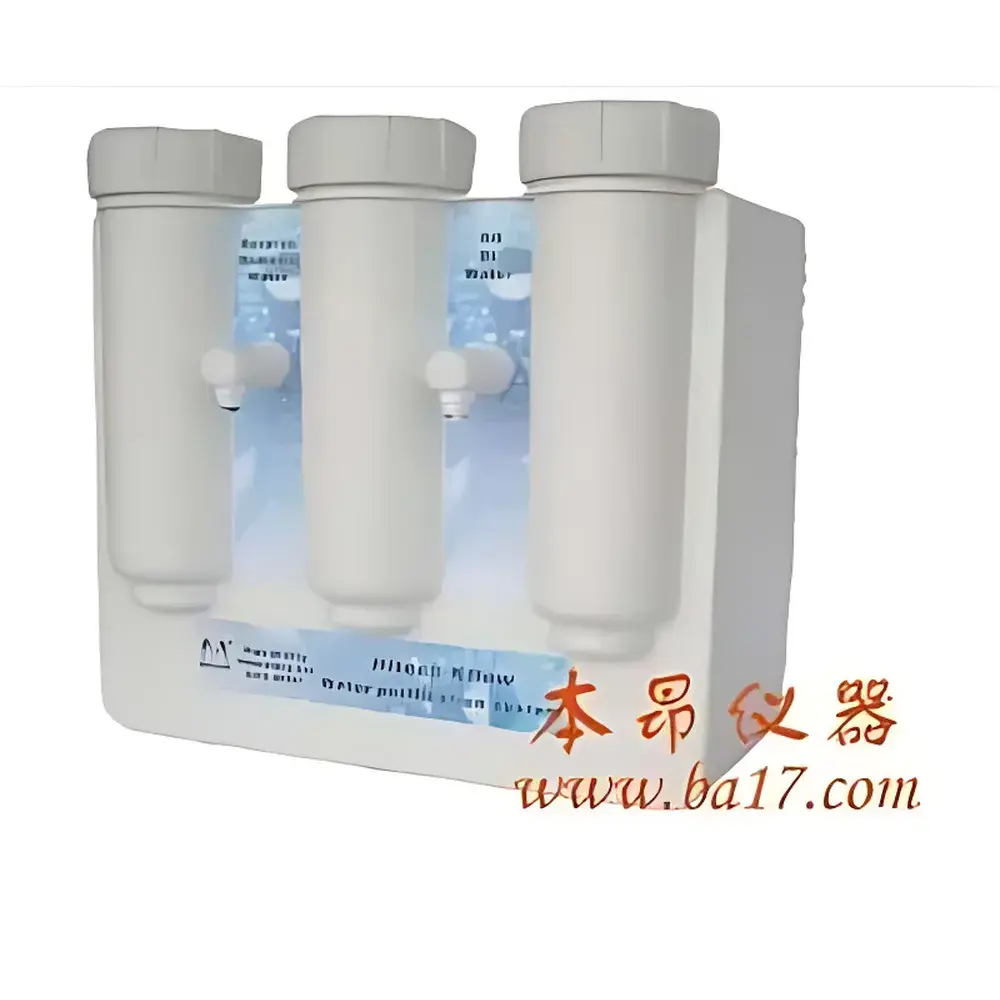
BenAng RD-15D Reverse Osmosis & Deionization Ultra-Pure Water System
| Brand | BenAng |
|---|---|
| Origin | Shanghai, China |
| Manufacturer Type | Authorized Distributor |
| Country of Origin | China |
| Model | RD-15D |
| Price | USD 1,220 (est.) |
| Purified Water Grade | ASTM Type III / ISO 3696 Grade 3 |
| Resistivity | 13–16 MΩ·cm @ 25 °C |
| Heavy Metals & Soluble Silica | < 0.1 ppb |
| Total Organic Carbon (TOC) | < 3 ppb |
| Microbial Count | < 1 CFU/mL |
| Endotoxin | < 0.001 EU/mL |
| Particles (>0.1 µm) | < 1 particle/mL |
| RO Recovery Rate | >99% |
| Conductivity | 0.063–0.077 µS/cm |
| Flow Rate | 15 L/h (RO + DI), 1.5 L/min (peak, with pressurized storage tank) |
| Feed Water Requirements | Municipal tap water, TDS < 150 ppm, 1–40 °C, pressure 69–100 kPa (10–14.5 psi) |
| System Configuration | PF + AC + RO + DI + UV (254 nm & 185 nm) + UF |
| Dimensions (H×W×D) | 42 × 41 × 22 cm |
| Weight | 12–20 kg |
Overview
The BenAng RD-15D Reverse Osmosis & Deionization Ultra-Pure Water System is an integrated laboratory-grade purification platform engineered to convert municipal tap water into consistently high-purity water meeting ASTM D1193 Type III, ISO 3696 Grade 3, and GB/T 6682–2008 Grade III specifications. Utilizing a multi-stage purification architecture—comprising pre-filtration (PP + activated carbon), high-rejection thin-film composite (TFC) reverse osmosis, dual-bed mixed ion exchange, dual-wavelength ultraviolet photooxidation (254 nm for microbial inactivation; 185 nm for TOC reduction), and ultrafiltration—the system achieves stable resistivity of 13–16 MΩ·cm at 25 °C, sub-part-per-trillion-level heavy metal and silica removal (<0.1 ppb), and endotoxin levels below 0.001 EU/mL. Its design adheres to fundamental principles of membrane separation thermodynamics and electrochemical deionization kinetics, ensuring reproducible output under variable feed-water conditions. The RD-15D is not intended for direct production of ASTM Type I or ISO Grade 1 water but serves as a robust, cost-optimized source for preparative applications requiring consistent Type III purity.
Key Features
- Integrated dual-output configuration: dedicated RO permeate port (TDS ≤ 10 ppm) and high-resistivity DI outlet (13–16 MΩ·cm)
- Real-time online resistivity monitoring with digital display calibrated per ASTM D1125 and ISO 7888
- Automated RO membrane antiscalant rinse cycle triggered by runtime or pressure differential, extending membrane service life beyond 24 months under typical lab usage
- Dual-wavelength UV chamber (254 nm + 185 nm) for simultaneous microbial control and low-molecular-weight organic oxidation, validated per USP <643> and EP 2.2.44
- Ultrafiltration module (MWCO ≤ 5 kDa) installed post-DI to remove residual endotoxins, nucleases, and colloidal particles >0.1 µm
- Fail-safe operational logic: automatic shutdown on low inlet pressure, high system backpressure, or DI cartridge exhaustion (monitored via resistivity decay trend)
- Modular consumables architecture supporting field replacement without tools; prefilter service interval ≥ 24 months at 15 L/h average demand
Sample Compatibility & Compliance
The RD-15D delivers water suitable for non-critical analytical and preparative workflows where stringent Type I water is not mandated. It complies with the minimum purity requirements for buffer preparation (e.g., PBS, Tris-HCl), media formulation for non-sterile cell culture maintenance, HPLC mobile phase dilution (non-UV-sensitive methods), atomic absorption spectroscopy (AAS) standards, and general reagent synthesis. While not certified to FDA 21 CFR Part 11 or GMP Annex 1 for sterile manufacturing, its architecture supports GLP-aligned documentation when paired with optional audit-trail-enabled data loggers. System validation protocols align with ISO/IEC 17025 clause 5.5.2 for calibration traceability of the integrated resistivity sensor (NIST-traceable reference solutions used during commissioning).
Software & Data Management
The RD-15D operates as a standalone hardware platform with no embedded firmware-based data logging or remote connectivity. All operational parameters—including real-time resistivity, cumulative runtime, and manual flush activation—are displayed locally via a high-contrast LCD interface. For laboratories requiring electronic records, third-party analog output modules (0–5 V or 4–20 mA) can be interfaced with building management systems or LIMS via standard industrial protocols (Modbus RTU). Calibration certificates for the resistivity sensor are provided with each unit, including as-found/as-left data referenced to NIST SRM 3194 conductivity standards. No proprietary software installation is required or supported.
Applications
- Preparation of chromatographic mobile phases for GC, IC, and non-UV HPLC applications
- Dilution of stock reagents and standards in environmental testing (EPA Method 200.7, 300.0)
- Rinsing and blanking in atomic spectroscopy (ICP-OES, AAS)
- Feed water for downstream Type I polishing systems (e.g., EDI or additional UV/UF stages)
- General laboratory glassware rinsing and equipment cleaning where particulate-free rinse water is required
- Non-GMP buffer and saline solution preparation for in vitro diagnostic development
- Water for feed in animal facilities operating under AAALAC-accredited housing protocols (non-injectable use)
FAQ
What is the expected service life of the RO membrane under typical laboratory conditions?
With automated antiscalant flushing and feed water meeting specified TDS and pressure limits, the TFC RO membrane typically exceeds 24 months of continuous operation before replacement is indicated by sustained resistivity drop below 12 MΩ·cm or TDS increase >15 ppm.
Can the RD-15D produce water compliant with CLSI EP28-A3c for clinical laboratory use?
Yes—the system meets CLSI EP28-A3c Tier 3 (Clinical Reagent Grade) requirements for resistivity, TOC, and endotoxin when operated within specification and maintained per manufacturer guidelines.
Is the UV lamp intensity monitored or validated?
No real-time UV intensity monitoring is integrated; however, lamp replacement is recommended every 9,000 hours (≈12 months at 24/7 operation), and validation per USP <643> using potassium permanganate challenge tests is advised annually.
Does the system support external data acquisition for IQ/OQ documentation?
Yes—via optional 0–5 V analog output for resistivity signal, compatible with most PLCs and data loggers used in formal qualification protocols.
What maintenance documentation is supplied with the unit?
Each shipment includes a Factory Acceptance Test (FAT) report, calibration certificate for the resistivity sensor, consumables replacement schedule, and a traceable lot history for all critical components (RO membrane, DI resin, UV lamp).
Related Products



