
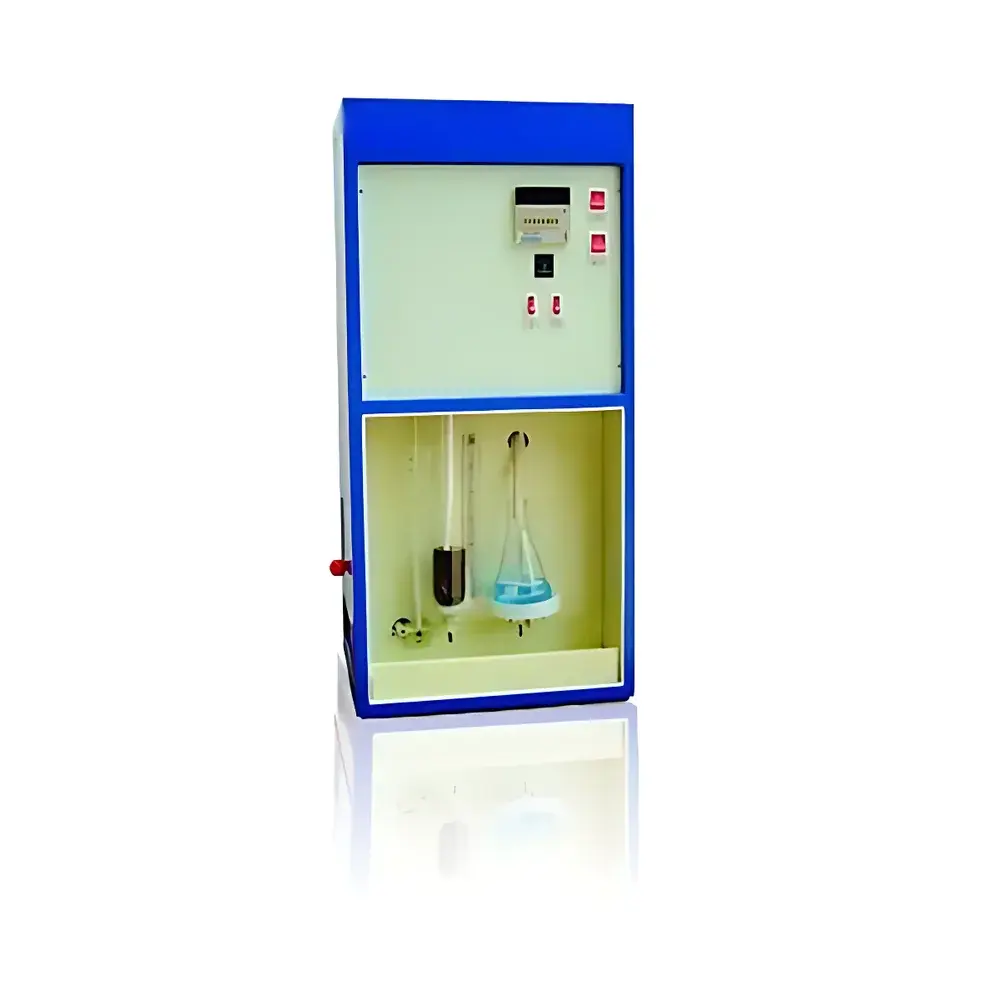
BenAng KA-1A Automated Kjeldahl Nitrogen Determinator
| Brand | BenAng |
|---|---|
| Origin | Shanghai, China |
| Manufacturer Type | Authorized Distributor |
| Country of Origin | China |
| Model | KA-1A |
| Instrument Type | Kjeldahl Nitrogen Analyzer |
| Distillation Time | <5 min/sample |
| Repeatability | <±1% RSD |
| Nitrogen Recovery Rate | 100±1% |
| Power Consumption | 800 W |
| Sample Capacity | ≤5 g (solid) or ≤15 mL (liquid) |
| Nitrogen Detection Range | 0.1–200 mg N (equivalent to 0.02–95% N content) |
| Cooling Water Flow | 2 L/min |
| Operating Voltage | 220 V, 50 Hz |
| Dimensions | 380 × 330 × 820 mm |
| Weight | 24 kg |
Overview
The BenAng KA-1A Automated Kjeldahl Nitrogen Determinator is a fully integrated, benchtop instrument engineered for precise and reproducible quantification of total nitrogen content in diverse matrices via the classical Kjeldahl digestion and steam distillation method. It operates on the principle of acid digestion (typically using concentrated H₂SO₄ and catalysts), followed by alkaline distillation to liberate ammonium ions as ammonia gas, which is then trapped in boric acid and titrated volumetrically. Designed in strict alignment with GB/T 6423–1994 — the Chinese national standard equivalent to ISO 8968-1 and AOAC 984.13 for protein determination — the KA-1A delivers traceable, regulatory-compliant results suitable for routine quality control, research, and compliance testing in food, agricultural, environmental, and pharmaceutical laboratories.
Key Features
- Rugged, chemically resistant construction: Housing fabricated from reinforced plastic steel; critical contact surfaces lined with ABS anti-corrosion panels and stainless-steel base plates to withstand repeated exposure to strong acids, alkalis, and steam.
- Intelligent automation architecture: Fully programmable distillation sequence with independent control over alkali addition volume, dilution water dosage, heating ramp profiles, and condensate cooling timing — eliminating manual intervention during analysis.
- Dual-mode liquid handling: Supports both automatic and manual reagent dosing modes, enabling method flexibility for validation studies, troubleshooting, or non-standard sample types.
- High-efficiency fluidics system: Incorporates imported diaphragm pumps (alkali pump and water supply pump) and an optimized steam generator with rapid thermal response, ensuring consistent steam pressure and uniform distillation kinetics across all samples.
- User-centric interface: One-touch operation with intuitive LED display and physical function keys; no PC dependency required for basic operation, reducing setup complexity and minimizing software-related failure points.
- Thermal and hydraulic safety protocols: Integrated temperature sensors, overheat cutoffs, low-water-level detection, and automatic shutdown safeguards ensure operational integrity and personnel protection during unattended runs.
Sample Compatibility & Compliance
The KA-1A accommodates solid samples up to 5 g and liquid samples up to 15 mL per digestion tube, supporting heterogeneous materials including cereal grains, dairy powders, animal feed, soil extracts, wastewater sludge, pharmaceutical excipients, and industrial chemical intermediates. Its validated performance meets the repeatability (<±1% RSD) and recovery (100±1%) criteria specified in GB/T 6423–1994, and its methodology is inherently compatible with international frameworks such as ISO 5983-1 (animal feeding stuffs), AOAC Official Methods® 984.13 (dairy products), and USP <467> (residual solvents — where nitrogen-bearing impurities require monitoring). While the instrument itself does not include built-in audit trail or electronic signature capabilities, its deterministic analog control logic ensures full traceability when operated within GLP or GMP environments using paper-based SOPs and manual logbooks.
Software & Data Management
The KA-1A operates as a standalone hardware platform without embedded software or network connectivity. All operational parameters are set locally via front-panel controls, and analytical outcomes are recorded manually or interfaced externally via optional burette-compatible titration systems (e.g., METTLER TOLEDO DL series or Hanna HI901). For laboratories requiring digital data capture, integration with LIMS or ELN platforms can be achieved through RS-232 or USB-to-serial adapters connected to external titrators that support ASCII output and timestamped CSV export. No proprietary drivers or cloud services are involved, preserving data sovereignty and simplifying 21 CFR Part 11 compliance when paired with validated third-party titration modules featuring electronic signatures and audit trails.
Applications
This instrument is routinely deployed in QC labs for protein content verification in raw materials and finished goods (e.g., whey protein concentrates, soy isolates, infant formula); in agrochemical testing for fertilizer nitrogen efficiency evaluation; in environmental monitoring for total Kjeldahl nitrogen (TKN) assessment in municipal wastewater and sediment; and in pharmacopeial testing for nitrogen-based active pharmaceutical ingredient (API) purity checks. Its robust design and stable distillation kinetics make it especially suited for high-throughput batch processing in contract testing laboratories serving food safety accreditation bodies (e.g., CNAS, UKAS).
FAQ
Is the KA-1A compliant with ISO or AOAC methods?
Yes — its operational methodology aligns with ISO 5983-1, ISO 8968-1, and AOAC 984.13 when used with standardized digestion protocols and certified reference materials.
Does it support digestion step automation?
No — the KA-1A performs only the distillation and titration-ready ammonia collection step. Digestion must be conducted separately using a dedicated block digester or microwave system.
Can it be integrated into a LIMS environment?
Direct integration is not supported; however, when coupled with a digital titrator offering serial data output, full LIMS ingestion is achievable via standard ASCII/CSV protocols.
What maintenance intervals are recommended?
Daily: rinse condenser and trap; weekly: inspect pump tubing and alkaline reservoir seals; annually: calibrate steam pressure sensor and verify temperature sensor accuracy against NIST-traceable references.
Is service and technical support available outside China?
BenAng provides remote diagnostics and English-language documentation; local authorized service partners are available in Southeast Asia, the Middle East, and select EU markets — contact regional distributors for SLA coverage details.




