
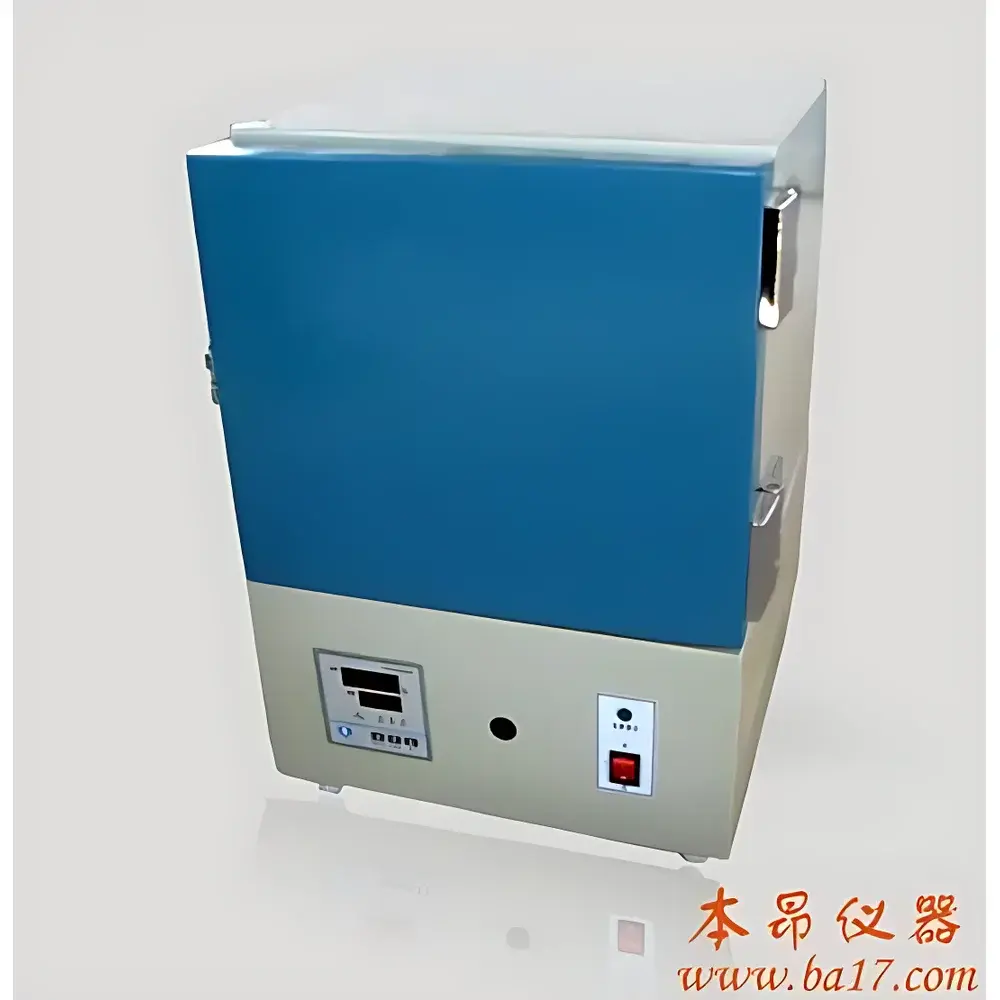
BenAng BA-10-4C Ceramic Fiber Muffle Furnace
| Brand | BenAng |
|---|---|
| Origin | Shanghai, China |
| Model | BA-10-4C |
| Type | Box-type Muffle Furnace |
| Max Temperature | 1000 °C |
| Temperature Control Accuracy | ±1 °C |
| Max Power | 4000 W |
| Heating Rate to 1000 °C | 12 min |
| Heating Method | Resistance Wire (Kanthal® A1 alloy) |
| Internal Chamber Dimensions | 300 × 300 × 300 mm |
| Voltage | 220 V AC |
| Weight | 30 kg |
| Insulation | 50 mm High-Purity Alumina-Silica Ceramic Fiber |
Overview
The BenAng BA-10-4C Ceramic Fiber Muffle Furnace is a high-performance benchtop box furnace engineered for rapid, uniform, and energy-efficient thermal processing in research laboratories, quality control facilities, and academic institutions. Designed around the principles of low-thermal-mass heating and advanced refractory insulation, it employs a high-purity alumina-silica ceramic fiber chamber (50 mm thick) and Kanthal® A1 resistance heating elements—sourced from Sweden—to achieve precise temperature control up to 1000 °C. Unlike conventional brick-lined muffle furnaces, the BA-10-4C eliminates thermal lag through its lightweight, low-conductivity insulation architecture, enabling a full ramp to maximum operating temperature in just 12 minutes. Surface temperature remains below 60 °C at 1000 °C internal setpoint—well within ISO 27889 and IEC 61000-3-2 safety thresholds for laboratory equipment—ensuring operator safety and minimizing ambient heat load. Its compact 300 × 300 × 300 mm working volume supports standardized sample handling while maintaining excellent radial and axial temperature uniformity (±3 °C across the chamber at 1000 °C, per ASTM E220 calibration practice).
Key Features
- High-purity ceramic fiber insulation (50 mm thickness) with 60% versus traditional firebrick furnaces
- Kanthal® A1 alloy heating elements—resistant to oxidation and creep deformation up to 1400 °C, ensuring long-term stability and minimal resistance drift
- 30-segment programmable temperature controller with ramp/soak capability, supporting GLP-compliant thermal profiles for ashing, calcination, and heat treatment protocols
- Integrated over-temperature protection (independent dual-limit sensor), door safety interlock, and real-time fault logging
- Surface temperature <60 °C at full operating temperature—exceeding EN 61000-3-2 and UL 61010-1 surface-heating requirements for Class II lab equipment
- Energy consumption reduced to ~40% of conventional muffle furnaces of equivalent volume and rating, verified per IEC 62301 standby power test methodology
Sample Compatibility & Compliance
The BA-10-4C accommodates crucibles (alumina, quartz, platinum), petri dishes, ceramic boats, and standard ASTM G160–22 sample holders. Its clean, non-shedding ceramic fiber chamber eliminates particulate contamination—critical for trace-metal analysis (EPA Method 3050B), coal ash determination (ASTM D3174), and pharmaceutical residual solvent testing (USP ). The furnace meets general requirements for ISO/IEC 17025-accredited laboratories when operated with documented calibration (NIST-traceable thermocouple verification recommended annually). It supports compliance with FDA 21 CFR Part 11 when paired with validated data acquisition software (e.g., optional RS485/Modbus RTU interface for integration into LIMS or SCADA systems).
Software & Data Management
The embedded microprocessor controller supports full 30-step program storage with time-temperature hold, rate-limited ramps, and cycle repetition. Optional USB or RS485 communication enables export of timestamped temperature logs (CSV format) and remote parameter adjustment via PC-based configuration utility. Audit trail functionality records all setpoint changes, alarm events, and door-open durations—supporting GLP/GMP documentation requirements. Firmware supports firmware update via secure bootloader and includes password-protected administrator mode for SOP enforcement.
Applications
- Materials Science: Sintering of advanced ceramics, pre-firing of piezoelectric composites, and thermal aging of polymer matrix composites
- Environmental & Geochemical Analysis: Gravimetric ash content determination (ASTM D2974, ISO 1171), loss-on-ignition (LOI) testing for soil and sediment, and preparation of reference materials per ISO Guide 35
- Pharmaceutical & Clinical Labs: Residue-on-ignition testing (USP ), moisture and volatile content analysis (EP 2.2.32), and sterilization validation support
- Coal & Energy Research: Proximate analysis (ASTM D3172–D3176), fusibility testing (ASTM D1857), and elemental ash composition prep for ICP-OES/MS
- Academic Teaching: Kinetics studies, phase transformation experiments, and thermogravimetric method development in undergraduate physical chemistry and materials engineering labs
FAQ
What is the maximum continuous operating temperature?
The BA-10-4C is rated for continuous operation at 1000 °C. Short-term excursions to 1050 °C are permissible for ≤30 minutes per cycle, provided cooling intervals exceed 60 minutes.
Does the furnace include NIST-traceable calibration documentation?
Factory calibration is performed using a Class 1 platinum-rhodium thermocouple referenced to ITS-90; full calibration certificate (with uncertainty budget) is available as an optional add-on.
Can the furnace be integrated into an automated sample-handling system?
Yes—via optional RS485 Modbus RTU interface, enabling start/stop commands, setpoint modulation, and real-time temperature readback for robotic workflow synchronization.
Is the ceramic fiber lining resistant to acid vapors during ashing procedures?
The high-purity alumina-silica fiber exhibits excellent resistance to weak organic acids and neutral salts; however, prolonged exposure to HF, HCl, or concentrated H₂SO₄ vapors is not recommended without secondary quartz shielding.
What maintenance schedule is recommended for optimal performance?
Visual inspection of heating elements and door gasket integrity every 200 operating hours; thermocouple verification annually or after 500 thermal cycles above 800 °C.



