
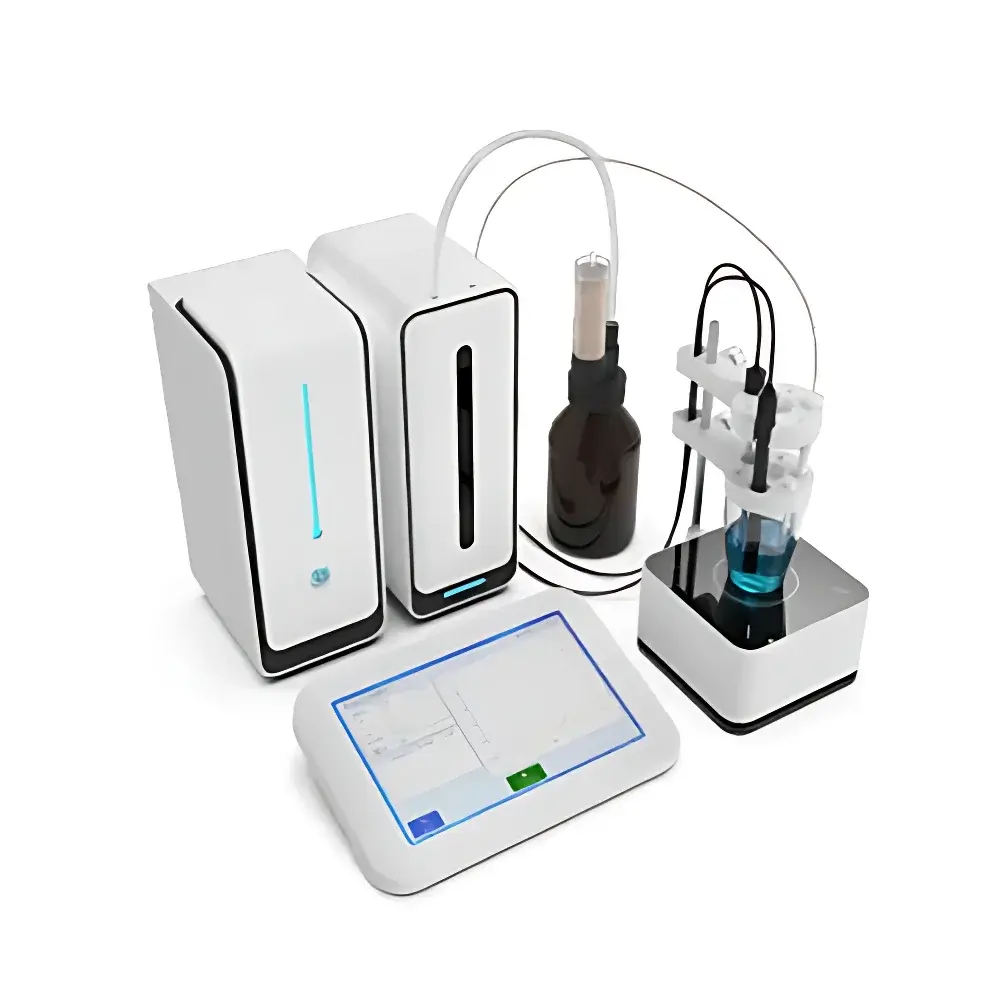
BenAng APT-10 Intelligent Potentiometric Titrator
| Brand | BenAng |
|---|---|
| Origin | Shanghai, China |
| Model | APT-10 |
| Instrument Type | General-purpose Potentiometric Titrator |
| Application Scope | Universal |
| Potential Measurement Range | −2000.0 mV to +2000.0 mV |
| Meter Accuracy | ±0.1 mV ± 0.03% FS |
| Meter Resolution | 0.1 mV |
| Titration Accuracy | ≤0.15% |
| Titration Resolution | 1/100000 |
| pH Range | −2.00 to +16.00 pH |
| pH Resolution | 0.01 pH |
| Temperature Range | −5 °C to 120 °C |
| Temperature Resolution | 0.1 °C |
| Temperature Accuracy | ±0.1 °C |
| Burette Capacity | 10 mL |
Overview
The BenAng APT-10 Intelligent Potentiometric Titrator is a fully automated, microprocessor-controlled electrochemical analysis system engineered for precision potentiometric titrations across diverse sample matrices—including aqueous, non-aqueous, viscous, and highly corrosive media. It operates on the fundamental principle of monitoring potential change (in mV) at the indicator electrode relative to a stable reference electrode as titrant is incrementally delivered. The instrument detects inflection points in the E–V curve (potential vs. volume), enabling robust endpoint determination without reliance on visual indicators or subjective interpretation. Designed for routine QC/QA laboratories, R&D facilities, and regulatory-compliant testing environments, the APT-10 supports standardized methods per ISO 8587, ASTM E2087, USP , and numerous GB/T standards referenced in food, pharmaceutical, petrochemical, and materials testing.
Key Features
- High-stability potentiometric measurement module with dual-channel analog input, optimized for low-noise signal acquisition and long-term drift suppression.
- Integrated 10 mL precision burette with 1/100,000 volumetric resolution and flow-rate stability maintained via stepper-motor-driven syringe pump architecture.
- Corrosion-resistant fluidic path constructed from PTFE, ETFE, and ceramic components—compatible with strong acids (e.g., concentrated HCl, HNO₃), bases (e.g., 1 M NaOH), and organic solvents (e.g., glacial acetic acid, chloroform, DMF).
- Automatic polarity reversal circuitry enables real-time endpoint tracking and adaptive addition mode switching (dynamic, incremental, or fixed-volume), minimizing overshoot and improving reproducibility.
- Modular, rack-mountable design with electrically isolated signal buses—reducing electromagnetic interference (EMI) and enhancing measurement integrity in shared lab environments.
- 10-inch capacitive touchscreen interface with context-aware navigation, real-time titration curve rendering, method parameter recall, and on-screen calibration prompts for pH and burette volume.
- Automated rinse-and-refill cycle with multi-stage solvent flush (up to 5× pre-wet), eliminating carryover between samples and ensuring cross-contamination-free operation.
- Onboard self-diagnostic suite including electrode impedance check, tubing occlusion detection, and burette linearity verification against certified standard volumes.
Sample Compatibility & Compliance
The APT-10 accommodates a broad spectrum of sample types: liquid foods (milk, juice, wine, edible oils), industrial chemicals (crude oil, lubricants, surfactants), environmental extracts (soil leachates, wastewater), pharmaceutical excipients, and inorganic salts. Its electrode configuration supports interchangeable sensor modules—including combination pH electrodes (for acid–base and non-aqueous titrations), Ag/AgCl and silver wire electrodes (for argentometric determinations of Cl⁻, Br⁻, I⁻, SCN⁻, S²⁻), platinum working electrodes (for redox assays of SO₂, ascorbic acid, peroxide value), and ion-selective electrodes (ISEs) for direct ion concentration measurements. The system conforms to GLP documentation requirements through time-stamped audit trails, user-access logs, and electronic signature support. Method validation aligns with ICH Q2(R2) guidelines, and data integrity complies with FDA 21 CFR Part 11 principles when paired with secure network storage and role-based access control.
Software & Data Management
The embedded firmware provides full method programming capability—including up to 99 customizable titration protocols, conditional logic branching (e.g., “if slope > X, switch to slow-add mode”), and multi-step sequences (e.g., pre-titration conditioning, post-endpoint stabilization). All raw data (mV, pH, temperature, volume, time stamps) are stored in CSV-compatible binary format with metadata embedding (operator ID, method version, calibration history). Export options include USB flash drive, Ethernet file transfer, and optional OPC UA integration for LIMS connectivity. Audit trail records capture every parameter modification, calibration event, and result export—retained for ≥36 months unless purged under documented retention policy. Backup and restore functions support rapid recovery after firmware updates or hardware replacement.
Applications
- Determination of total acidity (TA) and volatile acidity in wines and fruit juices per GB/T 15038–2006 and OIV MA-AS313.
- Acid value (AV) and peroxide value (PV) quantification in edible oils and fats per GB/T 5530–2005 and AOCS Cd 8b-90.
- Chloride content in cement, soil, and food products using potentiometric argentometry per GB/T 176–2017 and AOAC 942.05.
- Free fatty acid (FFA) and saponification value analysis in biodiesel feedstocks per EN 14104 and ASTM D664.
- Oxidation-reduction titrations for residual sulfur dioxide in dried fruits and wine per AOAC 990.28 and GB 5009.34–2016.
- pH and ion activity profiling in pharmaceutical suspensions and buffer solutions under USP environmental monitoring protocols.
- Complexometric EDTA titrations for Ca²⁺/Mg²⁺ hardness in water per ISO 6059 and APHA 3111B.
FAQ
Does the APT-10 support Good Laboratory Practice (GLP) documentation requirements?
Yes—it generates complete electronic records with timestamps, operator IDs, calibration logs, and method versioning. Audit trails are immutable and exportable for regulatory review.
Can the instrument perform non-aqueous titrations such as perchloric acid titration in glacial acetic acid?
Yes—the fluidic system and electrode interfaces are chemically inert to common non-aqueous media; dedicated non-aqueous pH electrodes and solvent-compatible tubing kits are available as accessories.
Is remote operation or LIMS integration possible?
The APT-10 supports Ethernet-based file export and optional OPC UA server configuration for bidirectional communication with laboratory information management systems.
What maintenance routines are recommended for long-term reliability?
Daily rinsing of all fluid paths, weekly verification of burette accuracy using certified water weights, and quarterly inspection of electrode junctions and membrane hydration status are advised per the maintenance schedule in the technical manual.
How does the APT-10 handle samples with high turbidity or suspended solids?
For particulate-laden samples, filtration prior to analysis is recommended; alternatively, flow-through cell configurations with sintered glass frits can be integrated to minimize clogging while preserving endpoint fidelity.
Related Products




