
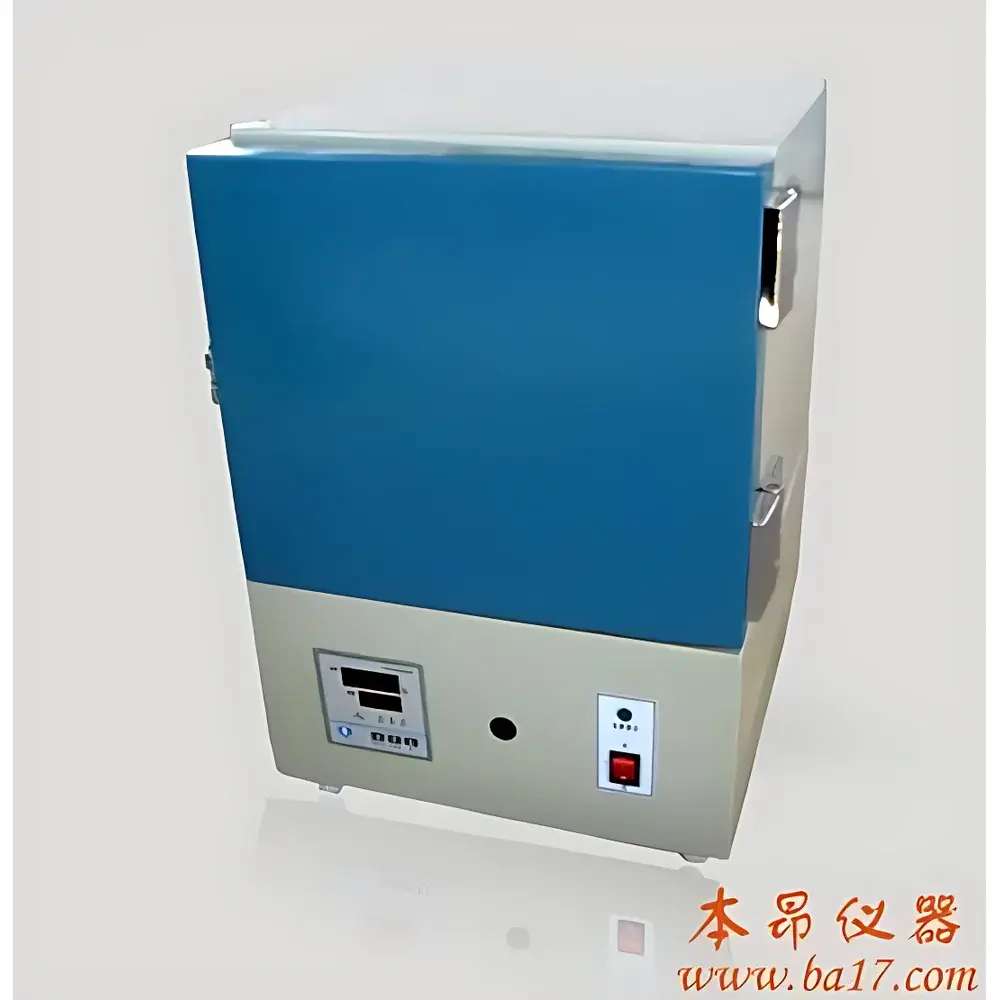
BenAng BA-5-12B Ceramic Fiber Muffle Furnace
| Brand | BenAng |
|---|---|
| Origin | Shanghai, China |
| Model | BA-5-12B |
| Instrument Type | Box-Type Muffle Furnace |
| Max Temperature | 1200 °C |
| Temperature Control Accuracy | ±1 °C |
| Rated Power | 5000 W |
| Heating Rate to 1000 °C | 12 min |
| Heating Element | Kanthal® A1 Silicon Carbide Rods |
| Internal Chamber Dimensions | 400 × 400 × 400 mm |
| Insulation | 50 mm High-Purity Alumina-Silica Ceramic Fiber |
| Thermocouple Type | K-Type (NiCr–NiSi) |
| Power Supply | AC 220 V, 50/60 Hz |
Overview
The BenAng BA-5-12B Ceramic Fiber Muffle Furnace is a high-performance, laboratory-grade box-type resistance furnace engineered for rapid thermal processing under controlled inert or ambient atmospheric conditions. Designed around the principles of efficient radiant heat transfer and low thermal mass insulation, it employs a dual-layer thermal architecture: an inner heating zone formed by Kanthal® A1 silicon carbide rods—known for exceptional oxidation resistance and stable resistivity up to 1200 °C—and a 50 mm-thick cavity lined with high-purity alumina-silica ceramic fiber (≥99.5% Al₂O₃ + SiO₂). This construction enables a surface temperature of ≤60 °C at 1000 °C chamber setpoint—well below the ISO 21873:2021 safety threshold of 100 °C—while achieving full ramp to 1000 °C in just 12 minutes. Its operational envelope spans ambient to 1200 °C, making it suitable for ashing, calcination, sintering, heat treatment, and thermal decomposition protocols across materials science, environmental analysis, pharmaceutical QA/QC, and coal characterization workflows.
Key Features
- High-efficiency thermal architecture: 50 mm thick, low-conductivity ceramic fiber insulation minimizes standby heat loss and reduces energy consumption to ~40% of conventional refractory-brick muffle furnaces.
- Precision temperature control: PID-based digital controller with K-type thermocouple feedback ensures ±1 °C stability over the full operating range; programmable ramp-soak profiles support GLP-compliant thermal protocols.
- Robust heating system: Kanthal® A1 silicon carbide rod elements provide uniform radial heat distribution, extended service life (>5000 h at 1100 °C), and minimal resistance drift during thermal cycling.
- Integrated safety architecture: Dual redundant protection includes door-activated power cutoff, surface overtemperature cutout (auto-shutdown if external casing exceeds 85 °C), and auto-restart inhibition after power interruption.
- Compact yet scalable chamber: 400 × 400 × 400 mm internal volume accommodates standard crucibles (e.g., Pt, Al₂O₃, quartz), ASTM E1529-compliant ashing boats, and multi-sample trays without compromising thermal homogeneity (±5 °C across load zone per ASTM E220).
Sample Compatibility & Compliance
The BA-5-12B supports routine thermal treatment of inorganic matrices—including soil, coal, biomass, pharmaceutical excipients, catalysts, and ceramic precursors—without cross-contamination risk. Its non-reactive ceramic fiber lining eliminates particulate shedding, satisfying USP heavy metal testing requirements and ASTM D3174 (ash content), D3175 (volatile matter), and D3176 (elemental analysis) pre-treatment specifications. The furnace meets IEC 61000-6-3 EMC standards and complies with EN 61000-6-2 for industrial immunity. For regulated environments, its controller logs timestamped setpoints and actual temperatures—enabling audit-ready traceability aligned with FDA 21 CFR Part 11 (when paired with compliant data acquisition software) and ISO/IEC 17025 calibration documentation pathways.
Software & Data Management
While the base unit features a standalone 3.5-inch TFT touchscreen interface with 10-segment programmable ramp-soak capability, optional RS485/Modbus RTU output enables integration into centralized Lab Information Management Systems (LIMS) or SCADA platforms. Real-time temperature logging (1-second resolution), event-triggered alarms (e.g., door open, overtemp), and CSV export via USB port support method validation per ISO/IEC 17025 Clause 7.7. Firmware updates preserve calibration constants and maintain metrological integrity across firmware revisions—critical for laboratories maintaining accredited thermal testing scopes.
Applications
- Coal & Energy Testing: Determination of moisture, ash, volatile matter, fixed carbon, fusibility (ASTM D1857, D3172), and elemental composition (ASTM D3176) following standardized gravimetric protocols.
- Environmental Analysis: Total suspended solids (TSS) ash correction, TOC residue combustion (EPA Method 415.1), and sediment mineralization prior to ICP-MS quantification.
- Pharmaceutical Development: Residual solvent removal, excipient thermal stability screening (ICH Q1A), and API degradation kinetics studies under controlled oxidative atmospheres.
- Materials Research: Precursor calcination for oxide ceramics (e.g., LiCoO₂, YBCO), binder burnout in powder metallurgy, and thermal aging of polymer composites per ASTM D3045.
- Academic Instruction: Undergraduate thermodynamics labs (heat capacity measurement), solid-state chemistry synthesis modules, and graduate-level kinetics experiments requiring reproducible high-temperature holds.
FAQ
What is the maximum continuous operating temperature?
The BA-5-12B is rated for continuous operation at 1200 °C; however, sustained use above 1150 °C may reduce element service life and requires periodic verification of thermocouple drift per ISO/IEC 17025 Annex A.3.
Can this furnace be used under inert gas purge?
Yes—the chamber is sealable and compatible with N₂ or Ar purging via optional inlet/outlet ports; gas flow rate must be maintained ≥1.5 L/min to prevent oxygen ingress during sensitive oxidation-sensitive processes.
Is calibration certification included?
A factory-as-tested temperature uniformity report (per ASTM E220 Annex A) is supplied; NIST-traceable calibration certificates are available as an add-on service with documented uncertainty budgets.
What maintenance is required for long-term reliability?
Biannual inspection of heating element continuity, thermocouple junction integrity, and ceramic fiber compression is recommended; no lubrication or consumable replacement is needed within the first 3 years of typical academic lab usage.
Does the controller support remote monitoring?
Via optional RS485-to-Ethernet gateway, real-time temperature telemetry and alarm status can be integrated into enterprise-wide monitoring systems using Modbus TCP protocol—fully compatible with Ignition SCADA and LabArchives ELN platforms.



