
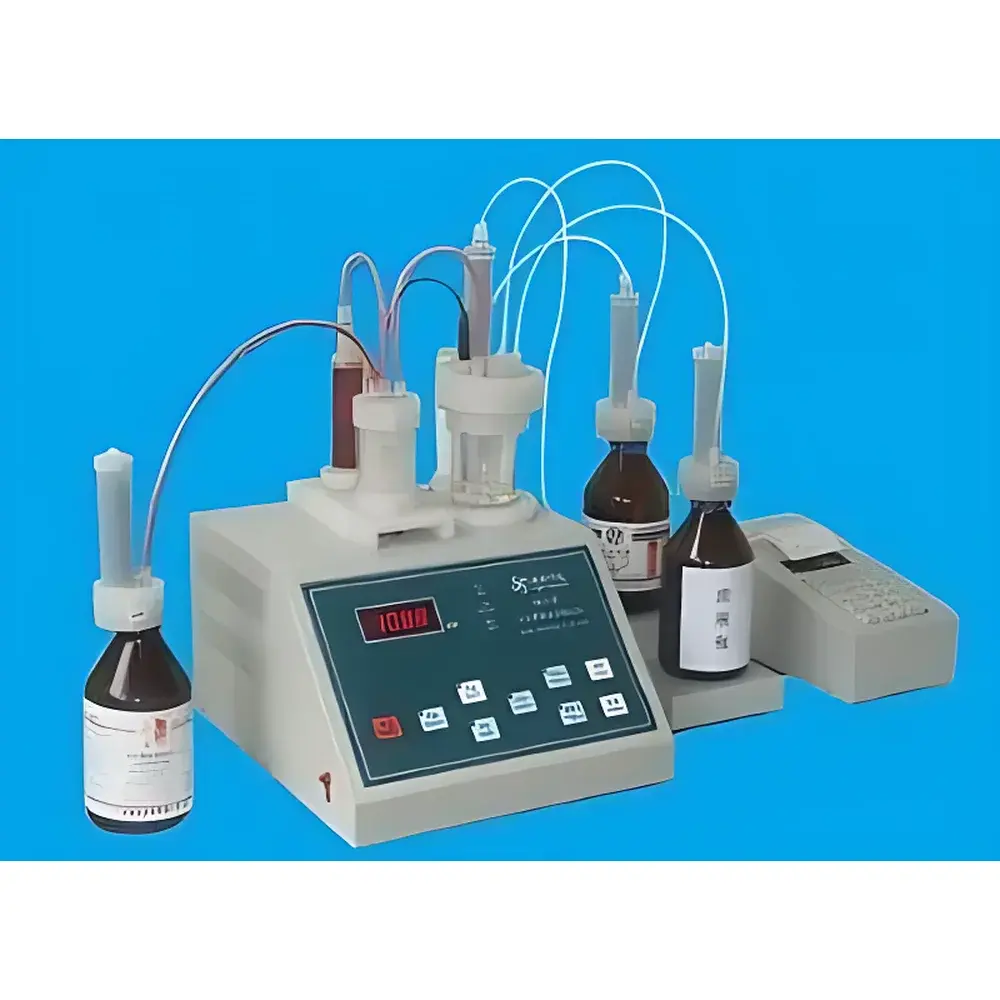
BenAng SKF-1(A) Automatic Coulometric Karl Fischer Moisture Titrator
| Brand | BenAng |
|---|---|
| Origin | Shanghai, China |
| Model | SKF-1(A) |
| Instrument Type | Volumetric Karl Fischer Titrator |
| Moisture Range | 0.001–100 wt% H₂O |
| Accuracy | ≤0.3% RSD |
| Minimum Dispensing Volume | 0.0005 mL (1/2000 of 1 mL syringe) |
| Endpoint Detection | Dual Platinum Electrode Polarization Voltage Method |
| Resolution | 0.01 mL |
| Repeatability | ≤0.01 mL |
| Linearity Correlation Coefficient | ≥0.998 |
| Fluidic System | Fully Enclosed |
| Compatible Reagents | Standard Pyridine-Based or Pyridine-Free KF Reagents |
| Power Supply | 220 ± 22 V, 50 ± 1 Hz |
| Data Output | Integrated Thermal Printer (A-model only) |
| Rapid Titration Mode | Enabled |
Overview
The BenAng SKF-1(A) Automatic Volumetric Karl Fischer Moisture Titrator is a precision laboratory instrument engineered for quantitative determination of water content in solid, liquid, and gaseous samples via the classical Karl Fischer (KF) titration principle. Based on the stoichiometric reaction between iodine, sulfur dioxide, water, and a base (typically imidazole or diethanolamine) in methanol solvent, the SKF-1(A) employs dual platinum electrode polarization voltage detection to identify the electrochemical endpoint with high reproducibility. Unlike coulometric systems optimized for trace moisture (<100 ppm), this volumetric platform delivers robust performance across an exceptionally wide dynamic range—from 0.001 wt% to 100 wt% water—making it suitable for pharmaceutical excipients, petrochemical intermediates, polymer resins, and hygroscopic raw materials where both low-level residual moisture and bulk water quantification are required.
Key Features
- Volumetric Titration Architecture: Utilizes a high-precision 1 mL glass burette with motorized piston drive and 1/2000 sub-microliter dispensing resolution (0.0005 mL minimum step), ensuring accurate reagent delivery even at low titrant consumption.
- Rapid Titration Mode (“Fast Drip”): Dynamically increases titrant flow rate during initial titration phase to minimize blank drift and reduce analysis cycle time by up to 40% compared to conventional constant-speed delivery—particularly advantageous for high-moisture samples or routine QC workflows.
- Fully Enclosed Fluidic Pathway: All reagent lines, sample injection ports, and titration cell interfaces are sealed under inert gas (optional N₂ purge compatible), preventing ambient moisture ingress and mitigating SO₂ or methanol vapor exposure per OSHA and CLP hazard guidelines.
- Dual Platinum Electrode Endpoint Detection: Measures polarization current across two identical Pt electrodes; endpoint is triggered when current drops below user-defined threshold following stoichiometric iodine consumption—eliminating subjective visual interpretation and enhancing inter-operator consistency.
- Integrated Thermal Printer (A-Model): Automatically records sample ID, titration volume, calculated moisture %, date/time stamp, and operator code—supporting audit-ready documentation aligned with GLP and ISO/IEC 17025 record retention requirements.
Sample Compatibility & Compliance
The SKF-1(A) accommodates diverse sample matrices including powders (e.g., lactose, microcrystalline cellulose), viscous liquids (e.g., silicone oils, glycerin), and volatile solvents (e.g., acetone, THF), provided appropriate KF reagent selection (pyridine-free for amine-containing samples; stabilized iodine formulations for aldehydes/ketones). It complies with ASTM E203–22 “Standard Test Method for Water Using Volumetric Karl Fischer Titration”, USP “Water Determination”, and EP 2.5.12. The enclosed design facilitates operation in ISO Class 8 cleanrooms, and its electrical safety conforms to IEC 61010-1:2010 for laboratory equipment.
Software & Data Management
While the SKF-1(A) operates via intuitive membrane keypad interface without PC dependency, its thermal printer output provides permanent, tamper-evident hardcopy records. For laboratories requiring digital archiving, optional RS-232 serial output enables connection to LIMS or custom data acquisition software. All printed reports include unique batch identifiers, calibration verification timestamps, and reagent lot traceability fields—facilitating FDA 21 CFR Part 11 compliance when paired with controlled electronic signature protocols.
Applications
- Pharmaceutical: Quantification of residual moisture in lyophilized APIs and final dosage forms per ICH Q5C stability guidelines.
- Chemical Manufacturing: Verification of drying efficiency in catalyst supports and zeolite molecular sieves.
- Polymer Industry: Monitoring hydrolytic degradation in polyesters and polyamides prior to extrusion.
- Food & Agriculture: Validation of dehydration endpoints in starches, maltodextrins, and powdered dairy products.
- Electronics: Moisture screening of conformal coatings and encapsulation resins to prevent delamination during reflow soldering.
FAQ
What distinguishes volumetric from coulometric Karl Fischer titration?
Volumetric KF measures water content by delivering standardized iodine solution from a burette; it is optimal for samples containing >100 ppm water. Coulometric KF generates iodine electrolytically and is preferred for ultra-trace analysis (<10 ppm).
Can the SKF-1(A) be used with pyridine-free reagents?
Yes—the instrument’s fluidic system and electrode compatibility are validated for both traditional pyridine-based and modern imidazole-based reagents, including single-component and two-component formulations.
Is method validation support available?
BenAng provides application notes aligned with USP and ASTM E203, including linearity, accuracy, precision, and ruggedness test protocols for IQ/OQ/PQ documentation.
How is reagent blank correction performed?
The unit supports manual or automatic blank subtraction using pre-titrated solvent blanks, with integrated calculation of corrected water mass based on titrant titer and sample weight.





