
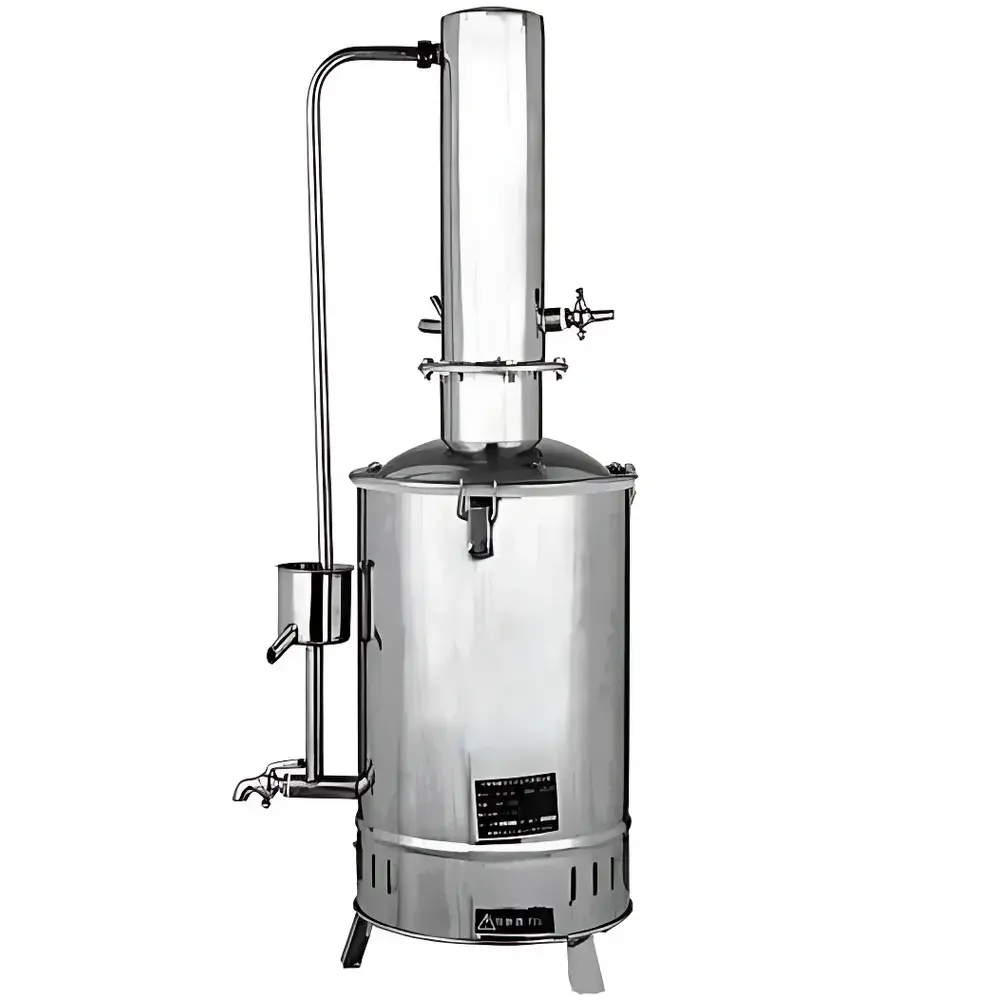
BenAng 10L/H Stainless Steel Electrically Heated Distillation Apparatus
| Brand | BenAng |
|---|---|
| Origin | Shanghai, China |
| Manufacturer Type | Authorized Distributor |
| Country of Origin | China |
| Model | 10L/H |
| Output Rate | 10 L/h |
| Heating Power | 7.5 kW |
| Supply Voltage | 380 V AC |
| Instrument Type | Sub-boiling Distiller |
| Construction Material | 304 Stainless Steel |
| Cooling Method | Recirculating Water Condensation |
| Compliance | GB/T 6682–2008 (Laboratory Water Specifications), GB 4706.1–2005 (Household and Similar Electrical Appliances Safety) |
Overview
The BenAng 10L/H Stainless Steel Electrically Heated Distillation Apparatus is a dedicated sub-boiling distillation unit engineered for continuous production of high-purity distilled water in laboratory, clinical, and research environments. Operating on the principle of controlled thermal vaporization followed by efficient condensation, this apparatus utilizes electric resistance heating elements (7.5 kW tubular heaters) to gently elevate feed water—standard municipal tap water—to its vapor phase without inducing vigorous boiling. The resulting steam passes through a precisely engineered stainless steel vapor chamber and enters a double-walled, recirculating water-cooled condenser, where phase reversal yields particle- and ion-depleted condensate. Designed in strict accordance with GB/T 6682–2008 Grade III water specifications, the system delivers consistent output at 10 liters per hour under nominal operating conditions, making it suitable for routine preparation of reagent-grade water used in analytical sample dilution, buffer formulation, glassware rinsing, and instrument feed applications.
Key Features
- Robust 304 stainless steel construction throughout the boiler chamber, condenser housing, and collection vessel—resistant to chloride-induced pitting, scaling, and long-term thermal fatigue
- Hermetically sealed vapor path with precision-machined flange joints and high-temperature silicone gaskets to prevent steam leakage and ensure operator safety
- Sub-boiling operation mode minimizes carryover of volatile organics and entrained droplets, enhancing purity over conventional boiling distillers
- Integrated recirculating cooling loop compatible with standard laboratory chillers or external tap water supply (flow rate ≥ 1.2 L/min recommended)
- Ergonomic front-panel controls including ON/OFF toggle, heating indicator lamp, and over-temperature cut-off sensor (auto-resettable at 110°C)
- No external vacuum or inert gas requirements—fully self-contained and compliant with standard electrical infrastructure (380 V, 3-phase, 50 Hz)
Sample Compatibility & Compliance
This distillation apparatus accepts potable tap water meeting local municipal standards as its sole feedstock—no pretreatment (e.g., reverse osmosis or deionization) is required, though pre-filtration via 5 µm sediment filter is recommended to extend heater life. Output water conforms to GB/T 6682–2008 Type III specifications (conductivity ≤ 0.5 mS/m at 25°C; total organic carbon < 0.4 mg/L; bacterial count < 100 CFU/mL), and is routinely validated for use in non-critical applications such as general lab cleaning, media preparation, and calibration standard dilution. While not certified to ISO 15195 or CLSI EP21-A for clinical reference material production, the unit’s design supports GLP-aligned documentation practices—including batch log recording of run duration, input volume, and output volume—for internal quality assurance traceability.
Software & Data Management
The BenAng 10L/H distiller operates as a standalone analog-controlled system with no embedded microprocessor or digital interface. All operational parameters are fixed at factory configuration to ensure mechanical reliability and regulatory simplicity. No firmware, data logging, or network connectivity is provided—consistent with IEC 61000-6-2/6-3 immunity requirements for electromechanical lab equipment. For laboratories requiring audit-ready records, integration with external time-stamped flow meters (e.g., electromagnetic or ultrasonic type) and manual logbooks aligned with ISO/IEC 17025 Clause 7.5 is recommended. The absence of software eliminates validation burdens associated with FDA 21 CFR Part 11 compliance, rendering it appropriate for facilities maintaining paper-based QA systems.
Applications
- Preparation of rinse water for HPLC mobile phase reservoirs and GC vial washing stations
- Feed water for autoclave chambers and steam generators in biosafety Level 2 (BSL-2) laboratories
- Production of solvent blanks in UV-Vis spectrophotometry and atomic absorption spectroscopy
- Formulation of non-sterile culture media in microbiology teaching labs
- Calibration of conductivity and pH meters where Type III water is specified
- Supporting ASTM D1193–20 Standard Specification for Reagent Water in non-pharmaceutical testing protocols
FAQ
What feed water quality is required?
Municipal tap water meeting WHO Guidelines for Drinking-water Quality is acceptable. Hardness > 200 ppm CaCO₃ or free chlorine > 2 mg/L may accelerate scale formation; optional 5 µm particulate filtration is advised.
Can this unit produce USP Purified Water?
No. It does not meet USP purified water criteria (e.g., endotoxin limit, microbial enumeration, TOC specification) nor is it designed for continuous sanitization cycles required in pharmaceutical settings.
Is installation requiring plumbing or ventilation?
Yes—dedicated 380 V / 3-phase power circuit and a condenser cooling water supply (inlet/outlet ports: G½” BSP) are mandatory. Ventilation is not required beyond standard lab air exchange, as all steam remains internally contained.
What maintenance intervals are recommended?
Descaling every 200 operating hours using 5% citric acid solution; annual inspection of heater element insulation resistance (> 1 MΩ); gasket replacement every 18 months under continuous operation.
Does the unit include a water level sensor or dry-run protection?
Yes—a float-actuated cutoff switch interrupts power if boiler water level falls below safe operating threshold, preventing heater damage.



