
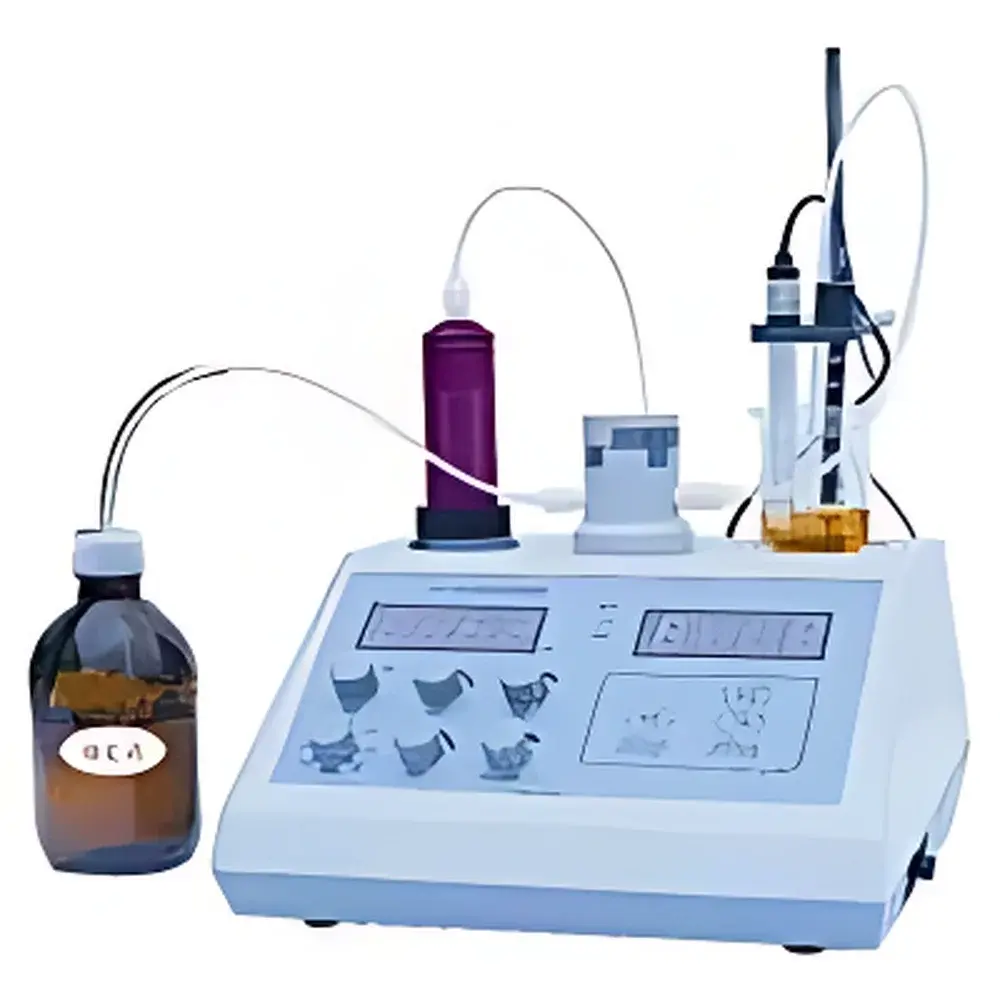
BenAng ZD-3A Automatic Potentiometric Titrator
| Brand | BenAng |
|---|---|
| Origin | Shanghai, China |
| Model | ZD-3A |
| Measurement Range | ±1999 mV / 0–14.00 pH |
| Accuracy | 0.1% F.S. (mV), ±0.01 pH |
| Resolution | ±0.03 pH / ±3 mV |
| Input Impedance | >10¹² Ω |
| Power Supply | AC 220 V ±10%, 50 Hz |
| Power Consumption | 20 W |
| Operating Temperature | 5–40 °C |
| Relative Humidity | <85% RH |
| Weight | 6 kg |
Overview
The BenAng ZD-3A Automatic Potentiometric Titrator is a benchtop electrochemical analytical instrument engineered for precision and reliability in volumetric titration based on potentiometric endpoint detection. It operates on the fundamental principle of monitoring potential difference (in mV) or pH change across a redox, acid–base, precipitation, or complexometric reaction to identify the stoichiometric equivalence point. Unlike manual or semi-automated systems, the ZD-3A integrates real-time electrode potential feedback with programmable titrant delivery control, enabling both user-initiated manual titration and pre-defined endpoint-driven automatic titration. Its dual functionality—as both a Class 0.01 pH meter and a general-purpose potentiometric titrator—makes it suitable for routine quality control, academic teaching labs, and method development in regulated environments where traceable, reproducible endpoint determination is essential.
Key Features
- Integrated high-impedance potentiometric measurement circuitry with input impedance exceeding 10¹² Ω, ensuring minimal loading effect on reference and indicator electrodes (e.g., Ag/AgCl, glass, or redox electrodes).
- Dual-mode operation: manual titration with real-time LED digital display of volume dispensed, and automatic titration triggered by preset mV or pH thresholds.
- High-resolution digital readout: ±0.03 pH and ±3 mV resolution, supporting accurate endpoint localization even in shallow titration curves.
- Stable analog signal conditioning architecture compliant with IEC 61000-4 electromagnetic compatibility standards for laboratory environments.
- Compact, robust chassis design (6 kg mass) optimized for benchtop stability and vibration resistance during burette dispensing cycles.
- Compliant with basic electrical safety requirements per GB 4793.1 (equivalent to IEC 61010-1) for laboratory electrical equipment.
Sample Compatibility & Compliance
The ZD-3A supports standard aqueous and non-aqueous titrations including acid–base (e.g., HCl vs. NaOH, acetic acid vs. KOH in glacial acetic acid), redox (e.g., Ce⁴⁺ vs. Fe²⁺, KMnO₄ vs. oxalate), precipitation (e.g., AgNO₃ vs. Cl⁻), and complexometric (e.g., EDTA vs. Ca²⁺/Mg²⁺) methods. It accepts conventional 10 mL or 25 mL glass burettes with PTFE stopcocks and accommodates standard pH and redox electrodes equipped with BNC connectors. While not certified for GMP or GLP environments out-of-the-box, its stable calibration behavior, linear mV response, and documented repeatability support use in ISO/IEC 17025-accredited testing laboratories when operated under validated SOPs. Data recording adheres to ALCOA+ principles when paired with external logbooks or LIMS-integrated documentation workflows.
Software & Data Management
The ZD-3A operates as a standalone hardware platform without embedded microprocessor-based software or USB connectivity. All parameter settings—including endpoint mV/pH values, titrant concentration, and sample volume—are configured via front-panel rotary controls and push-button inputs. Titration results (final volume, calculated titer, endpoint mV/pH) are displayed on a fixed-segment LED screen and must be manually recorded. For laboratories requiring electronic data capture, integration with external data acquisition systems (e.g., via RS-232 optional module, if retrofitted) or time-stamped video documentation of LED outputs is recommended to satisfy audit trail requirements under FDA 21 CFR Part 11 or EU Annex 11 when used in regulated quality assurance contexts.
Applications
- Environmental analysis: chloride, cyanide, and fluoride determination in wastewater per APHA Standard Methods 4500-Cl⁻, 4500-CN⁻.
- Pharmaceutical QC: assay of active pharmaceutical ingredients (APIs) such as sulfonamides or barbiturates via non-aqueous titration (USP & EP monographs).
- Food and beverage testing: total acidity (as tartaric or acetic acid), salt content, and preservative quantification (e.g., sorbic acid).
- Chemical manufacturing: purity assessment of inorganic salts, catalyst precursors, and industrial acids/bases.
- Academic instruction: hands-on training in electrochemical fundamentals, titration curve construction, and Nernst equation validation.
FAQ
What types of electrodes are compatible with the ZD-3A?
Standard BNC-connected pH electrodes (e.g., glass-bodied, double-junction), redox electrodes (platinum or calomel), and ion-selective electrodes (when matched with appropriate reference electrodes) are supported.
Does the ZD-3A support dynamic or derivative titration modes?
No—the instrument implements fixed-endpoint potentiometric titration only; it does not calculate first or second derivatives of the titration curve in real time.
Can the ZD-3A be calibrated and verified according to ISO 8655?
Burette calibration must be performed externally using gravimetric or volumetric standards per ISO 8655-3; the instrument itself provides no built-in calibration verification protocol.
Is the ZD-3A suitable for use in GMP-regulated production environments?
It may be deployed in GMP settings only when incorporated into a fully validated analytical procedure, including documented electrode maintenance, system suitability testing, and manual record-keeping aligned with 21 CFR Part 11 expectations.
What is the typical service life of the internal electronics under continuous lab use?
With proper environmental control (stable temperature, low dust/humidity), the analog measurement circuitry and LED display typically maintain specification compliance for ≥8 years based on field service reports from academic and industrial users.






