
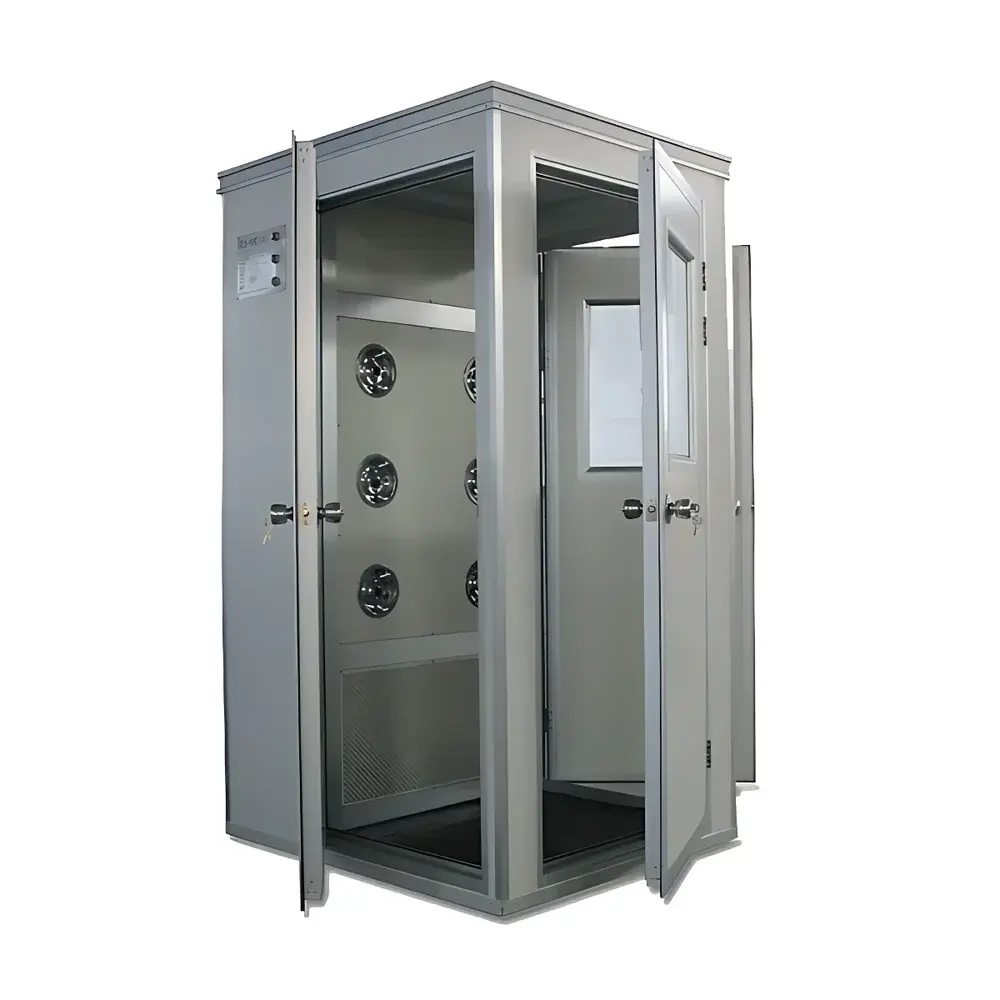
FLB-1D Single-Person Single-Blow Corner-Mounted Air Shower
| [Brand | HJ Purification |
|---|---|
| Origin | Shanghai, China |
| Manufacturer Type | Direct Manufacturer |
| Country of Origin | China |
| Model | FLB-1D |
| Power Supply | AC 220 V, 50 Hz |
| Rated Power | 550 W |
| Air Velocity at Nozzles | 20–28 m/s |
| Nozzle Quantity | 8 × adjustable stainless steel nozzles (Φ30 mm) |
| Filter Efficiency | ≥99.99% for particles ≥0.5 µm (sodium flame test) |
| High-Efficiency Filter Size & Qty | 600 × 600 × 120 mm, 1 unit |
| Internal Chamber Dimensions (W×D×H) | 700 × 750 × 2000 mm |
| External Dimensions (W×D×H) | 1050 × 760 × 2050 mm |
| Unit Weight | 200 kg |
| Air Shower Duration | 0–99 s (adjustable) |
| Interlocked Dual-Door Control | Photoelectric sensor-based |
| Structural Material | Stainless steel enclosure with corner-mounting configuration] |
Overview
The HJ FLB-1D is a single-person, single-blow, corner-mounted air shower engineered for controlled environments requiring personnel decontamination at the interface between non-classified and ISO Class 5–8 cleanrooms. It operates on the principle of high-velocity laminar airflow generated by a centrifugal fan system, delivering filtered air through eight precisely angled stainless steel nozzles (Φ30 mm) to dislodge and remove particulate contamination—including viable and non-viable aerosols—from operator clothing and surfaces. The unit integrates an internal recirculation loop: air drawn from the chamber passes first through a pre-filter (G4 grade), then through a certified HEPA filter (EN 1822 H14, ≥99.99% efficiency for ≥0.5 µm particles per sodium flame test), before being re-pressurized and ejected. Its corner-mounting design optimizes spatial utilization in constrained entryways while maintaining full compliance with cleanroom transition protocols defined in ISO 14644-1 and EU GMP Annex 1.
Key Features
- Stainless steel construction (AISI 304) for corrosion resistance, ease of disinfection, and long-term structural integrity in high-humidity or chemically exposed lab corridors.
- Corner-mounting configuration enables installation in L-shaped passageways without compromising access width or requiring wall recessing—ideal for retrofitting legacy facilities.
- Eight individually adjustable stainless steel nozzles with fixed 20–28 m/s exit velocity ensure uniform particle removal across torso, shoulders, and lower limbs without excessive turbulence or operator discomfort.
- Microprocessor-based control panel with digital timer (0–99 s adjustable in 1 s increments) and real-time status indicators for fan operation, filter life monitoring, and door interlock status.
- Dual-door electromagnetic interlock system activated by photoelectric sensors prevents simultaneous opening; ensures pressure cascade integrity and eliminates unfiltered air infiltration during transit.
- Integrated HEPA filter (600 × 600 × 120 mm, H14 class) housed in a gasket-sealed drawer for rapid, tool-free replacement—validated for ≤0.5 µm particle retention per EN 1822 and compatible with routine filter integrity testing (e.g., DOP/PAO scanning).
Sample Compatibility & Compliance
The FLB-1D is not a sample-processing instrument but a critical environmental control device used upstream of analytical, microbiological, and formulation workspaces. It supports compliance with multiple regulatory frameworks: its airflow performance and filtration meet ISO 14644-3 testing requirements for air shower validation; its door interlock logic satisfies EU GMP Annex 1 §4.32 (airlock functionality); and its stainless steel finish conforms to FDA 21 CFR Part 117 (food-grade facility hygiene) and ISO 13485 (medical device manufacturing). The unit is CE-marked for electromagnetic compatibility (EMC Directive 2014/30/EU) and low-voltage safety (LVD Directive 2014/35/EU). It is routinely deployed in QC labs handling sterile APIs, biologics fill-finish lines, semiconductor metrology suites, and ISO-certified food safety testing laboratories.
Software & Data Management
The FLB-1D operates via embedded firmware with no external software dependency. All operational parameters—including cycle duration, fan speed staging, and interlock event logging—are stored in non-volatile memory. Event logs (e.g., door breach attempts, filter runtime hours, manual override actions) are timestamped and accessible via front-panel navigation for GLP/GMP audit readiness. While the unit does not support network connectivity or remote diagnostics, its log structure aligns with FDA 21 CFR Part 11 requirements for electronic records when paired with site-level data capture systems (e.g., LIMS-integrated access logs). Filter replacement intervals are programmable and trigger visual alerts; maintenance history can be manually recorded in associated SOP documentation per ISO/IEC 17025 clause 6.4.10.
Applications
- Personnel ingress/egress control in ISO Class 5–7 pharmaceutical cleanrooms (e.g., aseptic processing suites, lyophilization corridors).
- Operator decontamination prior to entering microelectronics fabrication areas where sub-micron particle control is critical to wafer yield.
- Pre-entry conditioning in biosafety level 2 (BSL-2) laboratories handling recombinant proteins or viral vectors.
- Transition zone management in food microbiology labs accredited to ISO/IEC 17025, preventing cross-contamination between raw material prep and pathogen detection zones.
- Supporting USP and compliance in hospital pharmacy compounding environments through documented particulate reduction at entry points.
FAQ
What is the recommended maintenance frequency for the HEPA filter?
Under continuous daily use (≥8 cycles/day), the HEPA filter should be integrity-tested quarterly and replaced annually—or sooner if pressure drop exceeds 250 Pa across the filter bank, as indicated by the control panel’s differential pressure warning.
Can the FLB-1D be integrated into a building management system (BMS)?
No native BACnet or Modbus interface is provided; however, dry-contact relay outputs (NO/NC) are available for fan status and door lock signals, enabling third-party BMS integration via external I/O modules.
Is the unit suitable for use with powered air-purifying respirators (PAPRs)?
Yes—the nozzle velocity and chamber geometry accommodate operators wearing PAPRs; however, the air shower cycle must be extended to ≥30 s to ensure adequate surface decontamination of the respirator housing and harness.
Does the corner-mount design affect airflow uniformity compared to straight-wall models?
No—computational fluid dynamics (CFD) validation confirms equivalent particle removal efficiency (≥95% for 0.5–5 µm latex spheres) across all orientations, provided installation adheres to minimum clearance specifications (≥300 mm from adjacent walls).



