
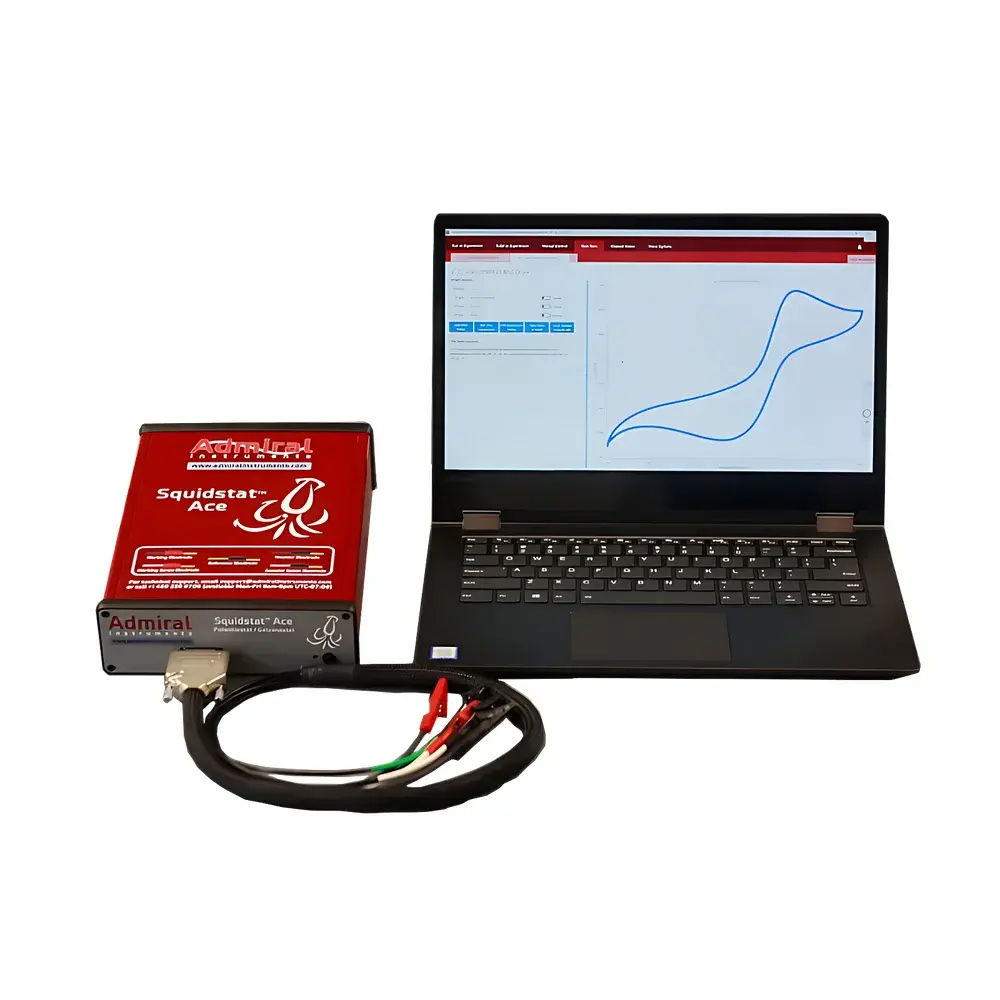
Admiral Squidstat Ace Portable Single-Channel Electrochemical Workstation
| Brand | Admiral |
|---|---|
| Origin | USA |
| Manufacturer Type | Authorized Distributor |
| Product Category | Imported Instrument |
| Model | Squidstat Ace |
| Instrument Type | Portable Electrochemical Workstation |
| Number of Channels | 1 |
| Current Range | ±1 A |
| Current Resolution | 3 pA (0.003% of full scale) |
| Potential Range | ±10 V |
| Potential Resolution | 300 µV |
| Time Resolution | 10 µs |
| AC Impedance Capability | Not Supported |
| Supported DC Techniques | Cyclic Voltammetry, Linear Sweep Voltammetry, Open Circuit Potential, Chronoamperometry/Chronocoulometry, Linear Sweep Chronoamperometry, Chronopotentiometry, Differential Pulse Voltammetry, Normal Pulse Voltammetry, Square Wave Voltammetry, Relaxation Voltammetry, Staircase Voltammetry, Tafel Scan, Pulse Plating, Stripping Voltammetry |
| Supported Battery Testing Modes | Galvanostatic Charge/Discharge, Potentiostatic Charge/Discharge, Constant Resistance Discharge, Constant Power Discharge, High-Power Discharge, Capacity-Limited Cycling, Steady-State I–V Profiling |
Overview
The Admiral Squidstat Ace is a compact, single-channel potentiostat/galvanostat engineered for precision direct-current (DC) electrochemical measurements. Based on proven bipotentiostatic architecture, it delivers high-fidelity control and acquisition for fundamental electrochemical characterization—including redox kinetics, charge transfer resistance, diffusion-controlled processes, and interfacial electron transfer behavior. Unlike hybrid AC/DC systems, the Squidstat Ace is purpose-built for DC-intensive applications where stability, low-noise current measurement, and sub-microsecond temporal resolution are critical—such as battery electrode screening, corrosion rate quantification, sensor calibration, and undergraduate electrochemistry laboratories. Its embedded non-volatile memory ensures uninterrupted data logging during power interruptions, preserving experimental integrity without reliance on host PC connectivity.
Key Features
- True single-channel DC electrochemical platform with ±1 A current compliance and ±10 V potential window, optimized for high-current transient analysis and low-current microelectrode studies.
- Ultra-high current resolution down to 3 pA (0.003% of full scale), enabling accurate detection of faradaic currents in trace analyte sensing or slow corrosion monitoring.
- Potential resolution of 300 µV and time resolution of 10 µs support rigorous kinetic modeling of fast electrode processes, including nucleation-growth mechanisms and adsorption-desorption dynamics.
- Modular system architecture: multiple Squidstat Ace units—or combinations with Squidstat Prime and Squidstat Plus—can be synchronized via external trigger lines to form scalable multi-channel configurations for rotating ring-disk electrode (RRDE) experiments or parallel sample testing.
- Onboard 16 MB flash memory enables autonomous operation; all raw data—including timestamps, applied waveforms, and measured responses—are saved directly to internal storage independent of PC connection.
- Intuitive, script-free software interface compliant with Windows OS; preloaded method templates conform to ASTM G5, G59, G102, and ISO 16773 standards for polarization resistance and Tafel analysis.
Sample Compatibility & Compliance
The Squidstat Ace interfaces seamlessly with standard three-electrode electrochemical cells (working, reference, counter), microelectrodes (down to 1 µm diameter), screen-printed electrodes, and custom flow cells. It supports conventional aqueous electrolytes (e.g., KCl, H2SO4, NaOH), non-aqueous Li-ion battery electrolytes (e.g., 1 M LiPF6 in EC:DMC), and ionic liquid media. All firmware and software comply with GLP documentation requirements, including electronic signature support, audit trail logging, and user-access-level controls. Data export formats (CSV, TXT, XLSX) facilitate integration into LIMS environments and satisfy FDA 21 CFR Part 11 readiness when deployed with validated IT infrastructure.
Software & Data Management
The bundled Scribner Associated Instruments (SAI) EChem Analyst software provides real-time visualization, automated baseline correction, peak integration, and equivalent circuit fitting for qualitative and semi-quantitative interpretation. Raw datasets retain full metadata—including instrument serial number, calibration date, operator ID, and environmental timestamp—ensuring traceability per ISO/IEC 17025 clause 7.5. Data files are checksum-verified upon write and support SHA-256 hashing for forensic integrity validation. Batch processing tools enable comparative analysis across multiple samples or aging cycles, with export options compatible with MATLAB, Python (via pandas), and OriginLab for advanced statistical modeling.
Applications
- Battery R&D: galvanostatic intermittent titration technique (GITT), incremental capacity analysis (ICA), and voltage-capacity hysteresis mapping for cathode/anode material evaluation.
- Corrosion Science: linear polarization resistance (LPR), electrochemical impedance spectroscopy (EIS)-compatible DC stepping protocols, and zero-resistance ammeter (ZRA) coupling for galvanic corrosion studies.
- Electrocatalysis: Tafel slope derivation, exchange current density estimation, and catalyst stability assessment under chronoamperometric stress.
- Environmental Monitoring: heavy metal detection via anodic stripping voltammetry (ASV) and speciation analysis in soil leachates or wastewater effluents.
- Academic Instruction: scaffolded experiment modules aligned with ACS Committee on Professional Training (CPT) learning outcomes, including CV simulation-to-measurement correlation and diffusion-controlled current validation using Randles–Sevcik equation.
FAQ
Does the Squidstat Ace support electrochemical impedance spectroscopy (EIS)?
No. The Squidstat Ace is a dedicated DC electrochemical workstation and does not include hardware-based frequency response analysis (FRA) capability. For EIS, users should consider the Squidstat Plus or Squidstat Prime models.
Can it operate without a connected computer?
Yes. All measurement sequences can be pre-programmed and executed autonomously using onboard memory; real-time data streaming requires USB connection, but standalone logging is fully supported.
Is the device suitable for ISO 17025-accredited testing labs?
Yes—provided that calibration certificates (traceable to NIST SRMs), uncertainty budgets, and procedural SOPs are maintained. Firmware versioning and audit logs meet clause 7.7.1 requirements for equipment management.
What electrode configurations are supported?
Standard three-electrode (WE/RE/CE), two-electrode (for symmetric cells), and optional bipotentiostatic mode (e.g., RRDE) when paired with a second Squidstat unit via external sync trigger.
How is current accuracy verified across the full ±1 A range?
Factory calibration uses precision shunt resistors (0.01% tolerance) and metrology-grade multimeters traceable to NIST. Users may perform periodic verification using certified reference resistors and open-circuit potential checks per ASTM E2789.




