
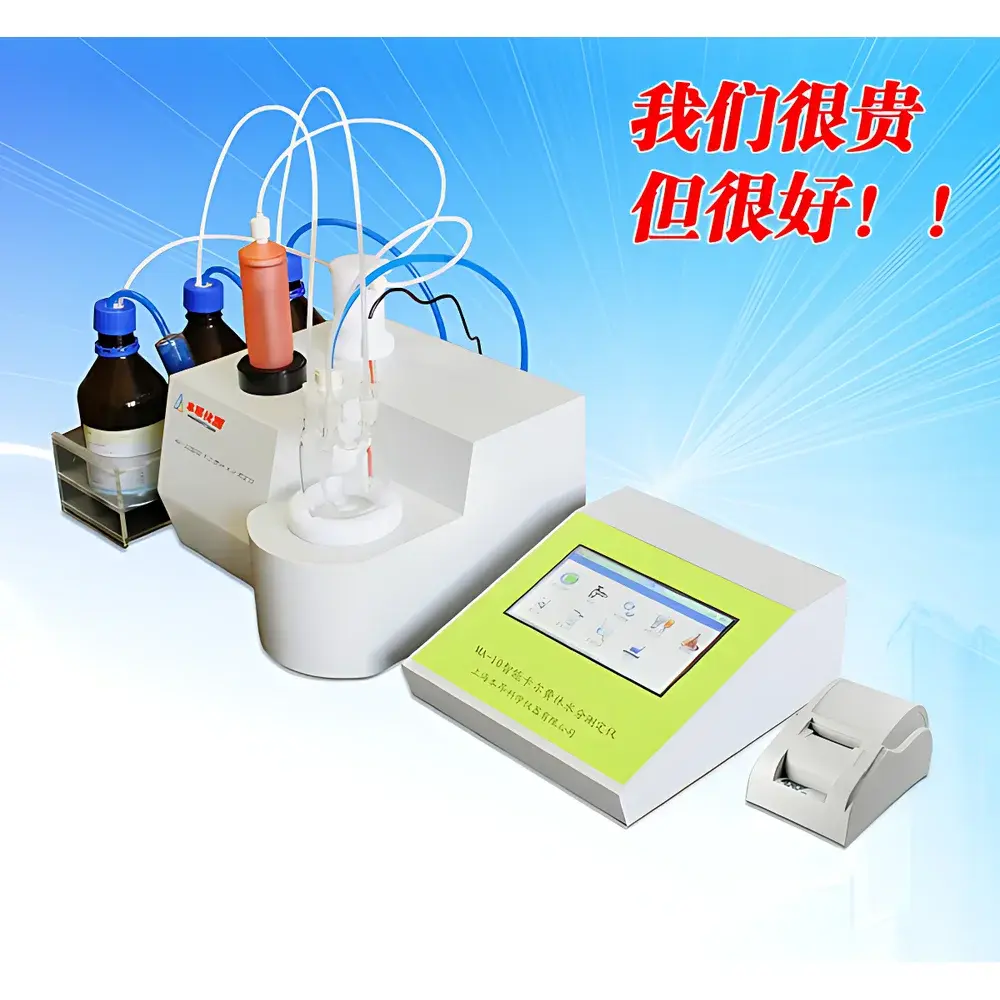
Benang MA-10 Intelligent Karl Fischer Coulometric Moisture Analyzer
| Origin | Shanghai, China |
|---|---|
| Manufacturer Type | Authorized Distributor |
| Origin Category | Domestic (PRC) |
| Model | MA-10 |
| Pricing | USD 5,600 (FOB Shanghai) |
| Titration Method | Fully Automatic Volumetric Titration |
| Instrument Type | Volumetric Karl Fischer Moisture Analyzer |
| Measurement Resolution | 1 ppm (H₂O) |
| Moisture Range | 5 ppm – 100% (w/w) |
| Accuracy | ±0.0005 mL titrant |
| Minimum Dispensing Increment | 1/2000 of burette volume |
| Titration Control Precision | ±0.001 mL |
| Repeatability | ≤0.005% RSD |
| Linearity Correlation Coefficient | ≥0.999 |
| Burette Volume Accuracy | ±0.0002 mL |
| Relative Error | ≤0.2% |
Overview
The Benang MA-10 Intelligent Karl Fischer Moisture Analyzer is a fully automated volumetric titration system engineered for high-precision water content determination in solid, liquid, and gaseous samples across research, quality control, and regulatory environments. Based on the classical Karl Fischer (KF) reaction—where iodine quantitatively reacts with water in the presence of sulfur dioxide, a base, and methanol—the MA-10 implements coulometric-free volumetric methodology using dual-platinum electrode end-point detection. Unlike coulometric systems, this volumetric configuration delivers robust performance for samples containing >100 ppm water while maintaining trace-level sensitivity down to 5 ppm. The instrument integrates a sealed, closed-loop reagent delivery architecture with real-time dynamic titration curve visualization, enabling users to identify side reactions (e.g., aldehyde interference or alcohol oxidation) during analysis and apply corrective procedural adjustments. Designed in collaboration with the 53rd Research Institute of China Ordnance Industry Group and refined with ultra-precise displacement metrology support from Tsinghua University’s State Key Laboratory of Precision Measurement Technology and Instruments, the MA-10 meets stringent operational requirements for GLP-compliant laboratories and ISO/IEC 17025-accredited testing facilities.
Key Features
- 7-inch capacitive touchscreen LCD with full Chinese/English bilingual UI and context-sensitive soft-key prompts—no programming expertise required.
- Intelligent titration engine allowing real-time adjustment of titrant delivery rate, stir speed, endpoint delay, and sensitivity threshold per method.
- Dual-platinum electrode system with automatic polarization compensation and micro-dosing capability for final endpoint refinement (down to 0.001 mL increments).
- Fully enclosed reagent handling module: integrated multi-channel peristaltic pump enables solvent exchange (methanol), waste evacuation, and KF reagent recovery—all without opening the reaction vessel.
- Patented glass metering components: burette tube and titration tip fabricated from German-sourced borosilicate glass, precision-cut using diamond machining in Antwerp, Belgium, ensuring long-term volumetric stability and chemical resistance.
- Reaction vessel with ground-glass joint interface and PTFE-coated magnetic stir bar—minimizes reagent evaporation, prevents leakage, and ensures homogeneous sample–titrant interaction.
- Anti-siphon waste bottle assembly with pressure-relief valve to prevent backflow during extended operation or vacuum-assisted purging cycles.
Sample Compatibility & Compliance
The MA-10 supports direct analysis of pharmaceutical actives, excipients, polymers, solvents, agrochemicals, food matrices, cosmetics, and petrochemical intermediates. It complies with major international standard methods including ASTM E203, ISO 760, DIN EN ISO 12937, JIS Z 8812, GB/T 6283, and BS ISO 8534. Its audit-trail-capable firmware (with optional 21 CFR Part 11 add-on module) logs user ID, timestamp, method parameters, raw titration data, endpoint confirmation, and calibration history—supporting full traceability for FDA, EMA, and NMPA submissions. All hardware interfaces—including VGA output, RS-232, and USB—enable seamless integration into LIMS and ELN platforms under GxP-aligned data governance protocols.
Software & Data Management
The embedded MA-10 OS stores up to 1,000 test records locally with timestamped metadata (operator ID, sample ID, method name, ambient temperature/humidity). Raw titration curves (mV vs. volume) and derivative plots are exportable in CSV format via USB drive or VGA-connected PC. Optional Benang DataLink software provides centralized database management, statistical process control (SPC) charting, report generation (PDF/Excel), and batch-wise trend analysis. All data modifications are logged with immutable timestamps and operator credentials—meeting ALCOA+ principles (Attributable, Legible, Contemporaneous, Original, Accurate, Complete, Consistent, Enduring, Available).
Applications
- Pharmaceutical QC: Residual moisture in lyophilized powders, tablet granules, and API batches per USP and Ph. Eur. 2.5.12.
- Chemical manufacturing: Water content verification in catalysts, silicone oils, and epoxy resins prior to polymerization.
- Food & beverage R&D: Quantification of bound vs. free water in dairy powders, starches, and hygroscopic flavor carriers.
- Electronics materials: Moisture screening in solder pastes, conformal coatings, and battery electrolyte solvents.
- Academic research: Kinetic studies of hydrolysis reactions and sorption isotherm modeling using sequential low-volume injections.
FAQ
What is the difference between volumetric and coulometric Karl Fischer titration?
Volumetric KF measures water by dispensing standardized iodine-containing titrant from a burette; it is optimal for samples with >100 ppm water. Coulometric KF generates iodine electrochemically at the anode and is preferred for sub-10 ppm measurements. The MA-10 is volumetric-only.
Can the MA-10 be validated for GMP environments?
Yes—when equipped with the optional 21 CFR Part 11 compliance package, it supports electronic signatures, role-based access control, and full audit trail generation required for FDA-submitted validation protocols.
How does the reagent recovery function work?
After idle periods exceeding 10 days, the system automatically transfers unused KF titrant from the burette back into the sealed reagent bottle via calibrated suction—reducing reagent consumption by up to 35% annually.
Is method transfer possible from other KF instruments?
Yes—predefined calculation templates (e.g., %H₂O, ppm, absolute µg H₂O, titrant volume consumed) align with AOAC, ASTM, and pharmacopoeial conventions, enabling straightforward cross-platform method migration.
What maintenance intervals are recommended?
Burette calibration every 6 months; electrode cleaning with ethanol weekly; glass component inspection quarterly; and full system performance qualification (SPQ) annually per ISO/IEC 17025 Clause 6.4.3.
Related Products




