
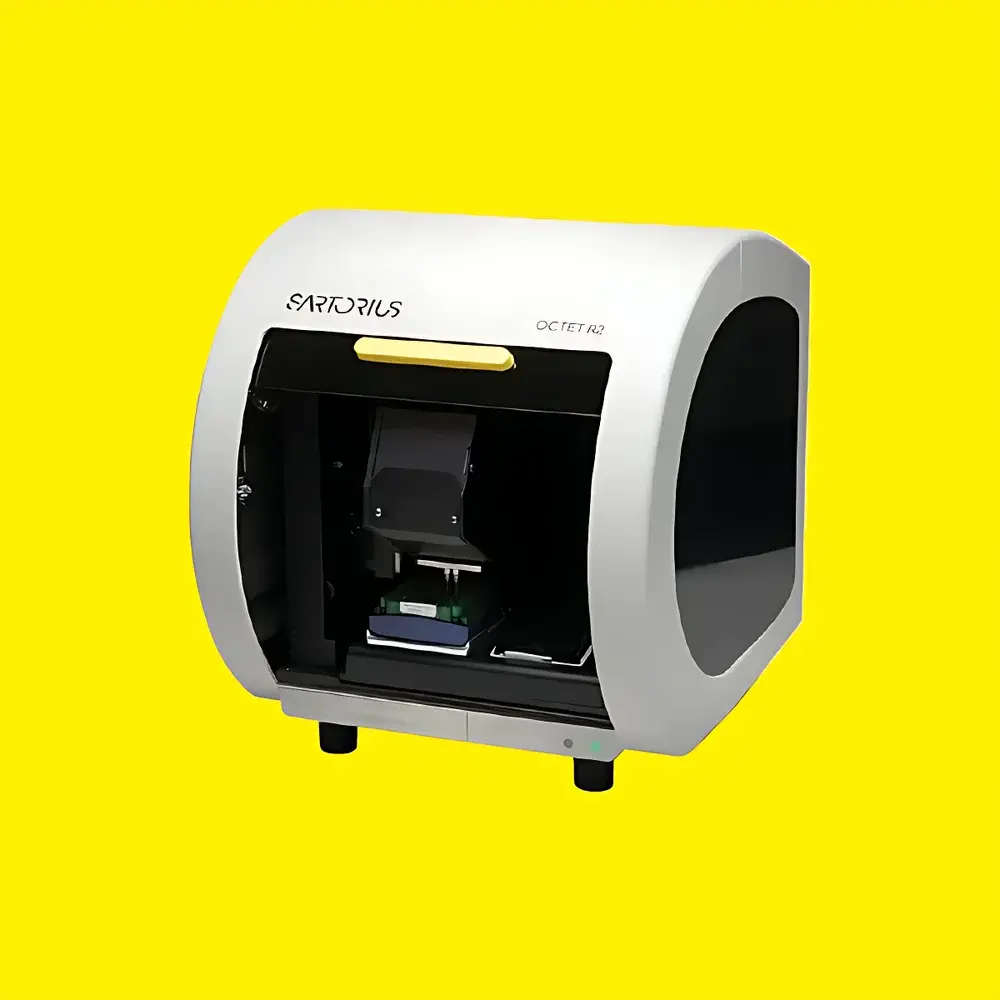
Sartorius Octet® R2 Biomolecular Interaction Analysis System
| Brand | Sartorius |
|---|---|
| Origin | Beijing, China |
| Manufacturer Type | Authorized Distributor |
| Origin Category | Domestic (China-manufactured under Sartorius OEM/technology license) |
| Model | Octet® R2 |
| Detection Method | Label-free Bio-Layer Interferometry (BLI) |
| Sample Format | 96-well microplate |
| Sample Volume per Well | 200 µL |
| Assay Duration | 2–60 minutes |
| Temperature Control Range | 15–40 °C |
Overview
The Sartorius Octet® R2 Biomolecular Interaction Analysis System is a benchtop, label-free platform engineered for real-time quantification and kinetic characterization of biomolecular interactions using Bio-Layer Interferometry (BLI). BLI operates on the principle of optical interference: when a biological ligand is immobilized on the surface of a fiber-optic biosensor tip, binding of an analyte induces a measurable shift in the interference pattern of reflected white light—proportional to the mass change at the sensor surface. Unlike surface plasmon resonance (SPR), BLI requires no microfluidic flow cells or complex surface chemistry optimization; instead, it employs dip-and-read kinetics in standard 96-well plates. This architecture eliminates clogging risks, reduces reagent consumption, and enables direct analysis of crude samples—including cell culture supernatants, lysates, serum, and unpurified expression harvests—without prior buffer exchange or filtration. The Octet® R2 delivers reproducible association (kon) and dissociation (koff) rate constants, equilibrium dissociation constants (KD), and concentration measurements across a broad dynamic range (pM to µM), supporting early-stage target validation, antibody affinity maturation, and biophysical QC in regulated environments.
Key Features
- Two independent, parallel detection channels—each with dedicated optics, temperature control, and sensor positioning—enabling simultaneous sample and reference measurements or dual-sample interrogation
- Integrated plate chiller maintaining 4–25 °C sample deck temperature (independent of ambient lab conditions), critical for thermolabile proteins, membrane receptors, or transient complexes
- Pre-validated, disposable biosensors available for amine coupling, streptavidin-biotin capture, Ni-NTA His-tag immobilization, Fc capture, and anti-human IgG Fc assays—eliminating sensor regeneration and surface passivation steps
- No fluidics or pumps: fully static assay format minimizes maintenance, avoids carryover, and supports long-term operational stability with minimal downtime
- Automated tip alignment and drift compensation algorithms ensure signal fidelity across extended kinetic runs (>30 min) and low-signal scenarios (e.g., small-molecule binding)
- Compliance-ready architecture: software supports user-defined roles, electronic signatures, audit trails, and data export in CSV, Excel, and vendor-neutral XML formats aligned with 21 CFR Part 11 and ALCOA+ principles
Sample Compatibility & Compliance
The Octet® R2 accepts native, unpurified, or partially purified samples directly from mammalian, insect, or bacterial expression systems. It routinely analyzes monoclonal antibodies (mAbs), bispecifics, Fc-fusion proteins, peptides, nucleic acids, glycans, and viral particles (e.g., VLPs, lentiviral vectors) without denaturation or labeling. Sensor surfaces tolerate high salt, glycerol, detergents (e.g., CHAPS, Triton X-100), and moderate concentrations of imidazole or reducing agents—reducing need for desalting or dialysis. All assay protocols are compatible with ISO 17025-accredited laboratories and support GLP/GMP-relevant documentation workflows. Instrument qualification packages (IQ/OQ/PQ) and method validation templates are available upon request for regulated biopharma applications.
Software & Data Management
Octet Data Acquisition and Data Analysis Software (v12.x or later) provides an integrated, single-platform interface for experimental design, real-time monitoring, global fitting, and report generation. Kinetic models—including 1:1 Langmuir, bivalent analyte, heterogeneous ligand, and mass transport-limited fits—are applied via nonlinear regression with confidence interval estimation. Raw sensorgrams are stored with full metadata (sensor lot, calibration date, operator ID, environmental logs). Exported datasets comply with FAIR principles (Findable, Accessible, Interoperable, Reusable) and integrate seamlessly with LIMS, ELN, and statistical platforms such as JMP or GraphPad Prism. Optional cloud-based data backup and multi-user collaboration modules support remote team access under role-based permissions.
Applications
- Antibody-antigen affinity ranking during lead selection and engineering
- Epitope binning using sequential binding and competition assays
- Concentration determination of therapeutic proteins in process intermediates
- Binding stoichiometry and avidity assessment for multivalent constructs
- Stability profiling: thermal or chemical denaturation monitored via binding retention
- Cell-based assay support: quantification of secreted cytokines or extracellular domain shedding
- QC release testing for biosimilars and gene therapy vectors (e.g., AAV capsid binding to host receptors)
FAQ
Can the Octet® R2 be upgraded to higher channel configurations?
Yes—the Octet® R2 chassis is mechanically and electronically compatible with 4-channel (Octet® R4) and 8-channel (Octet® R8) modules. Upgrades include firmware updates, hardware installation, and recalibration services performed by Sartorius Field Application Scientists.
Is BLI data comparable to SPR-derived kinetics?
When experimental conditions (temperature, buffer composition, immobilization density) are matched, BLI and SPR yield highly concordant KD values (typically within 2-fold). BLI exhibits lower sensitivity to bulk refractive index shifts but may require careful optimization for very fast (kon > 10⁶ M⁻¹s⁻¹) or very slow (koff < 10⁻⁵ s⁻¹) interactions.
What sample purity requirements apply for accurate kinetic analysis?
No minimum purity threshold is mandated; however, total protein concentration should remain below 1 mg/mL to avoid non-specific binding artifacts. Aggregates or particulates >1 µm may interfere with tip immersion consistency and are best removed by brief centrifugation (10,000 × g, 5 min) or 0.22 µm filtration.
Does the system support regulatory submissions?
Yes—software features including electronic signatures, audit trail review, instrument calibration logs, and raw data traceability meet FDA 21 CFR Part 11, EMA Annex 11, and ICH Q5E expectations for analytical method validation and comparability studies.




