
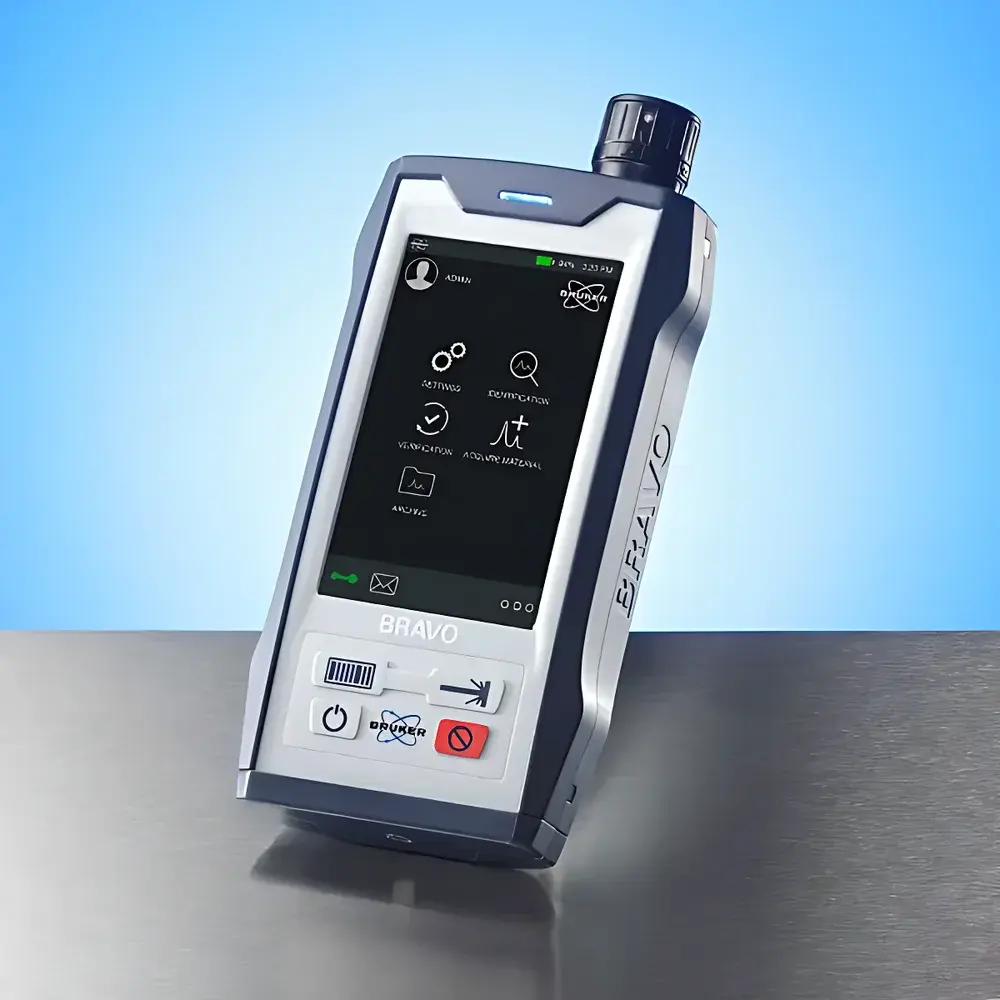
Bruker BRAVO Handheld Raman Spectrometer
| Brand | Bruker |
|---|---|
| Origin | Germany |
| Model | BRAVO |
| Instrument Type | Handheld Raman Spectrometer |
| Spectral Range | 3200–300 cm⁻¹ |
| Spectral Resolution | 10–12 cm⁻¹ |
| Spatial Resolution | 1–2 mm spot diameter |
| Minimum Wavenumber | 300 cm⁻¹ |
| Spectral Reproducibility | ≤1% RSD (typical, per NIST-traceable standards) |
| Laser Safety Class | Class 1 |
| Connectivity | Wi-Fi, Ethernet, Remote Control via OPUS Touch |
| Regulatory Compliance | FDA 21 CFR Part 11, USP <1120>, Ph. Eur. 2.2.48, GLP/GMP-ready audit trail |
Overview
The Bruker BRAVO Handheld Raman Spectrometer is an engineered solution for rapid, non-destructive molecular identification and verification in regulated and field-deployed environments. Operating on the principle of inelastic light scattering—where monochromatic laser excitation induces vibrational mode shifts in chemical bonds—the BRAVO delivers high-fidelity Raman spectra across a broad spectral window (300–3200 cm⁻¹), enabling unambiguous fingerprinting of organic, inorganic, and polymeric materials. Its compact, ergonomic form factor integrates dual-laser excitation (DuoLaser™) and patented Sequential Shift Excitation (SSE™) to suppress fluorescence interference without sample preparation—a critical capability for pharmaceutical raw material inspection, counterfeit detection, and hazardous substance screening. Designed for direct operation in production suites, warehouses, customs checkpoints, and laboratory corridors, the BRAVO maintains analytical equivalence to benchtop systems while eliminating optical alignment, thermal stabilization, or operator training overhead.
Key Features
- DuoLaser™ Dual-Wavelength Excitation: Simultaneous or sequential use of 785 nm and 830 nm lasers optimizes signal-to-noise ratio across diverse sample matrices—including pigmented, fluorescent, or thermally sensitive compounds—without hardware reconfiguration.
- SSE™ Fluorescence Suppression Technology: A proprietary time-resolved acquisition protocol that separates Raman scattering from persistent fluorescence background, enabling reliable analysis of dark-colored, aged, or highly fluorescing samples (e.g., herbal extracts, dyes, degraded polymers).
- Class 1 Laser Safety Certification: Fully compliant with IEC 60825-1:2014; requires no interlocks, safety goggles, or controlled access zones—enabling unrestricted deployment by non-specialist personnel in GMP manufacturing areas or field settings.
- IntelliTip™ Smart Probe Recognition: Automatic detection and calibration of interchangeable probe heads (e.g., standard, long-working-distance, or fiber-coupled variants) ensures traceable measurement conditions and eliminates manual parameter entry errors.
- OPUS TOUCH Graphical User Interface: A context-aware, workflow-driven interface with guided prompts for method selection, sample registration, and pass/fail decision logic—designed to minimize cognitive load and support 21 CFR Part 11-compliant electronic signatures.
Sample Compatibility & Compliance
The BRAVO performs non-contact, through-barrier analysis of solids, powders, gels, and liquids contained in transparent or amber glass vials, PET bottles, plastic bags, and laminated pouches—without opening packaging. Its 1–2 mm focused spot enables spatially resolved interrogation of heterogeneous samples (e.g., tablet coatings, layered films, or blended APIs). All firmware, spectral libraries, and reporting modules are validated per IQ/OQ protocols aligned with ISO/IEC 17025 and ASTM E1840-22. Data integrity safeguards include immutable audit trails, role-based access control, electronic signature enforcement, and encrypted local/cloud storage—fully supporting FDA, EMA, and PMDA expectations for analytical instrument qualification in pharmaceutical QC laboratories.
Software & Data Management
BRAVO operates exclusively within the Bruker OPUS TOUCH platform—a secure, embedded Linux-based environment supporting method-driven workflows, customizable pass/fail thresholds, and multi-level user permissions. Spectral libraries include >20,000 reference entries (pharmaceutical actives, excipients, polymers, explosives, narcotics) with configurable match confidence scoring (Cosine, Euclidean, and Mahalanobis distance algorithms). SyncService enables scheduled or event-triggered data export to LIMS, ELN, or enterprise NAS via TLS 1.2–secured FTP/SFTP or HTTPS REST API. All spectral acquisitions retain full metadata (instrument ID, operator, timestamp, GPS coordinates if enabled, environmental sensor logs), ensuring full traceability for regulatory inspections.
Applications
- Pharmaceutical raw material identity testing (USP and Ph. Eur. 2.2.48 compliance)
- Counterfeit drug detection at border control and distribution hubs
- In-process verification of blend uniformity and coating thickness
- Hazardous material identification in emergency response (HAZMAT teams, first responders)
- Polymer sorting in recycling facilities using spectral fingerprint matching
- Academic and industrial research requiring field-deployable molecular characterization
FAQ
Does the BRAVO require annual recalibration?
No—its solid-state laser sources and thermally stabilized spectrometer module maintain factory calibration for ≥12 months under normal operating conditions. Optional annual performance verification services are available per ISO/IEC 17025 requirements.
Can it identify mixtures or quantify components?
The BRAVO is optimized for qualitative identification and presence/absence verification. Quantitative analysis requires method development with certified reference standards and is not supported out-of-the-box.
Is spectral library customization permitted?
Yes—users may import, validate, and manage custom libraries using OPUS Library Manager, with version-controlled backups and change history logging compliant with ALCOA+ principles.
What environmental conditions affect measurement reliability?
Operation is rated for 10–40 °C and ≤80% RH non-condensing. Ambient light interference is mitigated via hardware shuttering and spectral background subtraction; no darkroom required.
How is data security enforced during remote transmission?
All network communications use AES-256 encryption; certificate-based authentication is mandatory for SyncService connections to corporate servers or cloud endpoints.




