
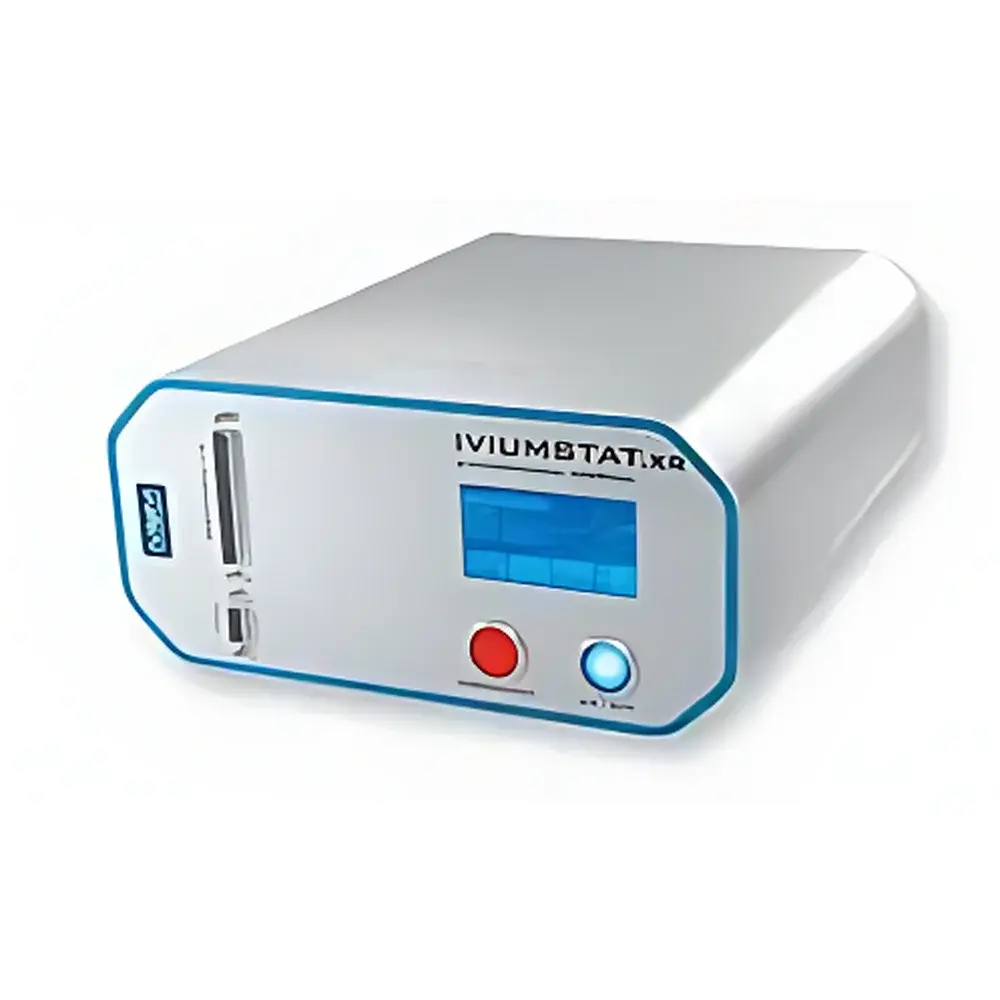
Ivium IVIUMSTAT.H Electrochemical Workstation
| Brand | Ivium |
|---|---|
| Origin | Netherlands |
| Model | IVIUMSTAT.H |
| Channel Count | Single-Channel |
| Current Range | 10 nA – 10 A |
| Current Accuracy | ±0.2% |
| Potential Accuracy | ±0.2% |
| Potentiostatic Range | ±1 mV, ±10 mV, ±100 mV, ±1 V, ±10 V |
| EIS Frequency Range | 10 µHz – 8 MHz |
Overview
The Ivium IVIUMSTAT.H Electrochemical Workstation is a high-performance, single-channel potentiostat/galvanostat engineered for precision electrochemical characterization across academic research, industrial R&D, and quality control laboratories. Built on Ivium’s proprietary digital potentiostat architecture, it employs real-time digital signal processing (DSP) and a 24-bit analog-to-digital converter to ensure high-fidelity data acquisition and exceptional baseline stability. Its core measurement principle integrates controlled-potential (potentiostatic), controlled-current (galvanostatic), and hybrid-mode operation—enabling simultaneous application of multiple stimuli while acquiring time-resolved or frequency-domain responses. With an extended electrochemical impedance spectroscopy (EIS) bandwidth spanning from ultra-low frequencies (10 µHz) up to 8 MHz, the IVIUMSTAT.H supports both slow kinetic processes (e.g., corrosion initiation, battery SEI growth) and fast interfacial phenomena (e.g., double-layer charging, semiconductor carrier dynamics). Designed for long-term unattended operation, it complies with ISO/IEC 17025 traceability requirements for instrument calibration and meets essential electromagnetic compatibility (EMC) standards per EN 61326-1.
Key Features
- Full suite of standard electrochemical techniques: cyclic voltammetry (CV), linear sweep voltammetry (LSV), chronoamperometry (CA), chronopotentiometry (CP), differential pulse voltammetry (DPV), square-wave voltammetry (SWV), and open-circuit potential (OCP) monitoring.
- Advanced EIS capability with 10 µHz–8 MHz frequency coverage, supporting multi-sine and single-sine acquisition modes; includes built-in Kramers–Kronig validation and real-time stability assessment.
- Mixed-Mode (Hybrid) measurement protocol: enables automated sequential or concurrent application of up to five independent stimuli—including potential steps, current steps, potential sweeps, current sweeps, and OCP—while simultaneously recording EIS at each step.
- High-current scalability: base unit supports ±10 A output; optional current booster modules extend capability to 40 A @ 10 V or 100 V @ 0.5 A, maintaining full accuracy and synchronization.
- Ultra-high resolution: potential measurement resolution down to 0.15 nV (0.00001% of 10 V range); current measurement resolution down to 0.6 aA (0.00006% of 10 A range).
- Dedicated modules for photoelectrochemical analysis: integrated I–V curve acquisition under illumination, photocurrent transient analysis, maximum power point tracking (MPPT), fill factor calculation, and incident photon-to-current efficiency (IPCE) derivation.
- Comprehensive electrochemical noise analysis: time-domain metrics (corrosion current density icorr, pitting index, localized corrosion resistance Rp) and frequency-domain methods (FFT-based spectral density, MEM spectral estimation, noise resistance Rn).
Sample Compatibility & Compliance
The IVIUMSTAT.H interfaces seamlessly with standard three-electrode electrochemical cells (working, counter, reference), rotating disk electrodes (RDE), rotating ring-disk electrodes (RRDE), microelectrodes, and custom-designed flow cells. It supports common reference electrodes (Ag/AgCl, SCE, Hg/Hg2SO4) and accommodates electrolyte resistances up to 1 MΩ via positive feedback iR compensation. The system conforms to ASTM G102 (calculation of corrosion rates), ASTM G59 (potentiodynamic polarization), ASTM G106 (electrochemical impedance), and ISO 16773 (coating degradation assessment). Data integrity aligns with GLP/GMP expectations through audit-trail-enabled software logging and user-access controls.
Software & Data Management
Controlled by IviumSoft v11 (Windows-based), the workstation provides intuitive experiment setup, real-time visualization, and post-acquisition modeling. The software features embedded equivalent circuit fitting (ECFit) with >60 predefined models and custom topology definition, batch EIS analysis with statistical outlier detection, and export compatibility with MATLAB, Origin, and Python (via .csv and .txt). All raw and processed datasets include metadata tags (timestamp, operator ID, method parameters, calibration history), satisfying FDA 21 CFR Part 11 requirements when deployed with electronic signature and role-based access configuration.
Applications
- Battery materials research: solid-electrolyte interphase (SEI) formation kinetics, Li-ion diffusion coefficient determination, and cycle-life degradation mapping.
- Corrosion science: electrochemical noise monitoring in chloride-containing environments, coating defect evaluation, and cathodic protection system validation.
- Electrocatalysis: oxygen reduction reaction (ORR) activity quantification, hydrogen evolution reaction (HER) overpotential analysis, and Tafel slope extraction.
- Photoelectrochemistry: solar fuel generation efficiency assessment, dye-sensitized solar cell (DSSC) charge-transfer resistance profiling, and perovskite stability testing under operational bias.
- Sensors & biosensors: amperometric detection limits, enzyme kinetics modeling, and impedance-based label-free biomolecular binding assays.
- Fuel cell membrane development: proton conductivity mapping, catalyst layer degradation tracking, and interfacial water uptake analysis via low-frequency EIS.
FAQ
What is the minimum measurable current with the IVIUMSTAT.H?
The system achieves a current measurement resolution of 0.6 aA (attoampere) in its most sensitive range, corresponding to 0.00006% of full scale on the 10 A range.
Can the IVIUMSTAT.H perform EIS on high-impedance samples such as polymer coatings or biological membranes?
Yes—the 10 µHz lower limit and high input impedance (>1013 Ω) enable stable EIS measurements on insulating and semi-insulating systems; optional guarded cell cables further reduce stray capacitance.
Is mixed-mode operation compatible with real-time EIS acquisition during potential sweeps?
Yes—Mixed Mode allows synchronized application of a linear potential sweep while superimposing small-amplitude AC perturbations and acquiring impedance spectra at user-defined points along the sweep.
Does IviumSoft support automated compliance reporting for regulated industries?
When configured with audit trail, electronic signatures, and secure user authentication, IviumSoft meets documentation requirements for GLP, GMP, and ISO 17025-accredited laboratories.
How is hardware calibration maintained over time?
The IVIUMSTAT.H includes internal reference voltage and current sources traceable to NIST standards; users may perform full-system calibration using the built-in self-test routine and optional external calibrators certified to ISO/IEC 17025.
Related Products






