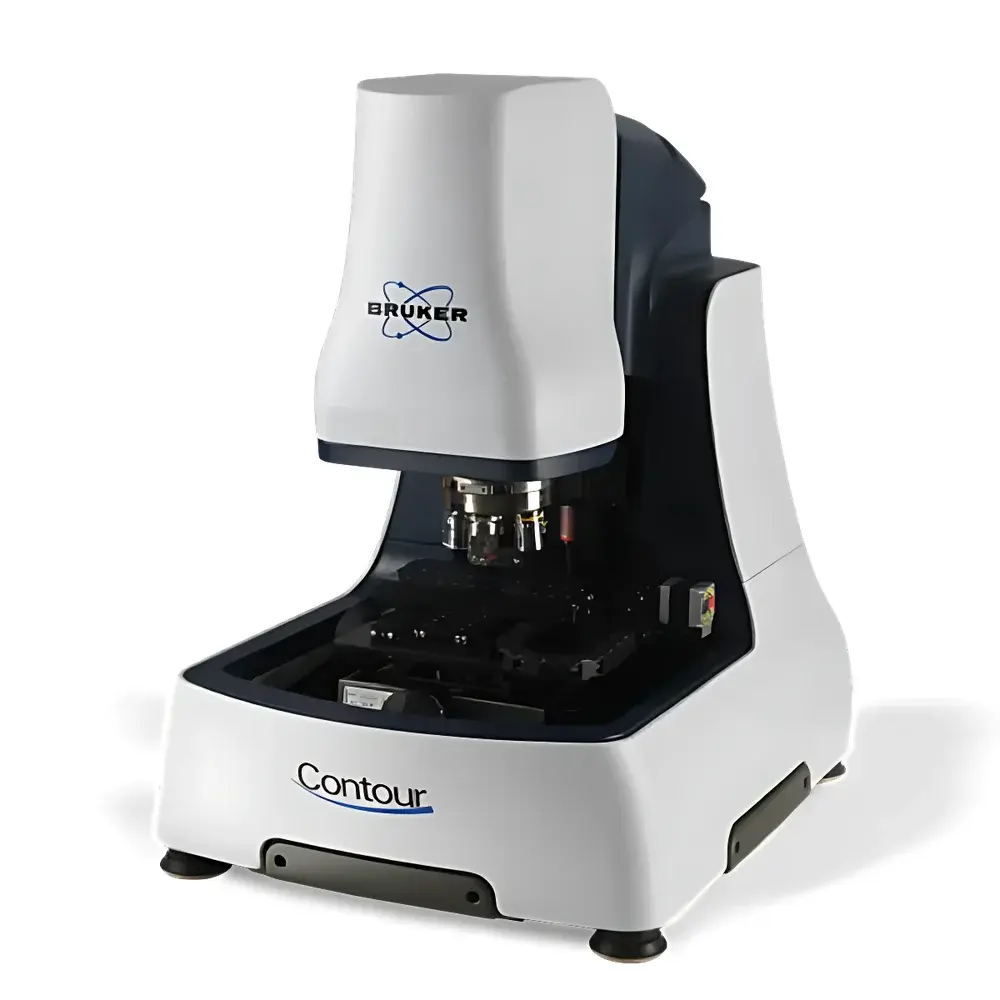
Bruker ContourX-200 3D Optical Profilometer
| Brand | Bruker |
|---|---|
| Origin | Germany |
| Manufacturer Type | Authorized Distributor |
| Origin Category | Imported |
| Model | ContourX-200 |
| Pricing | Upon Request |
| Vertical Resolution | < 0.1 nm |
Overview
The Bruker ContourX-200 3D Optical Profilometer is a high-precision, non-contact surface metrology system engineered for quantitative topographic characterization across research laboratories and industrial quality control environments. It leverages Bruker’s proprietary Widefield Interferometry (WLI) technology—refined over four decades of optical metrology innovation—to deliver sub-nanometer vertical resolution (< 0.1 nm), exceptional repeatability, and robust measurement stability across surfaces with reflectivity ranging from 0.05% to 100%. Unlike stylus-based profilometers or confocal systems constrained by scanning speed or surface compliance limitations, the ContourX-200 employs phase-shifting interferometry (PSI) and vertical scanning interferometry (VSI) within a single platform, automatically selecting the optimal acquisition mode based on surface slope, roughness, and coherence properties. This adaptive measurement architecture ensures traceable, NIST-compatible height data without operator intervention, making it suitable for ISO 25178-compliant surface texture analysis, thin-film step-height metrology, MEMS inspection, and semiconductor wafer defect quantification.
Key Features
- Sub-0.1 nm vertical resolution enabled by low-noise, high-dynamic-range CMOS imaging and thermally stabilized interferometric optics
- 5-megapixel camera with 1200 × 1000 active measurement array—optimized for wide-field coverage and enhanced lateral resolution without sacrificing signal-to-noise ratio
- Motorized XY stage with extended travel range and programmable stitching capability for seamless large-area mapping up to 200 mm × 200 mm
- Universal Scanning Interferometry (USI) mode: an intelligent, self-optimizing acquisition protocol that dynamically adjusts scan parameters, fringe contrast detection, and demodulation algorithms per local surface region
- Multi-objective turret support (5×–100×) enabling scalable magnification, field-of-view adaptation, and depth-of-field optimization for diverse sample geometries
- Integrated vibration isolation base and environmental drift compensation algorithms for stable operation in standard lab environments (no active air suspension required)
Sample Compatibility & Compliance
The ContourX-200 accommodates a broad spectrum of sample types—including polished wafers, machined metal parts, coated optics, medical implants, and microstructured polymers—without requiring conductive coating or vacuum conditions. Its wide dynamic range supports measurements on both highly reflective mirrors and low-reflectance matte surfaces (e.g., black anodized aluminum, sputtered thin films, or porous ceramics). All measurement routines comply with international standards for surface texture analysis, including ISO 25178-2 (areal surface texture parameters), ISO 4287 (profile-based roughness), and ASTM E2923 (standard guide for optical interferometric surface topography measurement). Data integrity is maintained through full audit trail logging, electronic signatures, and optional 21 CFR Part 11-compliant software modules for regulated industries (e.g., medical device manufacturing, pharmaceutical packaging validation).
Software & Data Management
The system operates via Bruker’s dual-platform software suite: VisionXpress for rapid setup and routine QC workflows, and Vision64 for advanced research-grade analysis. Vision64 provides over 2,000 customizable analysis functions—including power spectral density (PSD), bearing ratio curves (Abbott-Firestone), fractal dimension estimation, grain boundary segmentation, and automated defect classification using machine learning–enhanced thresholding. Raw interferograms are stored in vendor-neutral HDF5 format with embedded metadata (wavelength, objective ID, calibration timestamp, environmental logs). Batch processing, script-driven automation (via Python API), and direct integration with LIMS or MES platforms ensure scalability across multi-site manufacturing operations and centralized metrology labs.
Applications
- Semiconductor process control: trench depth, CMP uniformity, lithography overlay error, and EUV mask defect review
- MEMS/NEMS device characterization: actuator displacement, resonator surface flatness, and packaging-induced warpage
- Precision machining verification: surface finish on turbine blades, bearing races, and injection molds per ASME B46.1
- Optical component certification: wavefront error mapping of aspheres, lenslet arrays, and diffractive optical elements
- Biomedical device metrology: surface roughness of orthopedic implants, stent strut geometry, and hydrogel swelling kinetics
- Advanced materials R&D: graphene layer counting, battery electrode porosity quantification, and thermal barrier coating delamination assessment
FAQ
What measurement principles does the ContourX-200 use?
It combines Phase-Shifting Interferometry (PSI) for smooth, low-slope surfaces and Vertical Scanning Interferometry (VSI) for rougher or discontinuous topographies—automatically selected via its Universal Scanning Interferometry (USI) engine.
Is the system compliant with ISO 25178 for areal surface texture analysis?
Yes—Vision64 implements all core parameters defined in ISO 25178-2 (Sa, Sq, Sz, Ssk, Sku, etc.) with traceable calibration protocols and uncertainty reporting.
Can the ContourX-200 measure transparent or semi-transparent thin films?
Yes, when combined with optional broadband light sources and film-thickness analysis modules, it supports multi-layer stack characterization with sub-nanometer thickness resolution.
Does the system support automated pass/fail decision-making in production environments?
Yes—VisionXpress enables configurable tolerance limits, statistical process control (SPC) charting, and export-ready reports compatible with factory automation systems (OPC UA, SECS/GEM).
What level of technical support and calibration services are available globally?
Bruker provides factory-certified calibration, on-site preventive maintenance, ISO/IEC 17025-accredited traceability documentation, and remote diagnostics via secure TLS-encrypted connection.