
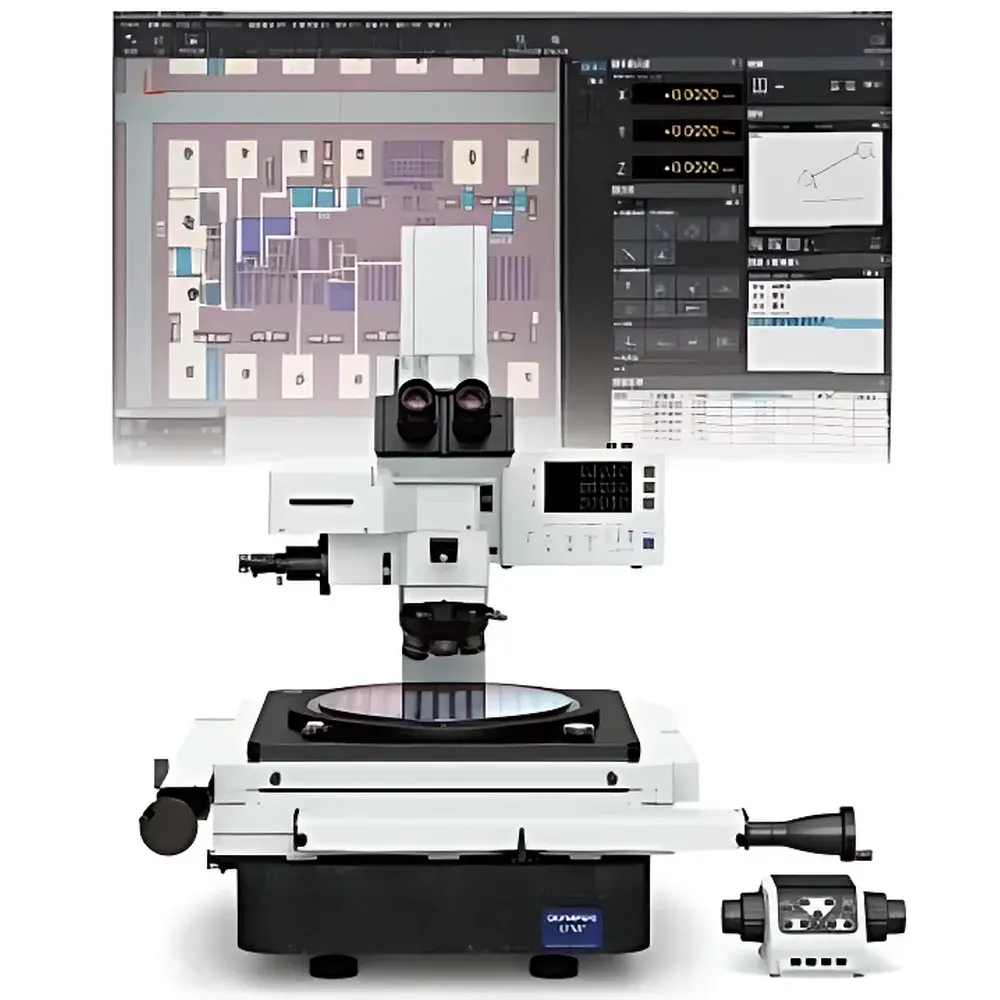
OLYMPUS STM7 Tool Measuring Microscope
| Brand | OLYMPUS |
|---|---|
| Origin | Japan |
| Model | STM7 |
| Measurement Axes | 3-axis (X, Y, Z) |
| Position Resolution | 0.1 µm |
| Focus Options | Manual & Motorized Focus Stands |
| Illumination | Adjustable LED Light Management System |
| Stage Travel | Square-format mechanical stage with configurable行程 (standard: 100 × 100 mm, optional up to 200 × 200 mm) |
| Objective Compatibility | Interchangeable objective lenses with extended working distance adapters |
| Software Interface | BSW (Basic Software) or optional advanced metrology software with audit trail capability |
Overview
The OLYMPUS STM7 Tool Measuring Microscope is a precision optical metrology instrument engineered for dimensional inspection and geometric analysis of machined parts, microcomponents, semiconductor wafers, and precision tooling. Built upon over a century of OLYMPUS optical expertise, the STM7 integrates high-fidelity transmitted and reflected light microscopy with calibrated coordinate measurement functionality. Its core measurement principle relies on a stabilized optical axis aligned with a thermally compensated granite base and precision-ground linear encoders mounted directly on each motion axis (X, Y, Z). This architecture ensures traceable, repeatable measurements compliant with ISO 10360-2 (coordinate measuring machines) and supports uncertainty budgets required in ISO/IEC 17025-accredited calibration laboratories. The system operates under standard ambient conditions (20 ± 1 °C, 40–60% RH), with environmental compensation available via optional thermal sensors.
Key Features
- Precision 3-axis measurement system with 0.1 µm encoder resolution on all axes, certified per manufacturer’s calibration certificate (traceable to JCSS standards)
- Dual-focus configuration options: manually operated focus stand for routine inspection or motorized focus stand with programmable Z-axis positioning for automated height profiling
- Optimized optical path delivering diffraction-limited resolution across magnifications from 10× to 1000× (with optional objectives), supporting both brightfield and coaxial illumination modes
- Modular square-format mechanical stage with standard 100 × 100 mm travel; upgradeable to 200 × 200 mm for large-part metrology without sacrificing rigidity or positional fidelity
- Detachable digital counter unit with real-time position display, independent of host PC—enabling rapid verification of stage coordinates and system status at point-of-use
- LED-based illumination management system with adjustable intensity, color temperature, and directional control—designed to minimize thermal drift and support consistent contrast for edge detection algorithms
Sample Compatibility & Compliance
The STM7 accommodates a broad range of sample geometries—from flat calibration artifacts and printed circuit boards to irregularly shaped cutting tools and injection-molded plastic components. Its extended working distance adapter kit enables observation of tall or recessed features (e.g., threaded inserts, cavity molds) without interference from objective lens housing. All optical components comply with ISO 8578 (microscope performance standards) and JIS B 7153 (Japanese industrial standard for measuring microscopes). When configured with BSW software or validated third-party metrology packages, the system supports audit trail generation, electronic signatures, and user access controls aligned with FDA 21 CFR Part 11 requirements for regulated environments. Routine verification follows ASTM E2923-22 (Standard Guide for Verification of Measurement Microscopes).
Software & Data Management
The STM7 interfaces with OLYMPUS BSW (Basic Software) as standard—a lightweight, intuitive application enabling point-to-point distance, angle, radius, and parallelism measurements with customizable annotation layers. For advanced workflows, it supports integration with validated metrology platforms offering GD&T evaluation (per ASME Y14.5-2018), statistical process control (SPC) charting, and automated report generation in PDF/XLS formats. All measurement data is timestamped and linked to operator ID, instrument serial number, and calibration status. Optional software modules provide full GLP/GMP compliance: electronic logbooks, change control records, and version-controlled measurement routines—all retained with immutable audit trails.
Applications
- Dimensional verification of precision-machined components in aerospace and medical device manufacturing
- Tool wear analysis and geometry validation of end mills, drills, and inserts in cutting tool production
- Micro-feature inspection of MEMS devices, stents, and microfluidic channels
- Calibration laboratory use for verifying gauge blocks, step gauges, and line standards per ISO 3650
- Failure analysis labs performing crack propagation mapping and surface defect quantification
- Educational institutions conducting hands-on metrology training with NIST-traceable reference samples
FAQ
Is the STM7 compatible with non-OLYMPUS objective lenses?
Yes—via standardized RMS or M25 threading, though metrological accuracy is guaranteed only with OLYMPUS-certified objectives due to encoder alignment tolerances.
Can measurement data be exported to SPC software?
Yes—BSW and third-party metrology packages support CSV, XML, and direct OPC UA connectivity for real-time data streaming into enterprise quality systems.
What is the typical recalibration interval?
Annual calibration is recommended per ISO/IEC 17025 guidelines; however, frequency should be risk-assessed based on usage intensity, environmental stability, and criticality of measured parameters.
Does the STM7 meet requirements for ISO 13565-3 surface texture analysis?
No—the STM7 is optimized for profile and form metrology, not areal surface topography; dedicated confocal or interferometric profilers are recommended for ISO 13565-3 compliance.
Is remote operation supported?
Yes—via secure RDP or VNC protocols when installed with Windows OS; however, physical intervention remains necessary for stage loading, focus initialization, and optical alignment verification.





