
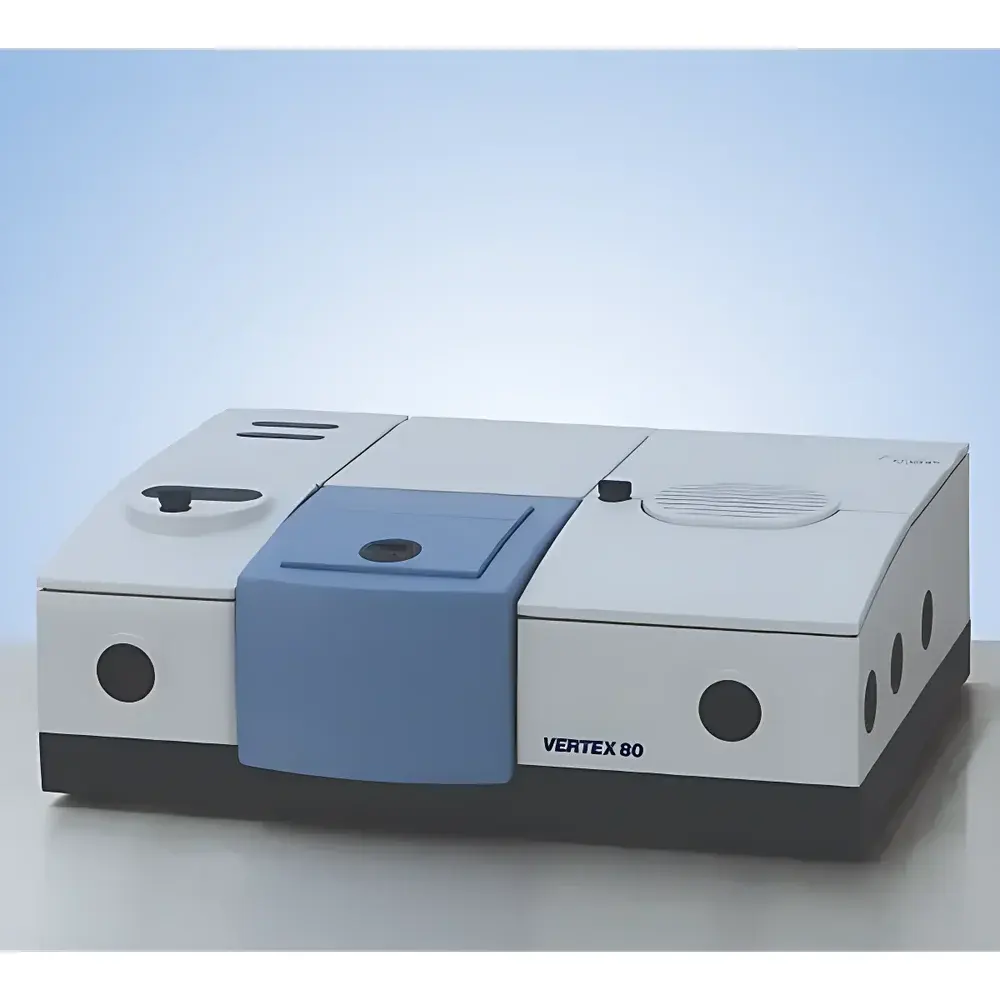
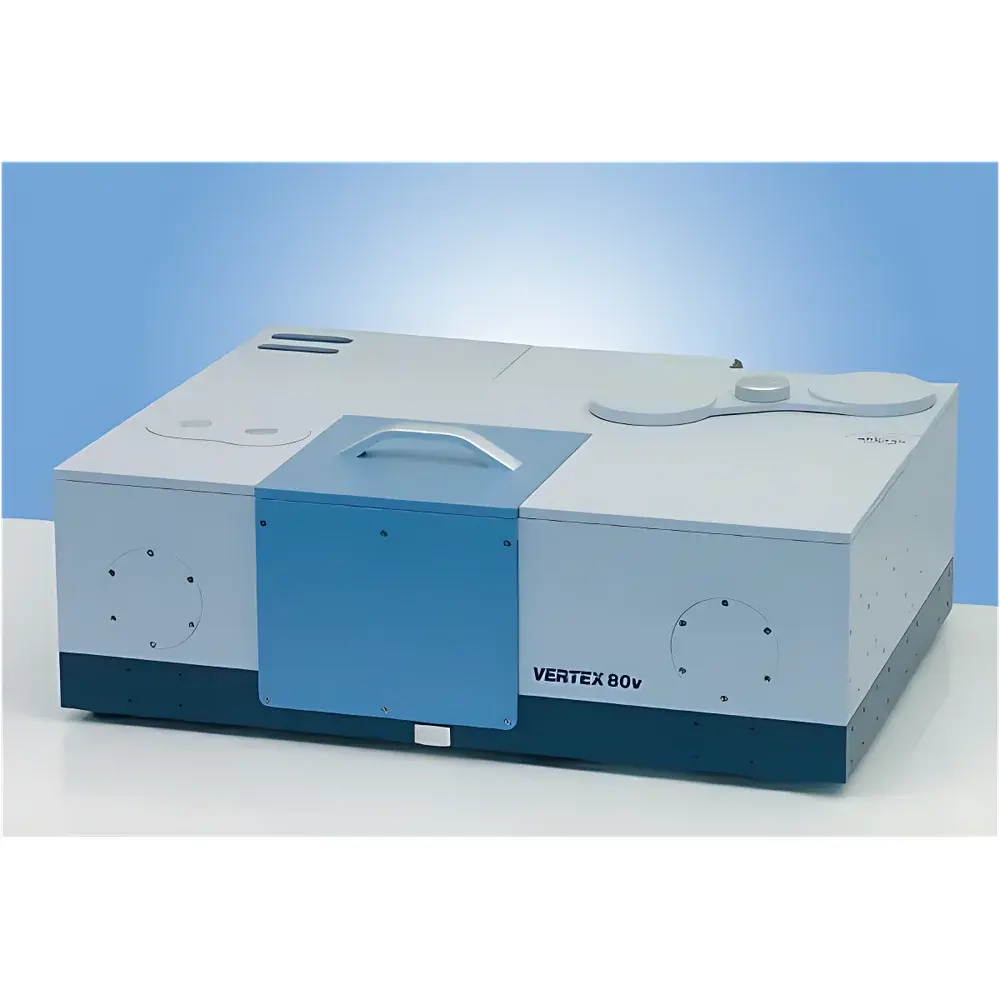
Bruker VERTEX 80/80v Fourier Transform Infrared (FTIR) Spectrometer
| Brand | Bruker |
|---|---|
| Origin | Germany |
| Model | VERTEX 80/80v |
| Instrument Type | Laboratory FTIR Spectrometer |
| Wavenumber Range | 50,000–5 cm⁻¹ |
| Spectral Resolution | ≤0.06 cm⁻¹ (PEAK) |
| Scan Speed | 115 scans/sec |
| Signal-to-Noise Ratio | 55,000:1 |
| Configuration Options | Purged (VERTEX 80) or Vacuum-Enabled (VERTEX 80v) |
Overview
The Bruker VERTEX 80 and VERTEX 80v are research-grade Fourier Transform Infrared (FTIR) spectrometers engineered for maximum spectral fidelity, dynamic range, and experimental flexibility. Based on Michelson interferometry with UltraScan™ actively aligned interferometer optics, these instruments deliver high-stability, high-reproducibility measurements across an unprecedented wavenumber range—from ultraviolet/visible (50,000 cm⁻¹) through near-infrared (NIR), mid-infrared (MIR), far-infrared (FIR), and into the terahertz (THz) region (down to 5 cm⁻¹). The VERTEX 80 operates under continuous purge with dry air or nitrogen, while the VERTEX 80v integrates a fully evacuated optical bench—eliminating atmospheric absorption artifacts (e.g., H₂O and CO₂ lines) and enabling detection of ultra-weak spectral features critical in low-coverage surface science, thin-film metrology, and cryogenic semiconductor characterization.
Key Features
- Ultra-broad spectral coverage: 50,000–5 cm⁻¹ (UV/VIS to THz) via modular optical configuration and broadband beam splitter options
- Best-in-class spectral resolution: ≤0.06 cm⁻¹ PEAK resolution—achieved with high-precision retroreflector alignment and thermally stabilized interferometer housing
- High-speed acquisition: Up to 115 full interferograms per second, supporting rapid kinetic studies, step-scan time-resolved spectroscopy, and real-time process monitoring
- Vacuum-compatible optical bench (VERTEX 80v): <10⁻³ mbar base pressure; enables artifact-free FIR/THz measurements and long-term baseline stability
- BMS-c Beam Splitter Changer: Motorized, vacuum-compatible module allowing remote selection of up to four beam splitters (e.g., KBr, quartz, Mylar, solid-state FIR) without venting
- Multi-port optical architecture: Five output ports (right, front-left, front-right, left, rear) and two input ports (rear, back) support simultaneous coupling to synchrotron sources, polarization modulation accessories (e.g., PMA50), FTIR microscopes (HYPERION series), bolometric detectors, and fiber-optic interfaces
- Predetermined optical alignment: Pre-aligned mirrors and monolithic interferometer design reduce maintenance downtime and ensure consistent optical throughput across configurations
Sample Compatibility & Compliance
The VERTEX 80/80v accommodates diverse sample forms—including transmission cells (gas, liquid, solid), ATR accessories, diffuse reflectance modules, photoacoustic cells, and cryostat-integrated stages. Its vacuum capability ensures compliance with ISO 17025 requirements for traceable spectral calibration and supports GLP/GMP workflows where environmental interference must be excluded from analytical records. The system is compatible with ASTM E1421 (Standard Practice for Describing and Measuring Performance of FTIR Spectrometers) and meets essential criteria for FDA 21 CFR Part 11–compliant data integrity when integrated with OPUS software’s audit-trail and electronic signature modules.
Software & Data Management
Controlled exclusively via Bruker’s OPUS software suite, the VERTEX platform provides unified instrument control, advanced spectral processing (e.g., phase correction, apodization, zero-filling, Mertz transformation), quantitative analysis (PLS, PCA, CLS), and automated method sequencing. OPUS supports raw interferogram export (binary or ASCII), HDF5-compliant data storage, and metadata embedding per IUPAC recommendations. For regulated environments, optional modules enable 21 CFR Part 11 compliance—including user access levels, electronic signatures, immutable audit trails, and secure data archiving. All spectral libraries (e.g., polymer, pharmaceutical, inorganic) are natively integrated and searchable via chemical substructure or functional group filters.
Applications
- Low-coverage surface science: Detection of sub-monolayer adsorbates (≤10⁻³ ML) on catalytic surfaces using reflection-absorption IR spectroscopy (RAIRS) under UHV-compatible conditions
- Terahertz spectroscopy of phonon modes in topological insulators, superconductors, and 2D materials (e.g., graphene, MoS₂)
- Time-resolved photochemistry: Step-scan measurements of transient intermediates with microsecond temporal resolution
- Pharmaceutical solid-state analysis: Polymorph identification, hydrate/solvate differentiation, and crystallinity assessment across NIR–FIR domains
- Advanced semiconductor metrology: Free-carrier concentration profiling in doped Si/Ge via FIR conductivity analysis; lattice vibration mapping in perovskite photovoltaics
- Environmental gas-phase kinetics: High-resolution rovibrational line analysis of transient species (e.g., OH, NO₂) at sub-torr pressures and cryogenic temperatures
FAQ
What distinguishes the VERTEX 80v from the VERTEX 80?
The VERTEX 80v features a fully evacuated optical bench (<10⁻³ mbar), eliminating atmospheric water vapor and CO₂ absorption that obscure weak FIR/THz signals. The VERTEX 80 relies on continuous purge gas and is optimized for routine MIR/NIR applications where vacuum is not required.
Can the VERTEX 80/80v perform step-scan or rapid-scan time-resolved experiments?
Yes—both models support step-scan operation with microsecond timing resolution and rapid-scan acquisition at up to 115 scans/sec, enabling pump-probe IR spectroscopy and real-time reaction monitoring.
Is the BMS-c beam splitter changer compatible with non-vacuum configurations?
No—the BMS-c is designed exclusively for the VERTEX 80v vacuum platform and requires integration into the sealed optical chamber.
Does the system support external synchronization with lasers or delay stages?
Yes—dedicated TTL trigger I/O ports allow precise hardware-level synchronization with femtosecond laser systems, mechanical choppers, or motorized stage controllers.
What calibration standards are recommended for wavenumber accuracy verification?
NIST-traceable polystyrene film (for MIR), silicon carbide (SiC) emission source (for FIR), and helium–neon laser wavelength reference (for interferometer pathlength calibration) are routinely employed per ASTM E1421 guidelines.
Related Products





