
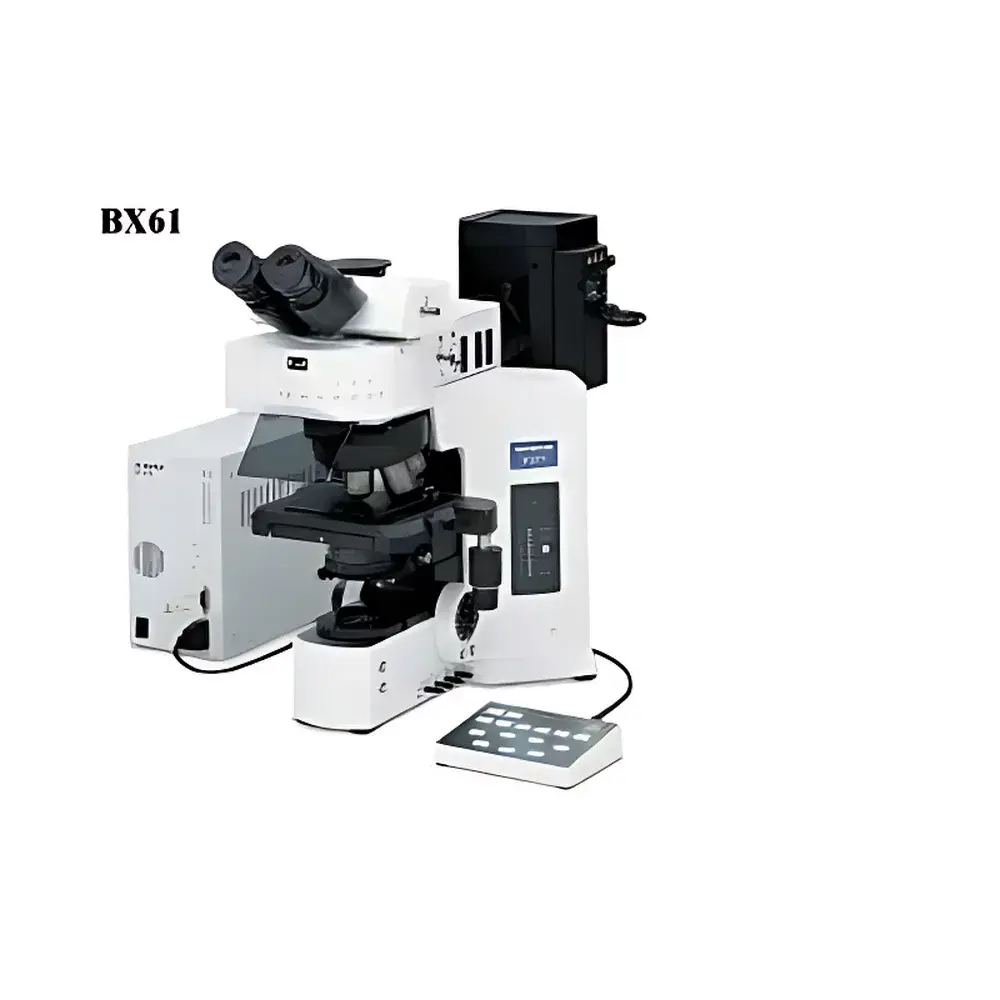
OLYMPUS BX61 Fully Motorized Upright Metallurgical Microscope
| Brand | OLYMPUS |
|---|---|
| Origin | Japan |
| Model | BX61 |
| Optical System | UIS2 Infinity-Corrected |
| Illumination | Reflected & Transmitted (100 W Halogen, 100 W Mercury, 75 W Xenon) |
| Focus Drive | Motorized (35 mm Travel, 0.01 µm Fine Adjustment Resolution) |
| Objective Turret | Motorized 5- or 6-Position (Brightfield/Darkfield/DIC-Compatible) |
| Stage Travel | 76 × 52 mm (standard) or 100 × 105 mm (4-inch wafer stage) |
| DIC Compatibility | U-DICR, U-DICRH, U-DICRHC Prism Sets |
| Eyepiece Field Number | 22 (wide-field) or 26.5 (super-wide-field) |
| Weight | 25.5 kg (standard configuration) |
| Dimensions | 317.5 × 602 × 541 mm (W × D × H) |
Overview
The OLYMPUS BX61 is a research-grade, fully motorized upright metallurgical microscope engineered for high-precision microstructural analysis of opaque, reflective specimens—including metals, alloys, ceramics, composites, and semiconductor wafers. It employs the UIS2 (Universal Infinite System 2) infinity-corrected optical platform, delivering exceptional image fidelity across UV–VIS–NIR wavelengths (extending from 340 nm to 1000 nm), enabling consistent performance in brightfield, darkfield, differential interference contrast (DIC), simple polarization, and fluorescence modalities. Its dual-path optical design supports both reflected-light observation (essential for polished metallographic samples) and transmitted-light imaging (e.g., for thin-sectioned inclusions or transparent coatings), with seamless switching between illumination modes via motorized control units. The system’s mechanical stability, thermal drift compensation, and rigorous chromatic/aberration correction ensure repeatable, quantitative imaging—critical for ASTM E3, ISO 643, and USP compliant microstructural evaluation.
Key Features
- UIS2 Infinity-Optimized Optics: Delivers high signal-to-noise ratio (S/N), >92% light transmission efficiency, and neutral color fidelity across magnifications—from 5× to 100×—with minimal wavefront distortion and uniform pupil alignment across all objective classes.
- Fully Motorized Core Functions: Integrated motorized focus drive (35 mm vertical travel, 0.01 µm fine-step resolution), motorized nosepiece (5- or 6-position, center-output or standard configurations), motorized brightfield/darkfield/DIC illumination turret, and motorized analyzer/polarizer sliders enable reproducible, protocol-driven workflows.
- Dynamic Auto-Focus System: Optional reflection-mode dynamic autofocus unit supports objectives up to 150×, utilizing multi-point laser triangulation for real-time Z-axis stabilization across large-area scans and time-lapse sequences—ideal for automated grain boundary mapping or phase distribution quantification.
- Ergonomic Human-Centered Design: Tilting binocular or trinocular observation tubes (10°–30° inclination) reduce cervical strain during extended sessions; standardized interpupillary distance adjustment and diopter compensation support GLP-compliant operator documentation.
- DIC Flexibility & Standardization: Three interchangeable UIS2-compatible DIC prism sets—U-DICR (universal), U-DICRH (high-resolution), and U-DICRHC (high-contrast)—are optimized for specific specimen topographies; unified exit pupil position eliminates recentering when changing magnification.
Sample Compatibility & Compliance
The BX61 accommodates specimens up to 25 mm in height and 100 × 105 mm in planar dimension (with optional 4-inch wafer stage U-WHP2), supporting standard metallographic mounts, embedded cross-sections, PCB substrates, and coated optical components. Its illumination architecture complies with IEC 61000-4-3 (EMC immunity) and JIS Z 8121 (microscopy terminology). For regulated environments, the system supports audit-trail-enabled operation when paired with analySIS FIVE software under FDA 21 CFR Part 11-compliant configurations—including electronic signatures, user-level access control, and immutable acquisition metadata logging. All optical components meet ISO 10110 surface quality standards (scratch-dig ≤ 10-5), and mechanical stages conform to ISO 9283 repeatability specifications (<1.5 µm positional deviation over full travel).
Software & Data Management
The BX61 integrates natively with analySIS FIVE (Olympus’ GxP-ready image analysis suite), enabling synchronized hardware control, multi-channel fluorescence acquisition, Z-stack reconstruction, and automated particle/grain measurement per ASTM E112 and ISO 13007. The software supports TIFF/OME-TIFF export with embedded EXIF-style metadata (objective ID, magnification, exposure, DIC bias voltage, illumination intensity), ensuring traceability for ISO/IEC 17025-accredited laboratories. Remote operation via Ethernet or USB 3.0 allows centralized instrument management in multi-user core facilities, while DIC parameter calibration files are stored per-objective—guaranteeing inter-operator consistency in quantitative contrast analysis.
Applications
- Quantitative metallography: Grain size distribution (ASTM E112), inclusion rating (ASTM E45), phase fraction analysis (ferrite/austenite/martensite)
- Semiconductor process control: Wafer defect inspection, CMP residue mapping, solder joint integrity assessment
- Failure analysis: Crack propagation path identification, intergranular corrosion visualization, thermal fatigue morphology characterization
- Advanced materials R&D: Oxide scale thickness measurement on high-temperature alloys, coating delamination depth profiling, ceramic grain boundary segregation analysis
- Forensic metallurgy: Toolmark comparison, bullet jacket microstructure correlation, fire-damaged component analysis
FAQ
Is the BX61 compatible with third-party camera systems?
Yes—the BX61 features standardized C-mount and F-mount adapters, supporting scientific CMOS and sCMOS cameras from Hamamatsu, PCO, and Andor, with trigger synchronization via TTL or USB.
Can the system be validated for GMP/GLP environments?
Yes—when configured with analySIS FIVE in audit mode, the BX61 meets requirements for instrument qualification (IQ/OQ/PQ), including calibration certificate traceability to NIST standards and electronic record retention per Annex 11.
What is the maximum usable magnification with DIC on reflective samples?
The UIS2 DIC optics support stable, high-contrast imaging up to 100× (100×/0.95 NA objective); higher magnifications (e.g., 150×) require dedicated reflection-mode DIC prisms and are limited to qualitative topographic assessment.
Does the motorized stage support coordinate-mapped stitching?
Yes—analySIS FIVE provides automated mosaic acquisition with sub-pixel registration accuracy, supporting area coverage up to 10 × 10 mm² at 100× magnification with <0.5 µm stitching error.
Are replacement UIS2 objectives available with apochromatic correction?
Yes—OLYMPUS offers apochromat-grade UIS2 objectives (e.g., UPLSAPO series) with corrected spherical/chromatic aberration from 340–1000 nm, suitable for hyperspectral reflectance mapping and UV-excited fluorescence.



