
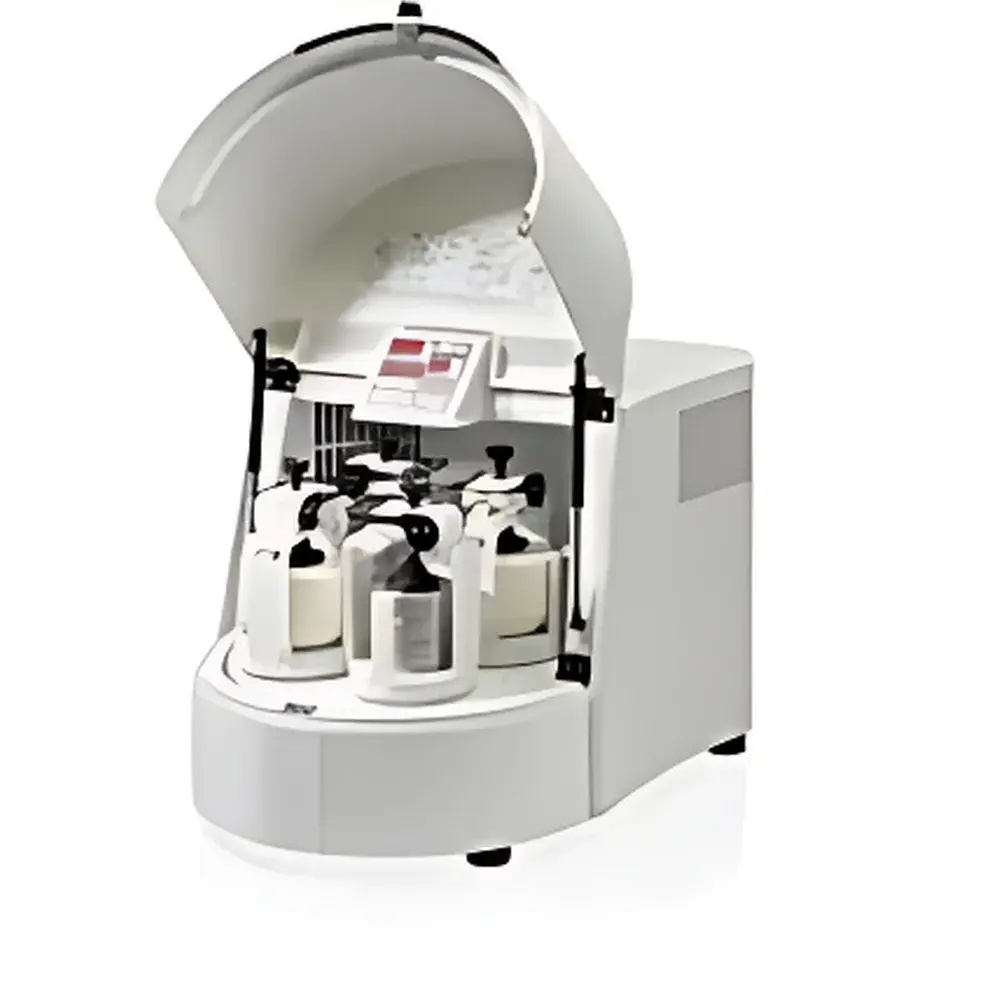
Fritsch PULVERISETTE 5 Premium Planetary Micro Mill
| Brand | Fritsch |
|---|---|
| Origin | Germany |
| Model | PULVERISETTE 5 |
| Sample Type | Hard to brittle materials, suspensions |
| Feed Size | ≤10 mm |
| Final Particle Size | <1 µm |
| Batch Volume per Jar | 10–225 mL × 4 |
| Grinding Modes | Dry & Wet |
| Inert Atmosphere Compatible | Yes |
| Power Supply | 100–240 V, 50–60 Hz, 880 W |
| Net Weight | 120 kg |
| Dimensions (W×H×D) | 58×67×57 cm |
| Noise Level (250 mL jar, 10 mm balls) | ~70 dB(A) |
| Optional GTM Integration | Yes |
| Jar Volumes | 80 / 250 / 500 mL |
| Ball Diameters | 3, 5, 10, 15, 20, 30, 40 mm |
| Jar & Ball Materials | Agate, Silicon Nitride, Alumina, Zirconia, Stainless Steel, Tempered Steel, Tungsten Carbide |
Overview
The Fritsch PULVERISETTE 5 Premium Planetary Micro Mill is a high-energy laboratory grinding system engineered for reproducible, contamination-controlled size reduction of hard, brittle, fibrous, and temperature-sensitive materials. First patented by Fritsch in 1962, this four-jar planetary mill operates on the principle of combined rotational and orbital motion—where grinding jars rotate on their own axes while simultaneously revolving around a central sun wheel. This dual-motion mechanism generates centrifugal accelerations up to 22 g, enabling intense impact, shear, and friction forces between grinding media and sample. The result is rapid, uniform comminution down to sub-micron particle sizes (<1 µm), with exceptional batch-to-batch consistency required for analytical sample preparation, nanomaterial synthesis, and mechanosynthetic process development.
Key Features
- Four independent grinding stations allow parallel processing of up to eight samples (two per jar using dual-sample inserts), significantly improving throughput without cross-contamination.
- Precise digital control of grinding time (1 s resolution), pause intervals, and rotational speed (100–800 rpm) ensures full method reproducibility and optimization for diverse material classes.
- Integrated cooling interface supports external recirculating chillers or compressed-air cooling to manage thermal load during extended high-energy milling—critical for heat-sensitive pharmaceuticals, polymers, or reactive intermetallic systems.
- Sealed, gas-tight grinding jars compatible with inert atmosphere (N₂, Ar) purging prevent oxidation, hydrolysis, or pyrophoric reactions during mechanochemical synthesis or air-sensitive material processing.
- Seven certified grinding media materials—including agate, silicon nitride, zirconia, and tungsten carbide—enable selection based on hardness, chemical inertness, density, and contamination thresholds per application.
- Optional GTM (Gas Temperature & Pressure Monitoring) system provides real-time, in-situ measurement of internal jar temperature and pressure dynamics during operation—a unique capability for kinetic studies of solid-state reactions, decomposition pathways, or solvent-free mechanochemical transformations.
Sample Compatibility & Compliance
The PULVERISETTE 5 accommodates a broad spectrum of sample types: from quartz, ceramics, and metal alloys to pharmaceutical APIs, biological tissues, coal, geological matrices, and composite precursors. Its robust architecture meets ISO 17025-relevant requirements for analytical sample homogenization prior to XRD, SEM-EDS, laser diffraction, or ICP-MS analysis. When operated under GLP/GMP conditions, the instrument supports audit-ready documentation via optional software modules compliant with FDA 21 CFR Part 11 for electronic records and signatures. All jar and lid components are designed for autoclavable sterilization or solvent-based cleaning, minimizing carryover risk between batches.
Software & Data Management
The mill interfaces with Fritsch’s proprietary EASY研磨 software (v5.x), which enables method library creation, parameter logging, user access control, and automatic report generation (PDF/CSV). All operational parameters—including speed profiles, time stamps, energy input estimates, and GTM-derived thermal-pressure curves—are timestamped and stored with checksum verification. Data export supports integration into LIMS environments and complies with ALCOA+ principles (Attributable, Legible, Contemporaneous, Original, Accurate, Complete, Consistent, Enduring, Available) for regulated laboratories.
Applications
- Mechanical alloying and solid-state synthesis of nanostructured metals, intermetallics, and high-entropy alloys.
- Top-down nanomaterial production (e.g., graphene oxide exfoliation, layered double hydroxide delamination).
- Pharmaceutical solid-form screening: amorphization, cocrystal formation, and polymorph control via solvent-free grinding.
- Preparation of homogeneous reference materials for geochemical, metallurgical, and cementitious analysis.
- Activation of catalysts and functional fillers through surface defect engineering and lattice strain induction.
- Routine sample homogenization for elemental analysis (XRF, AAS, ICP-OES) where particle size distribution directly affects measurement accuracy.
FAQ
What is the maximum recommended continuous operating time per cycle?
Standard protocols support up to 99 hours 59 minutes per program; however, thermal management and jar integrity should be validated for extended runs (>4 h) using appropriate cooling strategies.
Can wet grinding be performed with volatile organic solvents?
Yes—provided jars are rated for solvent compatibility and sealed under appropriate vapor pressure limits; explosion-proof configurations are available upon request for Class I, Division 1 environments.
Is calibration traceable to national standards?
Rotational speed is factory-calibrated against NIST-traceable tachometric references; temperature sensors in GTM modules are certified to DIN EN 60751 Class A tolerance.
How is cross-contamination prevented between different sample types?
Each jar is independently removable and cleanable; dedicated media sets (e.g., agate for silicates, zirconia for ferrous samples) are recommended, and cleaning validation protocols align with ASTM E1847 for residue detection.
Does the system support remote monitoring or network integration?
Ethernet and USB interfaces enable local network deployment; OPC UA connectivity is available via optional industrial gateway for integration into automated lab infrastructure (e.g., Siemens Desigo, LabVantage).
Related Products



