
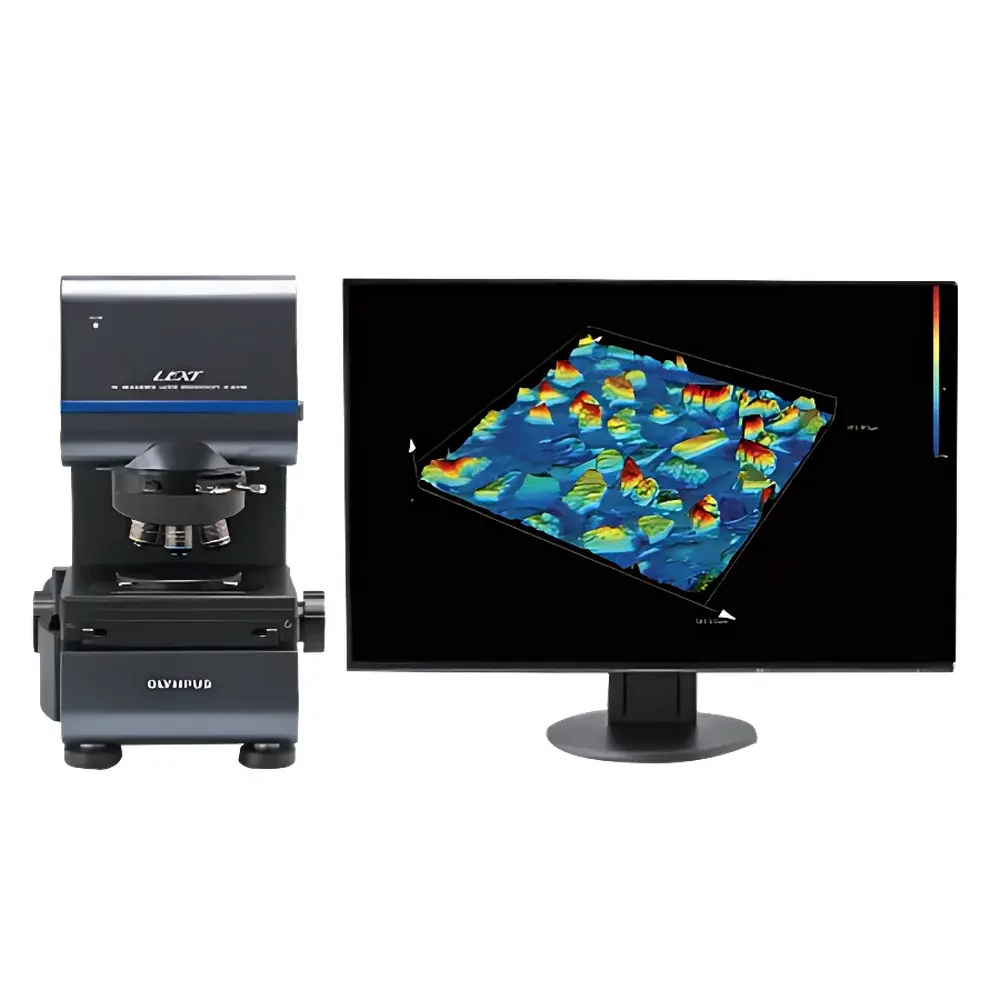
Olympus LEXT OLS5100 3D Laser Scanning Confocal Microscope
| Brand | Olympus |
|---|---|
| Origin | Japan |
| Model | OLS5100 |
| Excitation Wavelength | 405 nm |
| Optical Resolution (Lateral) | ≤ 120 nm |
| Vertical Resolution | ≤ 1 nm |
| Maximum Scan Area | 100 mm × 100 mm |
| Z-Range | Up to 10 mm |
| Software Platform | LEXT OS |
| Compliance | ISO 25178-2, ISO 4287, JIS B 0601, ASTM E2923 |
Overview
The Olympus LEXT OLS5100 is a high-precision 3D laser scanning confocal microscope engineered for non-contact, quantitative surface topography and roughness analysis in materials science, semiconductor R&D, precision manufacturing, and failure analysis laboratories. Unlike conventional optical microscopes or stylus profilometers, the OLS5100 employs dual-axis confocal laser scanning with a 405 nm violet semiconductor laser—optimized for high spatial coherence and minimal chromatic aberration—to achieve sub-micron lateral resolution (≤120 nm) and sub-nanometer vertical repeatability (≤1 nm). Its optical design follows the principle of point-by-point illumination and pinhole-confined detection, enabling true optical sectioning without physical contact or sample preparation. This architecture eliminates out-of-focus blur, delivers depth-resolved intensity profiles, and supports traceable, metrology-grade 3D surface reconstruction compliant with international standards including ISO 25178-2 (areal surface texture), ISO 4287 (profile-based roughness), and ASTM E2923 (laser scanning microscopy for dimensional metrology).
Key Features
- 405 nm confocal laser optics specifically engineered to minimize spherical and chromatic aberrations across the full field of view—ensuring faithful representation of surface geometry and edge fidelity.
- Motorized XYZ stage with 100 mm × 100 mm travel range and closed-loop Z-positioning for stable, repeatable large-area stitching and multi-scale hierarchical imaging.
- Smart Experiment Manager software module that automates acquisition workflows: users define measurement parameters (scan density, ROI, Z-step), and the system executes calibrated scans while logging metadata—including environmental timestamps, objective ID, laser power, and focus history—for GLP/GMP traceability.
- Smart Lens Advisor—a context-aware optical selection engine—that recommends optimal objective lenses (e.g., 10×, 20×, 50×, 100× LEXT series) based on required lateral resolution, working distance, and surface slope constraints—reducing operator-induced variability.
- Integrated vibration-damping base and thermal stabilization circuitry to maintain optical alignment stability during extended acquisitions (>30 min), critical for long-duration fatigue or creep surface monitoring.
Sample Compatibility & Compliance
The OLS5100 accommodates diverse sample types—including polished metals, sputtered thin films, MEMS devices, ceramic coatings, polymer composites, and brittle semiconductor wafers—without conductive coating or vacuum requirements. Its non-destructive nature makes it suitable for post-process inspection and in-line quality verification. All measurement algorithms are validated against NIST-traceable step-height standards and certified reference materials (e.g., VDI/VDE 2634 Part 2). The system supports audit-ready data export conforming to FDA 21 CFR Part 11 requirements when deployed with LEXT OS v5.2+ and optional electronic signature modules. Calibration certificates comply with ISO/IEC 17025-accredited procedures performed at Olympus’ Tokyo Metrology Center.
Software & Data Management
LEXT OS is a modular, Windows-based application platform delivering integrated acquisition, analysis, reporting, and database management. Core capabilities include: automated roughness parameter calculation per ISO 25178-2 (Sa, Sq, Sz, Sdr, etc.), cross-sectional profile extraction with statistical confidence intervals, grain boundary segmentation using adaptive thresholding, and trend visualization dashboards for longitudinal process monitoring. Raw data (32-bit float height maps, RGB + intensity channels) are stored in vendor-neutral HDF5 format with embedded EXIF-like metadata. Export options include CSV, STEP AP210, and PDF/A-2b reports with digital signatures and revision-controlled templates—fully compatible with enterprise LIMS and MES integration via OPC UA or RESTful API interfaces.
Applications
- Quantitative characterization of additive manufacturing surface defects (e.g., spatter, unmelted powder, layer delamination)
- Wafer-level inspection of CMP uniformity and trench profile fidelity in advanced packaging
- Wear track volumetric loss analysis in tribology testing (ASTM G133)
- Coating thickness mapping and interface roughness evaluation for thermal barrier systems
- Failure root-cause analysis of solder joint voids, wire bond lift-off, or die attach delamination
- Surface texture specification validation against automotive OEM standards (e.g., VW 60300, GMW14872)
FAQ
Does the OLS5100 require sample coating or vacuum operation?
No—its visible-range confocal laser enables direct imaging of conductive and non-conductive surfaces in ambient air without metallization or chamber evacuation.
Can measurement data be exported for third-party statistical process control (SPC)?
Yes—CSV and XML exports include full uncertainty budgets, GUM-compliant error propagation, and timestamped operator logs for SPC software integration.
Is the system compatible with ISO 17025 accredited calibration protocols?
Yes—Olympus provides factory calibration documentation aligned with ISO/IEC 17025:2017 and traceable to NMIJ (National Metrology Institute of Japan) standards.
What level of training and support is available for new users?
Olympus offers on-site installation qualification (IQ), operational qualification (OQ), and user competency workshops delivered by certified metrology engineers—with annual refresher courses and remote troubleshooting via secure TLS-encrypted session sharing.





