
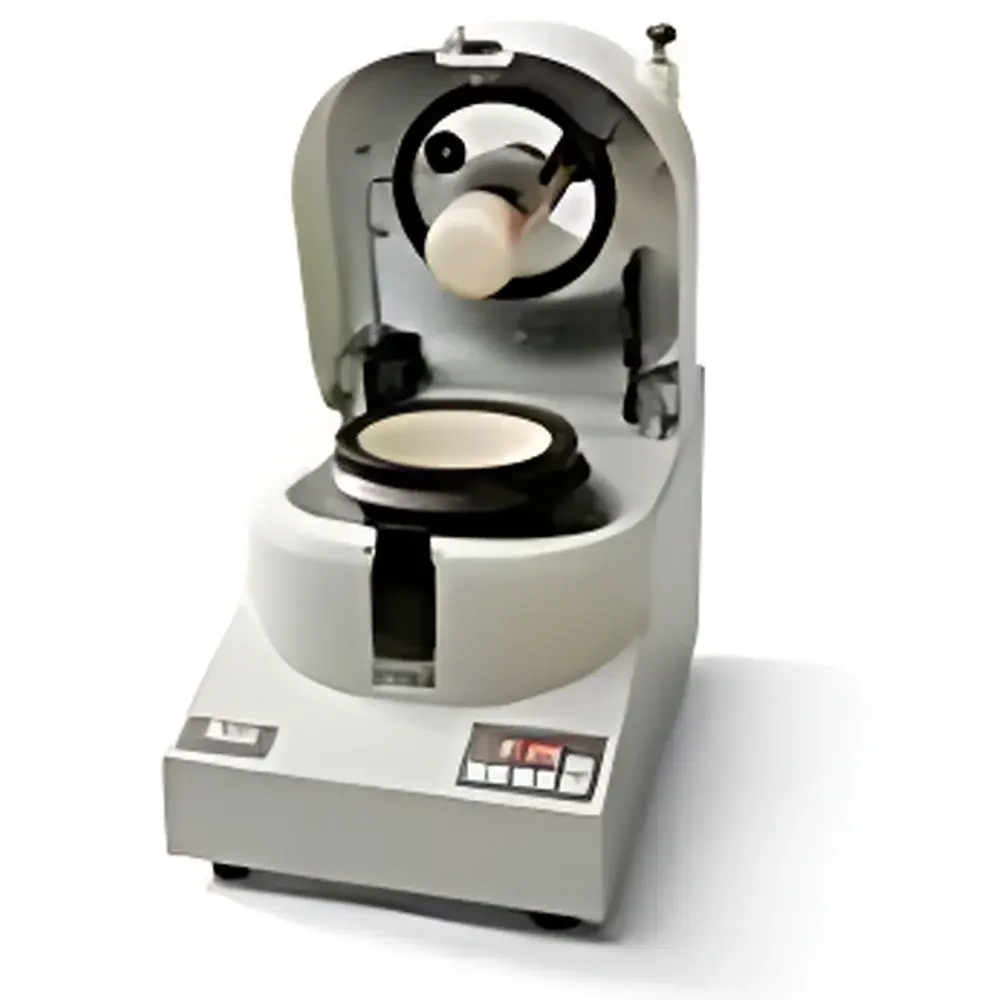
FRITSCH PULVERISETTE 2 Mortar Grinder
| Brand | FRITSCH |
|---|---|
| Origin | Germany |
| Model | PULVERISETTE 2 |
| Max. Feed Size | 8 mm |
| Processing Volume | 10–190 mL |
| Final Fineness | 10–20 µm |
| Motor Speed | ~70 rpm (50 Hz) / ~80 rpm (60 Hz) |
| Grinding Bowl ID/OD | 130 mm / 200 mm |
| Power Supply | 200–240 V, 1~ , 50–60 Hz, 250 W |
| Net Weight | 24 kg |
| Dimensions (L×W×H) | 31 × 46 × 41 cm |
| Safety Certification | EN 61010 compliant |
| Grinding Media Options | Agate, Alumina, Zirconia, Stainless Steel, Tempered Steel, Tungsten Carbide, Hard Ceramic |
Overview
The FRITSCH PULVERISETTE 2 Mortar Grinder is a precision-engineered laboratory grinding instrument based on the classical mortar-and-pestle principle. It operates via controlled mechanical compression and shear forces generated between a rotating pestle and a stationary grinding bowl—enabling reproducible size reduction of brittle, medium-hard to soft materials without thermal degradation or cross-contamination. Unlike high-energy impact mills, the PULVERISETTE 2 employs low-speed, high-torque grinding kinetics, minimizing amorphization and preserving crystalline integrity—critical for X-ray fluorescence (XRF), X-ray diffraction (XRD), and geochemical sample preparation. Designed and manufactured in Germany, the instrument meets the stringent safety requirements of EN 61010-1 for electrical equipment used in laboratory environments, ensuring operational reliability under routine QC, R&D, and regulatory-compliant workflows.
Key Features
- Low-speed, high-torque grinding mechanism (~70 rpm at 50 Hz; ~80 rpm at 60 Hz) ensures minimal heat generation and structural preservation of thermally sensitive or polymorphic samples.
- Digital control panel with real-time speed display and programmable grinding time (0.01–99.99 min) enables precise method reproducibility across operators and shifts.
- Transparent polycarbonate observation window allows visual monitoring of grinding progress without interrupting operation or compromising containment.
- Tool-free, snap-fit grinding bowl assembly—facilitates rapid disassembly, cleaning, and media exchange in accordance with GLP/GMP hygiene protocols.
- Dust-tight sealing system prevents sample loss and operator exposure, supporting ISO 17025-compliant weighing and trace-level analysis.
- Cryogenic compatibility: liquid nitrogen or other cryogens can be introduced directly into the grinding bowl prior to operation for embrittlement of elastomers, polymers, or biological tissues.
- Modular grinding media selection—including agate (for ultra-low contamination in trace metal analysis), zirconia (high wear resistance), tungsten carbide (for abrasive ores), and stainless steel (for general-purpose use)—ensures material-specific optimization.
Sample Compatibility & Compliance
The PULVERISETTE 2 accommodates dry solids, suspended particulates, pastes, clays, and semi-solid matrices within a 10–190 mL processing range. Its gentle yet effective comminution is validated for pharmaceutical excipients (e.g., lactose, microcrystalline cellulose), soil aggregates (per ASTM D422 and ISO 11277), mineral standards (e.g., NIST SRM soils), ceramic powders, metallurgical slags, and food-grade botanicals. All contact surfaces are non-reactive and fully autoclavable (where compatible with media choice). The unit conforms to EN 61010-1 for electrical safety and supports audit-ready documentation when integrated with validated SOPs—making it suitable for laboratories operating under FDA 21 CFR Part 11, ISO/IEC 17025, or EU GMP Annex 11 frameworks.
Software & Data Management
While the PULVERISETTE 2 operates via standalone digital controls, its time- and speed-based parameters are fully documentable in laboratory notebooks or LIMS-integrated electronic records. Optional FRITSCH LabSoft software (available separately) enables remote parameter logging, batch tracking, and export of timestamped grinding logs in CSV format—supporting data integrity requirements per ALCOA+ principles. All settings are retained after power cycling, eliminating reconfiguration errors during multi-batch runs.
Applications
- XRF and XRD sample preparation for geological surveys, environmental monitoring, and mining QA/QC.
- Homogenization of pharmaceutical tablets and granules prior to dissolution or content uniformity testing (USP & Ph. Eur. compliant).
- Particle size reduction of catalysts, battery electrode materials, and nanocomposites for SEM/TEM characterization.
- Preparation of certified reference materials (CRMs) requiring minimal phase transformation or elemental redistribution.
- Routine grinding of agricultural soils, sediments, and sludge samples for heavy metal analysis (EPA Method 6010D, ISO 11466).
FAQ
What types of samples are unsuitable for the PULVERISETTE 2?
Highly fibrous, elastic, or extremely ductile materials (e.g., raw rubber, certain polymers) may not fracture efficiently under compressive shear alone and require pre-chilling or alternative milling methods.
Can the instrument be used for wet grinding?
Yes—the PULVERISETTE 2 supports wet grinding with solvents or dispersants, provided the grinding media and bowl are chemically compatible and sealed appropriately to prevent leakage.
Is calibration required before use?
No routine calibration is mandated; however, periodic verification of timer accuracy and rotational speed (using an external tachometer) is recommended for ISO/IEC 17025 compliance.
How is cross-contamination prevented between samples?
By selecting inert grinding media (e.g., agate or zirconia), performing thorough mechanical cleaning between runs, and utilizing the dust-tight seal to eliminate airborne carryover.
Does FRITSCH provide validation documentation for regulated labs?
Yes—Factory Acceptance Test (FAT) reports, EN 61010 test certificates, and material declarations (RoHS, REACH) are supplied with each unit; IQ/OQ protocols are available upon request.



