
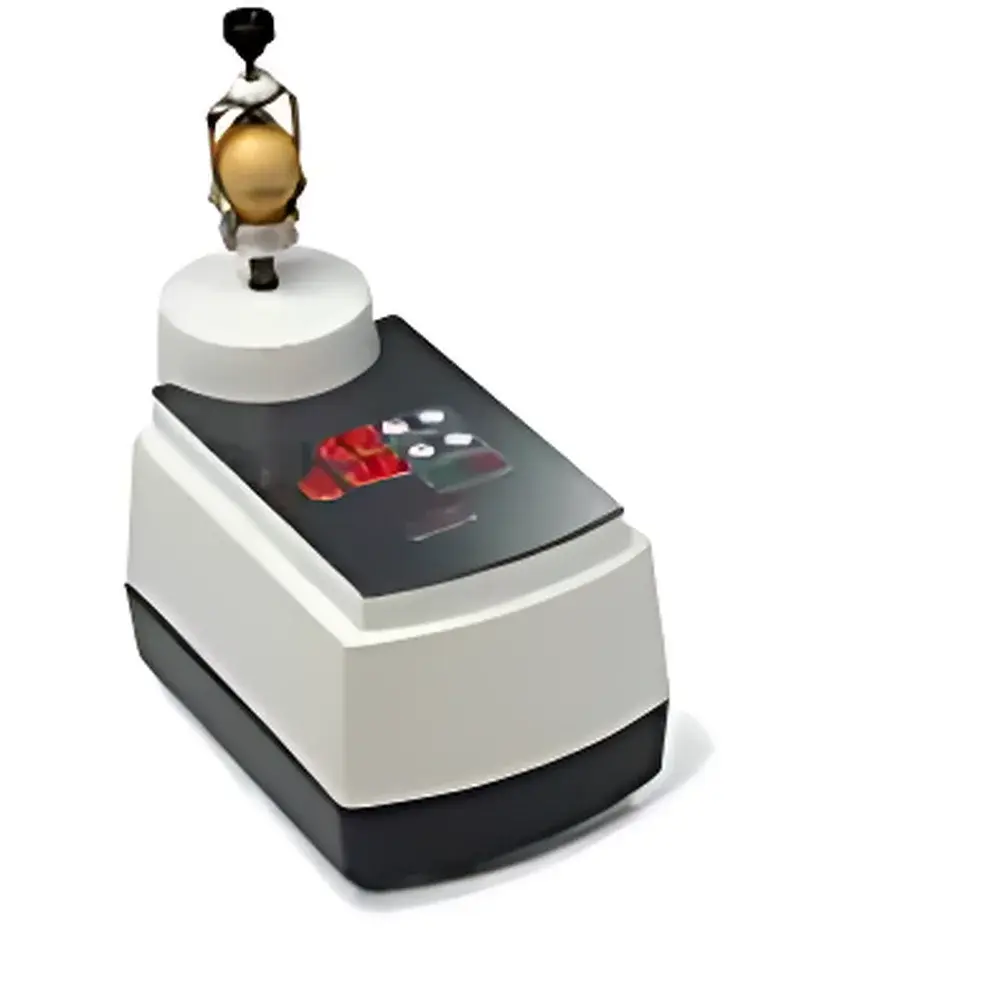
Fritsch PULVERISETTE 23 Mini Planetary Micro Mill
| Brand | Fritsch |
|---|---|
| Origin | Germany |
| Model | PULVERISETTE 23 |
| Max. Feed Size | 6 mm |
| Max. Sample Volume | 5 mL |
| Final Particle Size | ≤5 µm |
| Grinding Bowl Volumes | 5 / 10 / 15 mL |
| Grinding Ball Diameters | 3 / 5 / 10 / 15 mm |
| Grinding Modes | Dry & Wet |
| Dimensions (W×D×H) | 20 × 30 × 30 cm |
| Vibration Frequency | 900–3000 rpm |
| Amplitude | 9 mm |
| Net Weight | 7 kg |
| Bowl & Ball Materials | Zirconia, Stainless Steel, Hardened Steel, PTFE, Agate |
Overview
The Fritsch PULVERISETTE 23 Mini Planetary Micro Mill is a high-precision, vertically vibrated micro-grinding instrument engineered for reproducible sample homogenization and particle size reduction in analytical laboratories. Unlike conventional planetary ball mills, the PULVERISETTE 23 operates on a vertical oscillation principle—where grinding bowls and balls undergo controlled, high-frequency linear vibration along the vertical axis—generating intense impact and shear forces between the grinding media and sample. This mechanism ensures efficient comminution of minute quantities (as low as 0.01 g) while minimizing thermal load and cross-contamination. Designed specifically for trace-level and temperature-sensitive applications—including enzymatic, proteomic, and forensic workflows—the instrument supports cryogenic operation (e.g., placement inside refrigerated environments or use with liquid nitrogen-cooled bowls), preserving labile biomolecular integrity during mechanical disruption.
Key Features
- Vertical oscillation drive system delivering precise, adjustable vibration frequencies from 900 to 3000 rpm with a fixed 9 mm amplitude—enabling tunable energy input for diverse material hardness and brittleness.
- Digital control interface with intuitive parameter setting (time, speed, pause intervals) and real-time status feedback—ensuring protocol repeatability across users and shifts.
- Compact footprint (20 × 30 × 30 cm) and low operational vibration—permitting benchtop deployment in laminar flow hoods, cold rooms, or shared instrumentation spaces without structural reinforcement.
- Modular grinding assembly: interchangeable bowls (5 / 10 / 15 mL volumes) and spherical media (3 / 5 / 10 / 15 mm diameters) in five chemically inert and wear-resistant materials—zirconium oxide, stainless steel, hardened steel, PTFE, and agate—to prevent sample contamination and accommodate aggressive solvents or reactive matrices.
- Validated compatibility with both dry grinding and wet dispersion protocols—supporting slurry preparation for subsequent XRD, SEM-EDS, or ICP-MS analysis without intermediate transfer steps.
- Optimized for ultra-low-volume processing: maximum feed size of 6 mm and final particle size distribution consistently ≤5 µm (D90), meeting requirements for chromatographic column packing, MALDI matrix co-crystallization, and nanoparticle synthesis precursor homogenization.
Sample Compatibility & Compliance
The PULVERISETTE 23 demonstrates broad applicability across heterogeneous sample classes—from soft biological tissues (hair, leaves, root segments) and hydrated polymers to hard minerals, ceramics, and pharmaceutical excipients. Its ability to process samples under sub-zero conditions makes it suitable for RNA/DNA extraction workflows where RNase inhibition is critical. All grinding components comply with ISO 8504-2 for surface finish consistency and EU Directive 2014/30/EU (EMC) for electromagnetic compatibility. While not certified as GMP-compliant out-of-the-box, the mill’s traceable parameter logging (via optional PC interface), non-porous bowl geometry, and tool-free disassembly support GLP-aligned documentation practices required for regulated environments such as forensic toxicology labs or contract research organizations conducting ASTM E2927-19–based trace evidence preparation.
Software & Data Management
The instrument operates via embedded firmware with local digital display; no proprietary software is required for basic operation. For advanced data governance, an optional RS-232 or USB interface enables integration into laboratory information management systems (LIMS). Parameter sets—including duration, frequency, rest cycles, and bowl identification—can be exported as CSV logs for audit trails. When used in conjunction with validated SOPs, this functionality satisfies FDA 21 CFR Part 11 requirements for electronic records and signatures in quality-controlled settings, particularly when paired with timestamped operator authentication protocols.
Applications
- Pretreatment of forensic trace evidence (e.g., paint chips, textile fibers, gunshot residue) prior to GC-MS or SEM-EDS analysis.
- Homogenization of cryo-preserved tissue biopsies for quantitative proteomics or metabolomics profiling.
- Preparation of homogeneous pigment dispersions for colorimetric calibration standards in spectrophotometry.
- Routine milling of geological samples (clays, silicates, ores) for X-ray fluorescence (XRF) or XRD quantification.
- Size reduction of active pharmaceutical ingredients (APIs) and excipients in early-stage formulation development.
- Dispersion of nanomaterials (e.g., TiO₂, SiO₂) in aqueous or organic suspensions for dynamic light scattering (DLS) characterization.
FAQ
Can the PULVERISETTE 23 be operated inside a standard laboratory refrigerator?
Yes—its compact dimensions and minimal external vibration allow safe placement within refrigerated cabinets (2–8 °C) or cryocoolers (−20 °C), enabling temperature-controlled disruption of thermolabile proteins or nucleic acids.
Is cleaning validation supported for regulated environments?
The smooth, crevice-free interior surfaces of all bowl and lid components—especially zirconia and PTFE variants—facilitate automated solvent rinsing and visual inspection. Swab recovery studies per USP can be conducted using standardized ATP assays.
What is the typical service life of grinding balls under routine use?
Under standard dry grinding of medium-hardness materials (e.g., limestone, dried plant matter) at 2000 rpm for 2 min per cycle, zirconia balls (10 mm) typically maintain dimensional stability for ≥500 cycles before measurable wear affects reproducibility.
Does Fritsch provide application-specific method development support?
Yes—Fritsch Application Laboratories offer remote consultation and documented grinding protocols for over 200 material classes, including ISO/IEC 17025–accredited validation reports upon request.



