
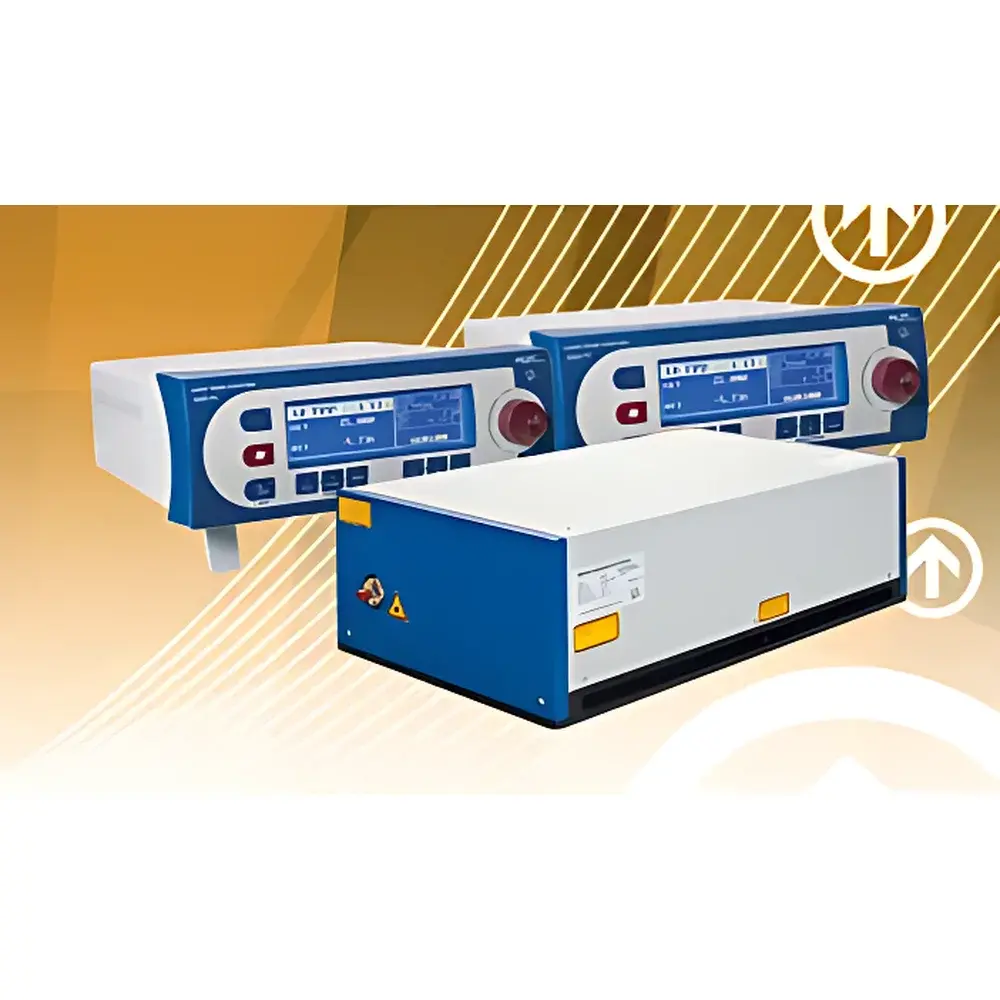
Sacher TEC-520-1550 Mode-Hop-Free Tunable Semiconductor Laser
| Brand | Sacher Lasertechnik |
|---|---|
| Origin | Germany |
| Model | TEC-520-1550 |
| Wavelength | 1550 nm |
| Tuning Range | Mode-hop-free over >35 GHz (typ.) |
| Linewidth | <100 kHz (1 ms) |
| Output Power | Up to 100 mW |
| Output Options | Free-space and fiber-coupled variants available |
| Control Interfaces | GPIB, RS232, USB |
| Cavity Type | Littman-Metcalf external cavity diode laser (ECDL) |
Overview
The Sacher TEC-520-1550 is a high-stability, mode-hop-free tunable semiconductor laser system engineered for precision spectroscopy, quantum optics, and metrology applications. Based on the Littman-Metcalf external cavity diode laser (ECDL) architecture, it integrates a distributed feedback (DFB) or gain chip with a high-finesse diffraction grating and piezoelectric transducer (PZT)-actuated end mirror to enable continuous, hysteresis-compensated wavelength scanning without mode hops. Operating at a nominal wavelength of 1550 nm—within the low-loss telecommunications C-band—the system delivers sub-100 kHz intrinsic linewidth (measured over 1 ms), exceptional long-term frequency stability (55 dB). Its solid-state design, hermetically sealed optical bench, and thermoelectrically cooled (TEC) laser diode ensure robustness against ambient thermal fluctuations and mechanical vibration—critical for cold atom experiments, optical frequency standards, and interferometric sensing.
Key Features
- Mode-hop-free tuning over ≥35 GHz (typical) via PZT-driven cavity length adjustment, enabling uninterrupted spectral scans for Doppler-free spectroscopy and cavity ring-down measurements
- Narrow intrinsic linewidth <100 kHz (1 ms measurement bandwidth), optimized for high-resolution absorption spectroscopy and coherent detection schemes
- Output power up to 100 mW in free-space configuration; fiber-coupled versions support polarization-maintaining (PM) or single-mode (SM) delivery with >70% coupling efficiency
- Integrated low-noise current driver and dual-stage TEC controller with milli-Kelvin temperature stability (±0.005 °C)
- Full remote operation via industry-standard interfaces: IEEE-488 (GPIB), RS232, and USB 2.0—with SCPI command compliance for seamless integration into LabVIEW, Python, or MATLAB automation frameworks
- Modular mechanical design compliant with ISO 9001-certified manufacturing processes; RoHS-compliant materials and laser safety Class 3B certification (IEC 60825-1:2014)
Sample Compatibility & Compliance
The TEC-520-1550 is compatible with vacuum-compatible optical tables, ultra-high vacuum (UHV) chambers (via feedthrough-mounted collimators), and fiber-pigtailed quantum memory setups. Its 1550 nm emission aligns with standard telecom-grade components—including acousto-optic modulators (AOMs), electro-optic modulators (EOMs), and InGaAs photodetectors—enabling straightforward integration into existing optical infrastructure. The system meets IEC 60825-1:2014 (laser safety), EN 61326-1:2013 (EMC for laboratory equipment), and conforms to essential requirements of the EU Machinery Directive 2006/42/EC. For regulated environments, optional firmware supports audit-trail logging and user-access control in alignment with FDA 21 CFR Part 11 principles when used in GLP/GMP-compliant optical characterization workflows.
Software & Data Management
Sacher provides the proprietary LaserControl Suite, a Windows-based application offering real-time wavelength calibration (via built-in wavemeter interface or external reference cell), automated scan sequencing, and lock-in acquisition synchronization. All instrument parameters—including drive current, TEC setpoint, PZT voltage, and photodiode monitor output—are logged with timestamped metadata in HDF5 format, ensuring traceability and compatibility with FAIR data principles. API libraries (DLL and Python bindings) allow direct parameter access and closed-loop locking to atomic transitions (e.g., Rb D2 line at 780 nm via second-harmonic generation) or optical cavities. Export options include CSV, MATLAB .mat, and ASCII for post-processing in Origin, Igor Pro, or custom Python analysis pipelines.
Applications
- Atomic physics: Optical molasses, magneto-optical traps (MOTs), and Bose-Einstein condensate (BEC) preparation using 1550 nm as pump or repump source in conjunction with frequency-doubled systems
- High-resolution spectroscopy: Cavity-enhanced absorption spectroscopy (CEAS), noise-immune cavity-enhanced optical heterodyne molecular spectroscopy (NICE-OHMS), and photoacoustic detection of trace gases (e.g., CH₄, CO₂)
- Optical metrology: Absolute distance interferometry (ADI) and synthetic wavelength interferometry requiring sub-nanometer phase stability over multi-second acquisitions
- Nonlinear optics: Seed source for optical parametric oscillators (OPOs) and difference-frequency generation (DFG) systems targeting mid-IR wavelengths (3–12 µm)
- Fiber-optic sensing: Characterization of fiber Bragg gratings (FBGs), distributed acoustic sensing (DAS), and coherent optical time-domain reflectometry (C-OTDR)
- THz generation: Dual-laser beating for photoconductive antenna excitation in time-domain spectroscopy (TDS) platforms
FAQ
What is the typical mode-hop-free tuning range for the TEC-520-1550?
The device achieves ≥35 GHz continuous, hysteresis-compensated tuning at 1550 nm using PZT actuation; exact range depends on grating groove density and cavity alignment.
Is fiber coupling included as standard or optional?
Fiber coupling is configurable at order entry—either as free-space collimated output or with PM-fiber or SM-fiber pigtailing (FC/APC connector); coupling efficiency and polarization extinction ratio are specified per unit.
Can the laser be locked to an atomic reference line?
Yes—integrated modulation inputs and analog error signal outputs support Pound-Drever-Hall (PDH) or saturated absorption locking; software includes preconfigured lock templates for common transitions.
Does the system comply with FDA 21 CFR Part 11 for use in pharmaceutical QC labs?
While not a medical device, its optional audit-log firmware and role-based access control meet foundational Part 11 expectations for electronic records in regulated optical testing environments.
What cooling method is used for thermal stabilization?
Dual-stage thermoelectric coolers (TECs) maintain diode junction temperature within ±0.005 °C; no water cooling or external chillers are required.






