
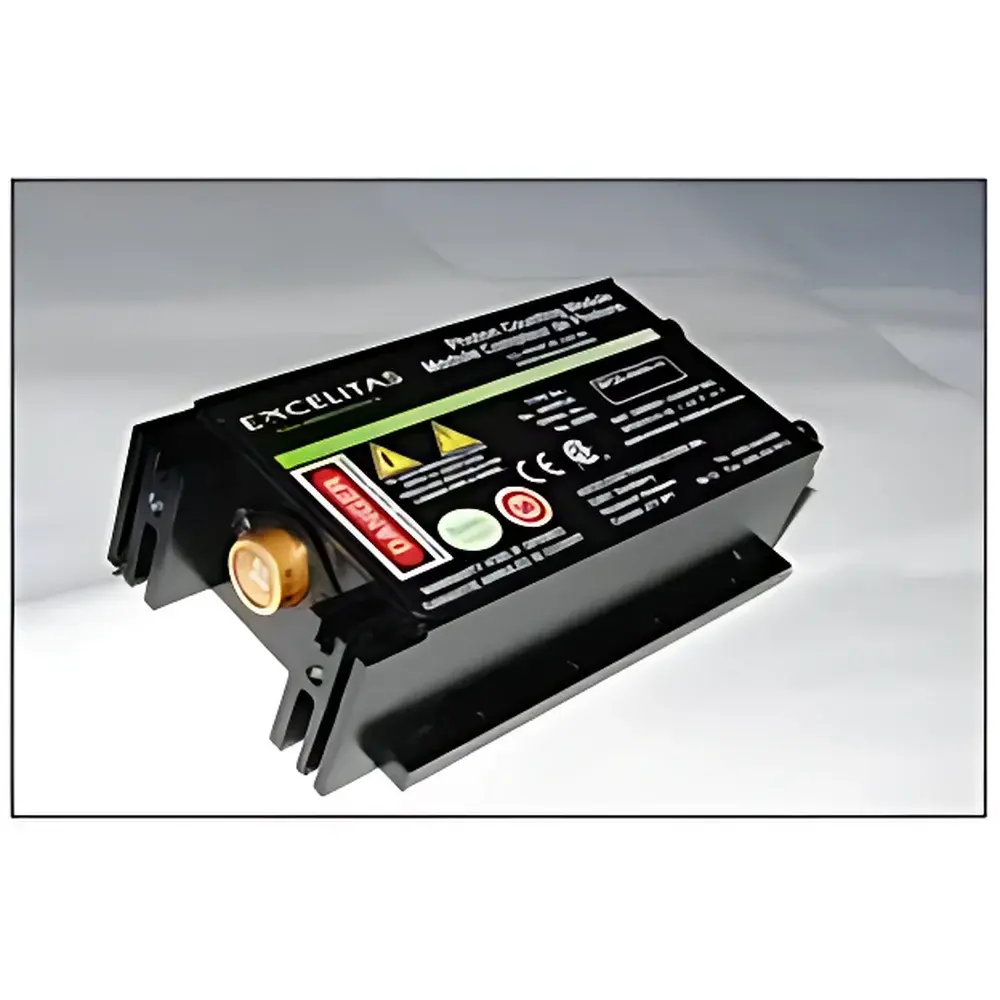
Excelitas SPCM-AQRH Series Single-Photon Counting Module
| Brand | Excelitas |
|---|---|
| Origin | Germany |
| Manufacturer Type | Authorized Distributor |
| Import Status | Imported |
| Model | SPCM-AQRH / SPCM-AQRH-XX-TR |
| Wavelength Range | 400–1060 nm |
| Peak Photon Detection Efficiency (PDE) | >70% @ 700 nm (standard) |
| Active Area Diameter | 180 µm |
| Timing Resolution | <250 ps (TR variant) |
| Maximum Count Rate | >35 Mcps |
| Output | TTL-compatible, 50 Ω terminated via BNC |
| Power Supply | +5 V DC only |
| Operating Temperature Stability | Engineered for low-drift performance in lab environments |
Overview
The Excelitas SPCM-AQRH Series Single-Photon Counting Module is a high-performance, solid-state photodetector engineered for ultra-sensitive optical measurement applications requiring deterministic detection of individual photons. Based on silicon avalanche photodiode (Si APD) technology operating in Geiger mode, the module leverages Excelitas’ proprietary SLiK™ (Silicon Low-Noise Kinetic) diode architecture to achieve exceptional photon detection efficiency (PDE), temporal fidelity, and signal-to-noise ratio across the visible to near-infrared spectrum (400–1060 nm). Unlike traditional photomultiplier tubes (PMTs), the SPCM-AQRH offers superior quantum efficiency in the red–NIR region, compact form factor, immunity to magnetic fields, and simplified biasing—making it ideal for integration into confocal microscopy, time-correlated single-photon counting (TCSPC), fluorescence lifetime imaging (FLIM), quantum optics experiments, and LIDAR calibration systems. The standard SPCM-AQRH and its time-optimized variant (SPCM-AQRH-XX-TR) are both designed for stable, reproducible operation under controlled laboratory conditions and comply with industrial-grade thermal management and long-term gain stability requirements.
Key Features
- High photon detection efficiency: >70% at 700 nm (standard model); >75% at 650 nm (TR variant), enabling optimal sensitivity for common fluorophores and telecom-wavelength sources
- Sub-250 ps timing resolution (SPCM-AQRH-XX-TR), optimized for TCSPC and ultrafast lifetime measurements with minimal instrument response function (IRF) broadening
- 180 µm circular active area—engineered for uniform PDE distribution and compatibility with diffraction-limited optical coupling
- True digital output: TTL-level pulses per detected photon, directly compatible with time-to-digital converters (TDCs), time-interval analyzers, and FPGA-based acquisition systems
- Single +5 V DC power supply simplifies system integration and eliminates need for high-voltage generators or temperature stabilization circuits
- Ruggedized hermetic packaging with integrated thermoelectric cooling control interface (optional), supporting long-term operational stability and low dark count rate (<50 cps typical at 20 °C)
- RoHS-compliant construction and lead-free soldering process aligned with EU Directive 2011/65/EU
Sample Compatibility & Compliance
The SPCM-AQRH series supports direct coupling to fiber-optic pigtails (FC/PC or SMA), free-space collimated beams, and microscope emission paths via C-mount or custom adapters. Its spectral response enables quantitative detection of photons from organic dyes (e.g., Alexa Fluor 647, Cy5), quantum dots, NV centers in diamond, and InGaAs-based pulsed lasers. The module conforms to IEC 61000-6-3 (EMC emission standards) and IEC 61000-6-2 (immunity), and its electrical interface complies with IEEE 1149.1 (JTAG) test access provisions for embedded diagnostics. While not certified for medical device use under ISO 13485, it is routinely deployed in GLP-compliant research labs where traceable calibration protocols (e.g., NIST-traceable attenuated LED sources) are applied per internal SOPs. Full documentation—including factory calibration reports, spectral responsivity curves, and dark count vs. temperature data—is provided with each unit.
Software & Data Management
The SPCM-AQRH operates as a hardware-level photon event generator; no proprietary driver stack is required for basic TTL pulse acquisition. It integrates natively with industry-standard platforms including National Instruments DAQmx, Becker & Hickl SPC-150NX firmware, PicoQuant TimeHarp 260 drivers, and open-source Python libraries (e.g., pyqtgraph, numpy) via counter/timer input channels. For TCSPC workflows, the module supports hardware synchronization with laser pulsers (e.g., PicoQuant LDH-P-C-470) using external gate and start/stop signals. Audit-trail functionality—including timestamped acquisition logs, firmware version tracking, and user-defined metadata tagging—is achievable when paired with compliant data acquisition software meeting FDA 21 CFR Part 11 requirements (e.g., LabVIEW with NI DIAdem or MATLAB with Simulink Test).
Applications
- Time-resolved fluorescence spectroscopy and lifetime mapping in biological tissues and thin-film semiconductors
- Quantum key distribution (QKD) receiver modules and entanglement verification setups
- Confocal and multiphoton microscopy photon-starved imaging modalities
- Calibration of radiometric standards and transfer standards for national metrology institutes
- Low-light-level reflectometry and interferometric displacement sensing in vacuum environments
- Development and validation of single-photon sources (e.g., quantum dots, color centers, SPDC crystals)
FAQ
What is the maximum recommended count rate before significant dead-time losses occur?
At >35 Mcps, the module exhibits measurable paralyzable behavior; for quantitative accuracy, operation below 20 Mcps is advised when absolute photon flux calibration is required.
Can the SPCM-AQRH be used without active cooling?
Yes—the module is specified for ambient operation (15–30 °C) with integrated passive thermal design; however, dark count rate increases by ~2× per 10 °C rise above 20 °C.
Is the output pulse width adjustable?
No—the TTL pulse width is fixed at ~10 ns nominal; external pulse shaping or discrimination must be implemented at the acquisition stage.
Does Excelitas provide NIST-traceable calibration certificates?
Yes—certificates of calibration (including PDE vs. wavelength, dark count rate, and timing jitter) are available upon request and conform to ISO/IEC 17025:2017 requirements.
How does the SPCM-AQRH compare to PMT-based single-photon detectors in terms of afterpulsing?
The SLiK™ diode architecture reduces afterpulsing probability to <0.5% (at 10⁶ cps), significantly lower than typical fast-gated PMTs operating in analog mode.



