
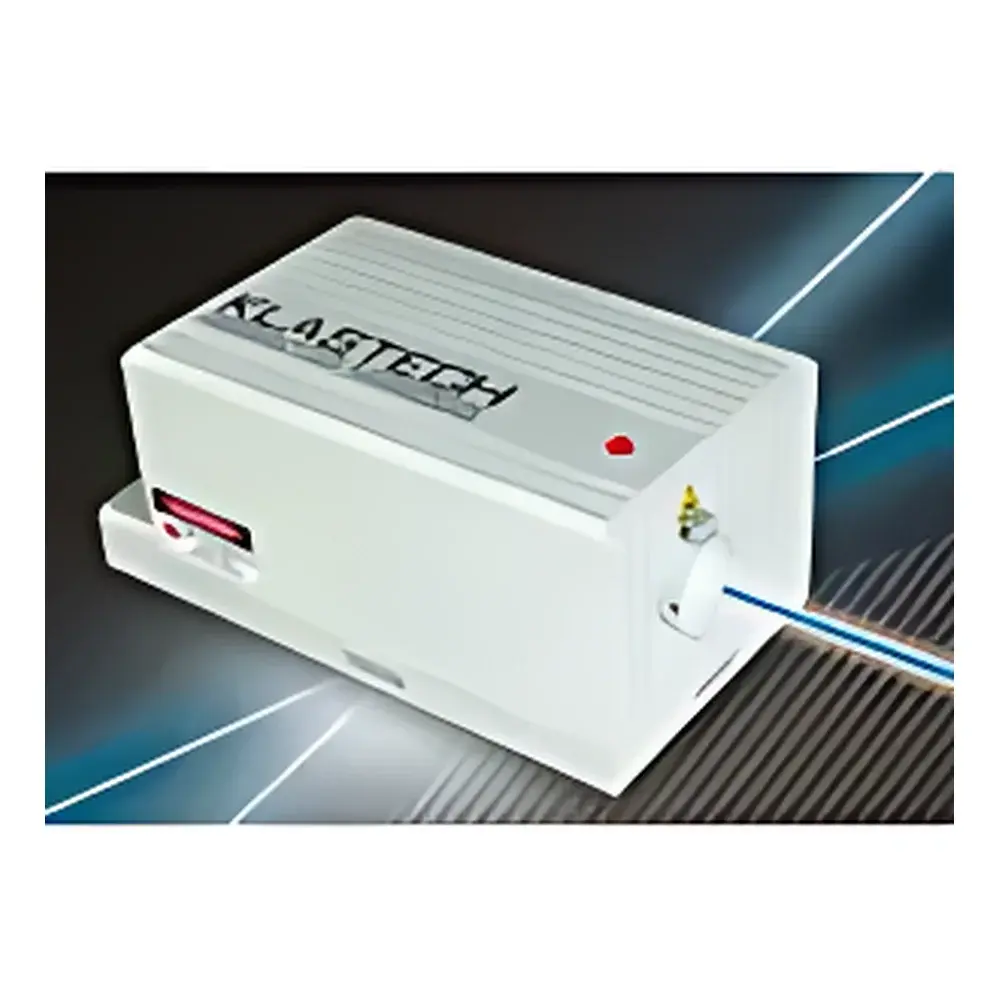
Blue Note® 488nm DPSS Blue Laser System
| Origin | USA |
|---|---|
| Manufacturer Type | Authorized Distributor |
| Origin Category | Imported |
| Model | Blue Note® 488nm |
| Pricing | Available Upon Request |
| Wavelength | 488 nm ±0.5 nm |
| Output Power (CW) | 100 mW |
| Beam Diameter | 1.2 mm ±0.2 mm @ 10 mm (1/e²) |
| Spatial Mode | TEM₀₀, M² < 1.1 |
| Beam Divergence | <1 mrad (½ angle) |
| Beam Pointing Stability | ≤10 μrad / °C |
| Longitudinal Mode | Single Longitudinal Mode (SLM) |
| Polarization | Vertical, Extinction Ratio ≥100:1 |
| Intensity Noise (p-p) | ≤3 % (10 Hz–2 MHz) |
| Intensity Noise (rms) | ≤0.5 % (10 Hz–2 MHz) |
| Power Stability | ≤2 % over 4 hours |
| Operating Temperature | 15–35 °C |
| Storage Temperature | 10–50 °C |
| Laser Head Dimensions | Not Specified |
| Laser Head Weight | 5720 g |
| Power Supply Dimensions (L×W×H) | 175×104×45 mm |
| Power Supply Weight | 740 g |
Overview
The Blue Note® 488nm DPSS Blue Laser System is a solid-state, diode-pumped continuous-wave (CW) laser engineered for high-stability, single-frequency operation at the critical 488 nm spectral line. Leveraging intracavity frequency-doubling of a Nd:YAG or Nd:YVO₄ fundamental wavelength (976 nm), this system delivers diffraction-limited TEM₀₀ output with exceptional beam quality (M² < 1.1) and intrinsic spectral purity—essential for applications demanding precise excitation, narrow linewidth, and long coherence length. Its SLM (Single Longitudinal Mode) architecture ensures minimal mode-hopping and sub-MHz linewidth, making it suitable for interferometric alignment, holographic recording, and coherent Raman techniques where phase stability directly impacts signal fidelity. Designed for integration into OEM instrumentation and research-grade platforms, the laser operates within tightly controlled thermal envelopes and incorporates active temperature stabilization to maintain wavelength accuracy (±0.5 nm) and pointing stability (≤10 μrad/°C) under laboratory or regulated manufacturing conditions.
Key Features
- Stable CW output at 488 nm with ±0.5 nm wavelength tolerance, traceable to NIST-calibrated spectrometers
- 100 mW nominal power with ≤2 % RMS power drift over 4-hour continuous operation—validated per ISO 11554
- Diffraction-limited beam profile (TEM₀₀) and M² < 1.1, enabling efficient coupling into single-mode fibers and high-NA microscope objectives
- Vertical linear polarization with extinction ratio ≥100:1, supporting polarimetric assays and polarization-resolved imaging
- Low-intensity noise performance: ≤0.5 % rms (10 Hz–2 MHz), critical for quantitative fluorescence correlation spectroscopy (FCS) and photon-counting applications
- Compact, air-cooled design with modular laser head (5720 g) and low-profile power supply (175 × 104 × 45 mm, 740 g), facilitating benchtop integration and cleanroom-compatible deployment
Sample Compatibility & Compliance
The Blue Note® 488nm laser is compatible with standard optical mounts (e.g., SM1-threaded housings), kinematic platforms, and OEM integration interfaces including TTL modulation input and analog power control (0–5 V). It meets IEC 60825-1:2014 Class 3B laser safety requirements when used with appropriate interlocks and beam enclosures. The system supports GLP/GMP-aligned workflows through optional digital logging of operational parameters (runtime, temperature setpoints, output power history) via RS-232 or USB interface—enabling audit-ready records per FDA 21 CFR Part 11 when paired with validated host software. No hazardous substances are employed in its construction; RoHS 3 and REACH compliance are certified by the original equipment manufacturer.
Software & Data Management
While the laser operates as a standalone analog-controlled source, full remote operation is supported via ASCII command protocol over RS-232 or USB virtual COM port. Compatible with LabVIEW™, MATLAB®, and Python-based control environments using PySerial or NI-VISA drivers. Optional firmware upgrades enable real-time monitoring of internal thermistor readings, diode current feedback, and interlock status—data streams timestamped and exportable as CSV for trending analysis. All configuration settings persist across power cycles, and factory calibration constants are stored in non-volatile memory to ensure repeatability across instrument lifecycles.
Applications
- Confocal Microscopy: Excitation of Alexa Fluor 488, FITC, GFP, and other common fluorophores with minimal photobleaching due to stable low-noise output
- Flow Cytometry: High-sensitivity cell sorting and multi-parameter immunophenotyping requiring consistent excitation intensity and polarization fidelity
- Raman Spectroscopy: Resonant enhancement for biological samples and carbon nanomaterials; narrow linewidth reduces spectral broadening in shifted bands
- Holography & Interferometry: Reference beam source for digital holographic microscopy (DHM) and dynamic speckle pattern analysis
- Optical Trapping: Stable gradient force generation in dual-beam or holographic optical tweezers systems
- Calibration Standards: Wavelength reference for spectrometer validation and metrology labs adhering to ISO/IEC 17025
FAQ
Is the Blue Note® 488nm laser compliant with FDA 21 CFR Part 11 for electronic records?
Yes—when operated with validated host software that implements audit trails, electronic signatures, and secure user access controls, the laser’s digital interface supports Part 11–compliant data acquisition.
Can the laser be modulated externally?
Yes—it accepts TTL-level modulation signals (0–5 V) for on/off gating up to 100 kHz, and analog voltage input (0–5 V) for linear power adjustment between 10–100 % of rated output.
What cooling method does the system use?
Passive convection and conductive cooling only; no forced air or liquid cooling is required, minimizing acoustic and vibrational interference in sensitive optical setups.
Is beam expansion or collimation included?
No—the specified beam diameter (1.2 mm ±0.2 mm at 10 mm) is measured at the output aperture; external beam shaping optics must be selected based on application-specific divergence and focus requirements.
Does the system include a warm-up stabilization period specification?
Yes—full spectral and power stability is achieved within 15 minutes of cold start at 23 °C ambient, per manufacturer qualification testing documented in the Certificate of Conformance.




