
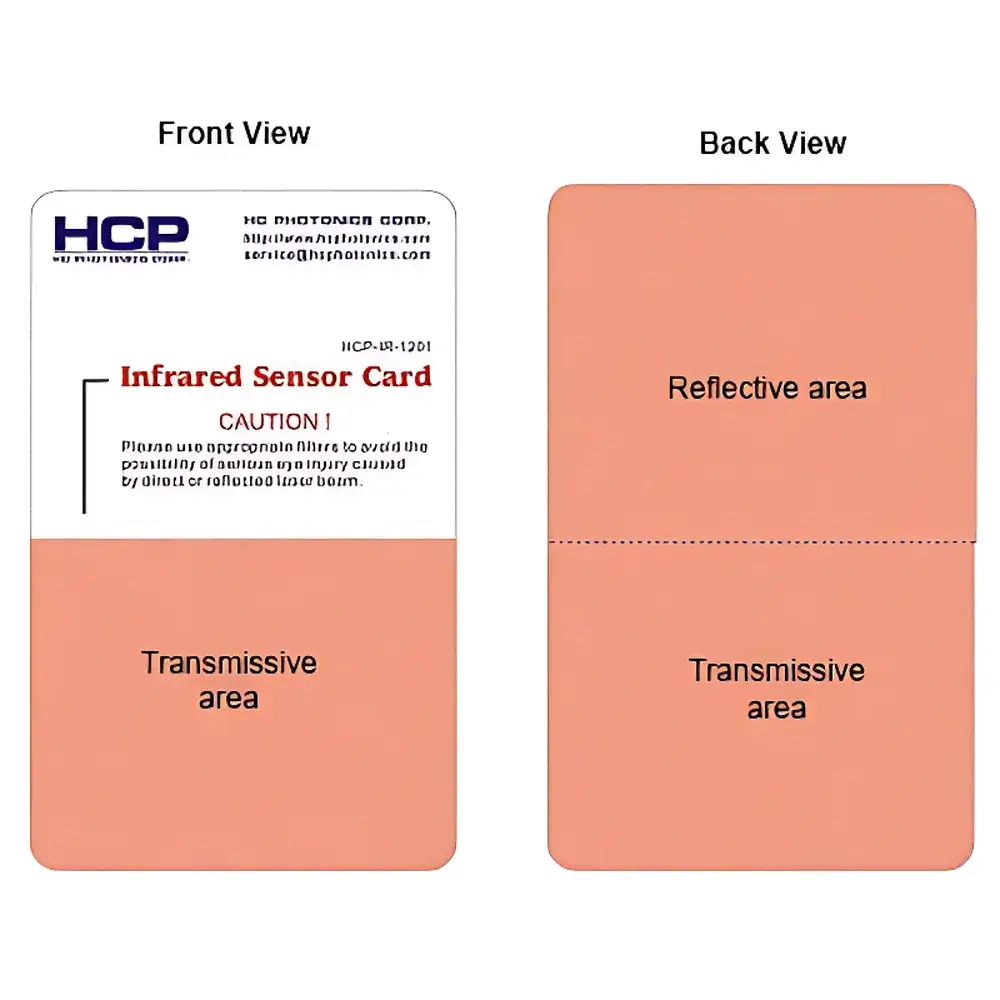
HCP+1201 Near-Infrared Upconversion Viewing Card
| Brand | HCP |
|---|---|
| Model | HCP-1201, HCP-0602 |
| Origin | Taiwan |
| Base Material | PVC (ISO card standard, reflective/transmissive dual-mode) |
| Display Area | 42 × 54 mm × 3 (1 reflective + 2 transmissive), or 20 × 20 mm |
| Primary Excitation Wavelengths | 950–980 nm (green emission @ 545 nm), 1500–1600 nm (red emission @ 670 nm), other IR bands up to 10600 nm |
| Effective Detection Range | 800–1600 nm (NIR), extendable to 1.5–13.2 µm (MIR via thermochromic mode) |
| Minimum Detectable Irradiance (dark room) | ≥67 µW/cm² @ 1550 nm |
| Minimum Detectable Irradiance (ambient light) | ≥3800 µW/cm² @ 1550 nm |
| Response Time (thermochromic mode) | <1 s |
| Emission Mechanism | Photon upconversion (NIR) / Thermally induced liquid crystal phase transition (MIR) |
| Customization | Shape, size, substrate (PVC, glass, ceramic, metal), spectral response, and functional coatings available |
Overview
The HCP-1201 Near-Infrared Upconversion Viewing Card is a precision optical diagnostic tool engineered for real-time visualization, alignment, and qualitative power assessment of invisible near-infrared (NIR) and mid-infrared (MIR) laser radiation. Unlike conventional thermal paper or phosphor-based detectors, the HCP-1201 integrates two complementary physical mechanisms in a single ISO-standard card format: (1) rare-earth-doped upconversion luminescence for NIR detection (700–10,600 nm), and (2) thermochromic liquid crystal (TLC) response for MIR detection (1.5–13.2 µm). This dual-mode architecture enables reliable beam profiling across semiconductor diode lasers (e.g., 980 nm, 1064 nm, 1550 nm), fiber-coupled sources, OPO/OPA systems, and industrial CO₂ or quantum cascade lasers—without requiring external power, optics, or calibration. The card operates on passive photonic excitation: incident NIR photons are absorbed by Yb³⁺/Er³⁺ co-doped microcrystalline phosphors (particle size 0.4–50 µm), triggering anti-Stokes emission in the visible spectrum; MIR irradiation induces localized heating in the embedded cholesteric liquid crystal layer, shifting its selective reflection band and producing reversible color contrast against the black metallic substrate.
Key Features
- Dual-band detection capability: Simultaneous NIR upconversion (visible green/red emission) and MIR thermochromic response (color shift from green to brown/black) within one compact ISO card (85.6 × 53.98 mm)
- High sensitivity: Detects ≥67 µW/cm² at 1550 nm in dark conditions; threshold rises to ≥3800 µW/cm² under typical laboratory ambient illumination
- Multi-substrate compatibility: Standard PVC base with reflective/transmissive dual-mode configuration; optional substrates include borosilicate glass, alumina ceramic, stainless steel, and flexible polymer films
- Quantitative spatial reference: Integrated crosshair etchings (±0.1 mm precision) aligned to card edges facilitate accurate beam centering and collimation verification
- Rapid thermal recovery: Full color reset in <1 second after irradiation ceases; mechanical tapping accelerates return to baseline (25–30 °C green state)
- Customizable optical response: Tailored emission peaks (e.g., 545 nm green for 950–980 nm pumps; 670 nm red for 1500–1600 nm), active area geometry, and spectral selectivity per application requirements
Sample Compatibility & Compliance
The HCP-1201 is compatible with continuous-wave (CW) and pulsed IR sources, including edge-emitting laser diodes, VCSELs, fiber lasers (Yb-, Er-, Tm-doped), Nd:YAG (1064 nm), OPO outputs, and quantum cascade lasers (QCLs). It meets ISO/IEC 17025 traceability guidelines for qualitative optical alignment tools when used within defined irradiance limits. While not a calibrated radiometric instrument, its consistent response profile supports GLP-compliant alignment procedures in laser safety audits, optical assembly workflows, and QC labs validating IR source stability. The PVC substrate conforms to RoHS Directive 2011/65/EU and REACH Annex XVII restrictions on phthalates and heavy metals. All custom formulations undergo ASTM D3359 adhesion testing and ISO 9211-4 environmental durability validation (thermal cycling −20 °C to +60 °C, 500 h UV exposure).
Software & Data Management
As a passive, analog optical indicator, the HCP-1201 does not incorporate onboard electronics or digital interfaces. However, it is fully interoperable with industry-standard imaging and analysis platforms: high-resolution CCD/CMOS cameras (e.g., FLIR Boson, Basler ace) capture time-resolved beam profiles for post-processing in MATLAB, ImageJ, or Thorlabs’ BeamGage software. When integrated into automated alignment stations (e.g., Newport ESP300 motion controllers), the card serves as a visual feedback endpoint for closed-loop optimization routines. For regulatory documentation, users may embed timestamped images of card response into electronic lab notebooks (ELNs) compliant with FDA 21 CFR Part 11 requirements—leveraging the card’s intrinsic repeatability and absence of firmware dependencies.
Applications
- Laser system commissioning: Rapid identification of NIR/MIR beam presence, divergence, and pointing stability during setup of fiber amplifiers, free-space optical links, or lidar transceivers
- Fiber optic component testing: Visual confirmation of coupling efficiency into single-mode fibers (SMF-28, PM1550) and splice loss estimation via relative spot brightness
- Medical laser safety: Qualitative verification of 980 nm diode or 1550 nm Er:glass laser output prior to tissue exposure in dermatology and ophthalmology systems
- Research-grade spectroscopy: Alignment aid for FTIR interferometers, cavity ring-down spectrometers, and photoacoustic gas sensors operating in the 1.5–4.0 µm range
- Educational laboratories: Demonstrating non-linear optical processes (upconversion), thermal photonics, and IR radiation fundamentals without costly IR cameras
FAQ
Is the HCP-1201 calibrated for absolute irradiance measurement?
No. It is a qualitative alignment and presence-detection tool. Quantitative power assessment requires traceable photodiodes or thermal sensors per ISO 11554.
Can the card be reused indefinitely?
Yes—provided irradiance remains below damage thresholds (≤2 W/cm² for sustained CW exposure; ≤10 W peak power for pulses <10 ns). Prolonged overexposure causes irreversible phosphor bleaching or TLC degradation.
Why does the visible spot size change with input power?
Upconversion efficiency scales nonlinearly with pump intensity; higher irradiance expands the excited volume within the phosphor layer, increasing apparent spot diameter—consistent with published models for Yb³⁺/Er³⁺ energy transfer dynamics.
Does ambient temperature affect MIR response accuracy?
Yes. The thermochromic transition midpoint is fixed at 27.5 ± 0.5 °C. Operation outside 20–35 °C requires empirical recalibration of color-intensity correlation using a reference thermal source.
Are custom spectral responses validated per batch?
Yes. Each production lot undergoes spectral responsivity mapping (using NIST-traceable monochromator + Si/InGaAs photodetectors) and is supplied with a Certificate of Conformance detailing measured λpeak, FWHM, and minimum detectable irradiance at three reference wavelengths (980 nm, 1064 nm, 1550 nm).





