
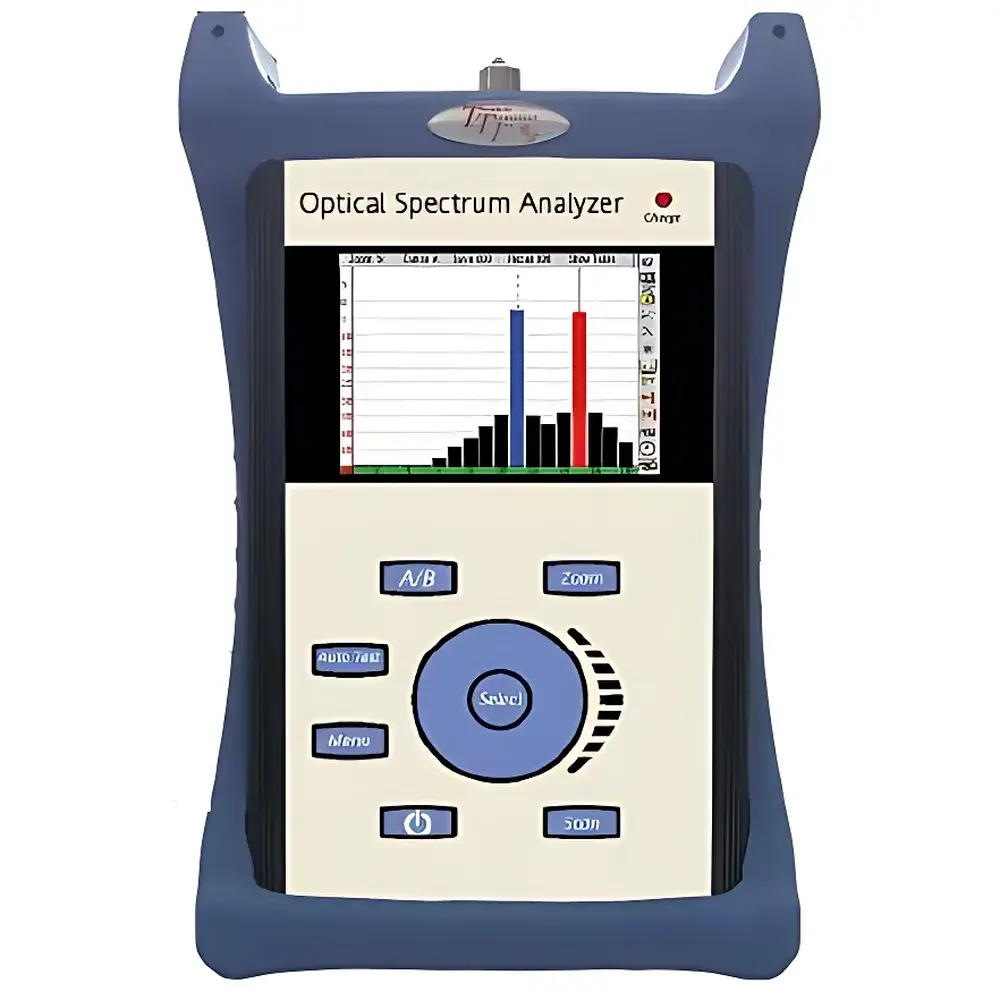
TTI FTE-8000 CWDM Optical Spectrum Analyzer
| Brand | TTI |
|---|---|
| Origin | USA |
| Model | FTE-8000 |
| Channel Capacity | Up to 88 ITU-T CWDM channels |
| Channel Spacing | 50 GHz or 100 GHz |
| Scan Rate | 2 full-spectrum sweeps per second |
| Display | 4-inch high-brightness color LCD |
| Data Storage | 1,000 test records |
| Interface | USB host & device (for PC connection and USB flash drive) |
| Housing | Rugged metal chassis with integrated rubber overmold |
| Compliance | ITU-T G.694.2 (CWDM wavelength grid), IEC 61300-3-35 (fiber optic device reliability) |
Overview
The TTI FTE-8000 CWDM Optical Spectrum Analyzer is a handheld, field-deployable instrument engineered for precise spectral characterization of coarse wavelength division multiplexing (CWDM) systems in both laboratory and outside-plant environments. Based on high-resolution diffraction grating optical filtering and calibrated InGaAs photodetector array architecture, the FTE-8000 delivers traceable optical power vs. wavelength measurements across the 1270–1610 nm CWDM band. Its core functionality centers on real-time channel identification, absolute power measurement (±0.5 dB typical accuracy), optical signal-to-noise ratio (OSNR) estimation (where applicable), and spectral shape analysis—including passband width, center wavelength deviation, and adjacent channel crosstalk assessment. Designed for rapid deployment in fiber installation, commissioning, and maintenance workflows, the analyzer operates without external power—drawing energy solely from its internal rechargeable Li-ion battery—and achieves thermal stability within 60 seconds of startup, minimizing warm-up drift during critical field tests.
Key Features
- ITU-T G.694.2 compliant CWDM channel detection supporting up to 88 wavelengths (1271–1611 nm in 20 nm steps)
- Simultaneous dual-mode display: wavelength (nm) or frequency (THz), with user-selectable channel count overlay (12–88 channels)
- Real-time full-band scanning at 2 Hz update rate, enabling dynamic monitoring of transient events such as EDFA gain transients or filter drift
- Integrated automatic test suite: one-button zeroing, auto-pass/fail evaluation against user-defined power thresholds (per-channel or global), and tilt compensation for DWDM-compatible flatness verification
- On-device spectral zoom: adjustable span (1–160 nm), resolution bandwidth (RBW) optimized for CWDM channel separation, and marker-based delta-λ/ΔP readout
- Ruggedized mechanical design: aluminum alloy housing with MIL-STD-810G compliant shock-absorbing elastomeric overmold, IP52-rated ingress protection
Sample Compatibility & Compliance
The FTE-8000 interfaces directly with standard single-mode fiber (SMF-28) via FC/PC or SC/PC adapters (included). It supports optical input power ranges from –50 dBm to +10 dBm without attenuation—enabling safe connection to live network links, passive splitters, or amplifier outputs. All optical calibration is NIST-traceable and performed at the factory using stabilized reference lasers and thermally controlled photodiode standards. The instrument complies with IEC 61300-3-35 for mechanical robustness under repeated handling and environmental cycling, and meets EN 61326-1 for electromagnetic compatibility in industrial and telecom infrastructure settings. While not a GLP/GMP-certified system, its data export capabilities support audit-ready documentation for Tier-2 and Tier-3 network validation per Telcordia GR-1089-CORE and ITU-T L.122 recommendations.
Software & Data Management
Test data—including spectral traces, channel tables, pass/fail logs, and timestamped metadata—are stored internally in non-volatile memory (1,000 records capacity). Export is supported via USB 2.0 interface to Windows/Linux PCs or USB mass-storage class flash drives. TTI-provided SpectraView Lite software (Windows 10/11 compatible, license included) enables batch report generation (PDF/CSV), comparative overlay of multiple scans, and threshold-based automated compliance flagging. All exported files contain embedded instrument ID, firmware version, calibration date, and operator-defined project tags—facilitating traceability in multi-team deployments. The onboard help system provides context-sensitive guidance in English, accessible via soft-key navigation; no internet connection is required for operation or parameter configuration.
Applications
- Field verification of CWDM MUX/DEMUX insertion loss, isolation, and channel alignment during fiber plant rollout
- EDFA gain tilt analysis and flattening optimization in metro-access hybrid networks
- Troubleshooting of unexpected channel dropouts, excessive ASE noise, or wavelength drift in aging passive components
- Pre-commissioning acceptance testing of vendor-supplied CWDM transceivers and active optics
- Educational use in optical communications labs for hands-on spectral analysis of multiplexed signals
- Integration into automated test benches via SCPI command set (USB-Virtual COM port emulation)
FAQ
What is the wavelength accuracy specification of the FTE-8000?
The instrument maintains ±0.1 nm wavelength accuracy across the full 1270–1610 nm range after factory calibration, verified at 10 reference points using NIST-traceable line sources.
Can the FTE-8000 measure DWDM signals?
It is optimized for CWDM (20 nm spacing); while it can detect individual DWDM channels, its 1.2 nm nominal resolution bandwidth does not resolve 50 GHz or 100 GHz DWDM grids with sufficient fidelity for compliance testing.
Is firmware upgrade supported in the field?
Yes—firmware updates are delivered as signed .bin files via USB flash drive and applied through the Settings > System menu without requiring PC connectivity.
Does the device support external triggering or synchronization?
No—the FTE-8000 operates autonomously and does not feature BNC trigger inputs or clock sync ports; all timing is internally generated.
How is calibration maintained over time?
TTI recommends annual recalibration at an authorized service center; the unit stores calibration history and alerts users when the due date approaches based on internal real-time clock tracking.





