
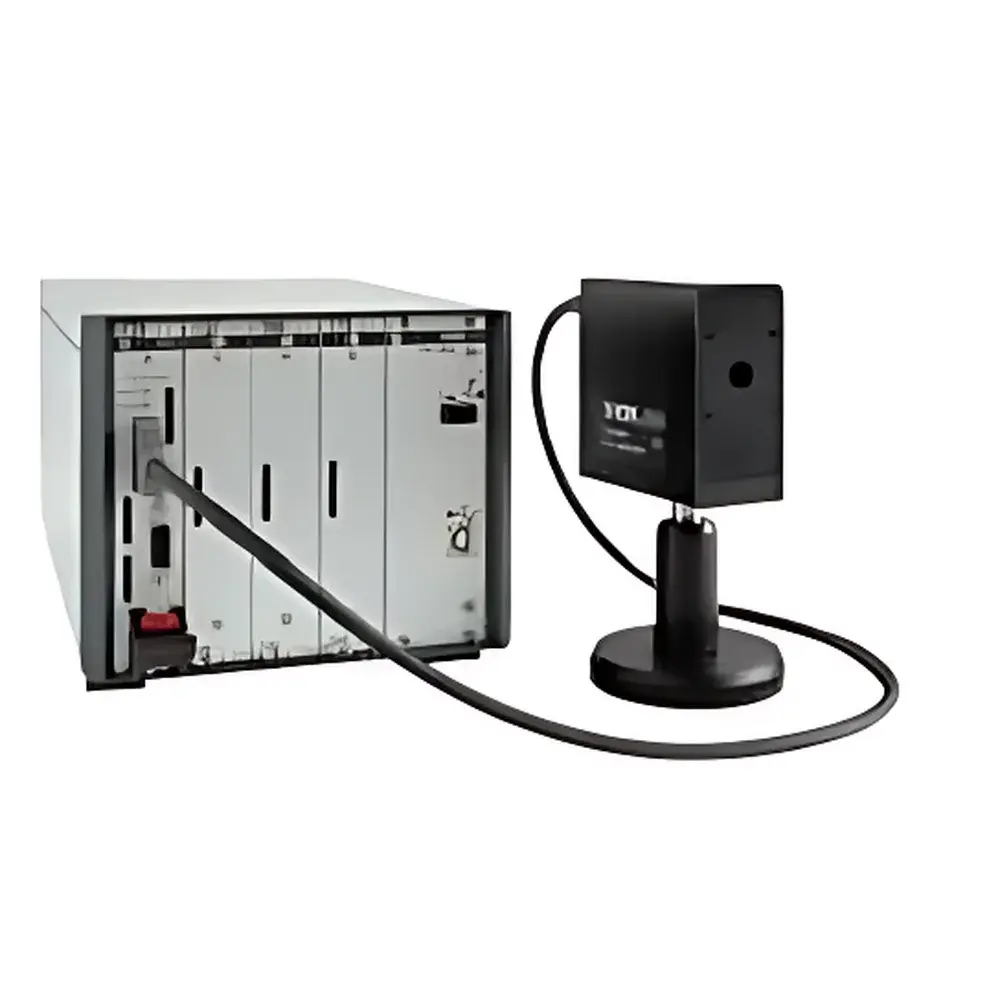
OZ Optics PAX5710-T Polarization Analyzer System
| Brand | OZ Optics |
|---|---|
| Origin | Canada |
| Model | PAX5710-T |
| Wavelength Ranges | VIS (400–700 nm), IR1 (700–1000 nm), IR2 (1000–1350 nm), IR3 (1300–1700 nm) |
| Input Power Range | −60 dBm to +10 dBm |
| Azimuth Accuracy | ±0.25° |
| Ellipticity Angle Accuracy | ±0.25° |
| Normalized Stokes Parameter Accuracy (S₁, S₂, S₃) | < 0.005 |
| Degree of Polarization (DOP) Accuracy | ±0.5% |
| Max Measurement Rate | 333 Hz |
| Fiber Interface | FC/PC (customizable) |
| Free-Space Input | Ø3 mm, divergence < 3 mrad |
| Analog Outputs | S₁, S₂, S₃, optical power (dBm), DOP |
| Digital Outputs | S₁, S₂, S₃, power, azimuth, ellipticity, power ratio, phase difference |
| Warm-up Time | < 15 min |
| Operating Temperature | 5–40 °C |
| Compliance | CE-certified, compatible with GLP/GMP data integrity requirements via optional audit-trail-enabled software logging |
Overview
The OZ Optics PAX5710-T Polarization Analyzer System is a modular, high-precision instrument engineered for real-time, full-Stokes vector characterization of optical polarization states in both free-space and fiber-coupled configurations. Based on the rotating waveplate (RWP) measurement principle—compliant with ISO 11146-2 and IEC 61290-12-1 standards—the system delivers traceable, NIST-referenced polarization metrics including azimuth, ellipticity, degree of polarization (DOP), and normalized Stokes parameters (S₁, S₂, S₃). Its architecture integrates a USB-connected TXP5004 chassis, interchangeable spectral modules (VIS/IR1/IR2/IR3), and detachable polarization probes, enabling scalable deployment across R&D laboratories, optical component manufacturing lines, and telecom system integration facilities. The system supports dual-mode operation: as a standalone polarization state analyzer and as the polarization measurement engine within larger platforms such as the PMD5000 polarization mode dispersion test system.
Key Features
- Modular wavelength scalability: Select from four calibrated spectral bands—VIS (400–700 nm), IR1 (700–1000 nm), IR2 (1000–1350 nm), and IR3 (1300–1700 nm)—via plug-in modules and matched probes.
- High-fidelity Stokes metrology: Achieves ±0.25° accuracy in azimuth and ellipticity angles; normalized Stokes parameter uncertainty < 0.005; DOP measurement uncertainty ±0.5%—validated per manufacturer calibration certificates traceable to NRC Canada.
- Dual-interface data acquisition: Simultaneous analog outputs (S₁/S₂/S₃, power in dBm, DOP) and digital outputs (azimuth, ellipticity, power ratio, phase difference) via USB 2.0 and optional RS-232.
- Flexible input coupling: Supports both free-space beams (Ø3 mm aperture, divergence < 3 mrad) and fiber inputs (standard FC/PC; custom connectors available upon request).
- Rapid temporal response: Maximum sampling rate of 333 Hz enables dynamic polarization monitoring in active alignment, laser stabilization, or polarization-dependent loss (PDL) characterization.
- Thermal stability: Full specification compliance over 5–40 °C ambient range; warm-up time < 15 minutes ensures repeatable measurements without extended stabilization delays.
Sample Compatibility & Compliance
The PAX5710-T accommodates linearly, circularly, and arbitrarily elliptically polarized light from lasers, LEDs, superluminescent diodes (SLDs), and amplified spontaneous emission (ASE) sources. It is routinely deployed in qualification testing of polarization-maintaining (PM) fibers, fiber Bragg gratings (FBGs), integrated photonic circuits, and electro-optic modulators. The system meets CE marking requirements for electromagnetic compatibility (EMC Directive 2014/30/EU) and low-voltage safety (LVD Directive 2014/35/EU). When operated with OZ Optics’ certified calibration kits and documented procedures, measurement records satisfy ALCOA+ principles for data integrity under FDA 21 CFR Part 11 and EU Annex 11 when paired with compliant software environments.
Software & Data Management
The included Windows-based control software provides real-time visualization of Stokes vectors on the Poincaré sphere, time-series plots of DOP/azimuth/ellipticity, and export to CSV, MATLAB (.mat), or HDF5 formats. Optional software packages support automated pass/fail reporting per user-defined tolerance limits, batch logging with timestamped metadata (including environmental sensor readings), and audit-trail generation compliant with GLP and GMP documentation standards. All firmware updates are digitally signed and delivered via secure HTTPS channels. Remote operation is supported through TCP/IP socket interface for integration into LabVIEW, Python (PyVISA), or MATLAB automation frameworks.
Applications
- Characterization of polarization extinction ratio (PER) in PM fiber pigtails, splices, and connectorized assemblies—supporting alignment verification during packaging and burn-in testing.
- Real-time feedback control in polarization-sensitive interferometric systems, such as fiber optic gyroscopes (FOGs) and coherent receivers.
- Quantitative assessment of polarization-dependent loss (PDL) and polarization mode dispersion (PMD) in DWDM components and reconfigurable optical add-drop multiplexers (ROADMs).
- Validation of Jones and Mueller matrix elements for birefringent devices—including waveplates, isolators, circulators, and polarization beam splitters—using sequential measurement protocols.
- In-process monitoring of polarization drift in high-power fiber lasers and amplifiers operating up to +10 dBm input power.
FAQ
What calibration standards does the PAX5710-T reference?
The system is factory-calibrated using NRC-traceable polarimetric standards, with certificate-of-conformance provided per unit. Annual recalibration services are available through OZ Optics’ ISO/IEC 17025-accredited laboratory.
Can the PAX5710-T measure unpolarized or partially polarized light?
Yes—it computes the degree of polarization (DOP) directly from measured Stokes parameters and reports DOP values from 0% (fully unpolarized) to 100% (fully polarized), with ±0.5% absolute accuracy.
Is fiber-to-fiber PER measurement supported out-of-the-box?
The PAX5710-T itself measures incident polarization state; for end-to-end PER of PM fiber assemblies, it is used in conjunction with a linear polarizer and tunable source—methodology aligned with Telcordia GR-1221-CORE and IEC 61300-3-37.
Does the system support trigger-synchronized acquisition?
Yes—via TTL-compatible external trigger input on the analog interface, enabling synchronization with pulsed lasers, mechanical choppers, or other instrumentation clocks.
How is thermal drift mitigated during long-duration measurements?
Internal temperature sensors feed a closed-loop compensation algorithm that adjusts gain and offset coefficients in real time, maintaining specified accuracy across the full 5–40 °C operating range without manual intervention.




