
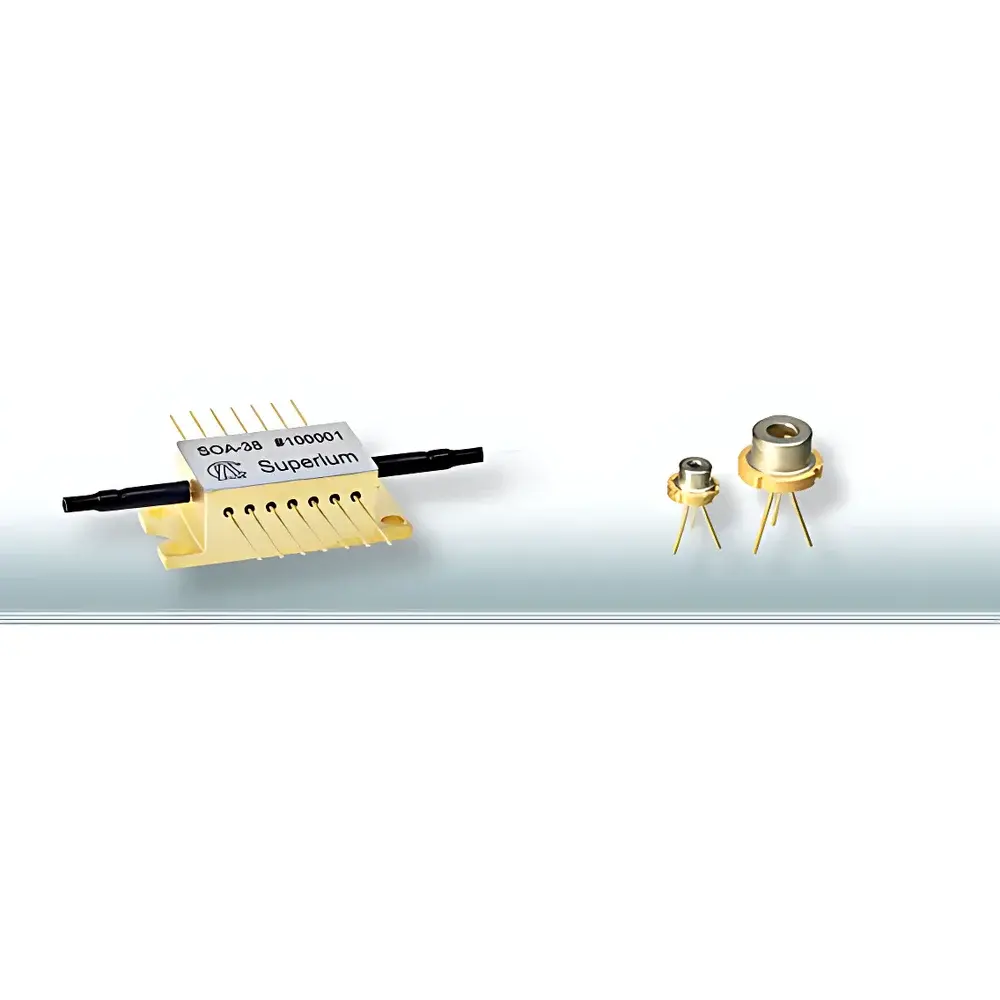
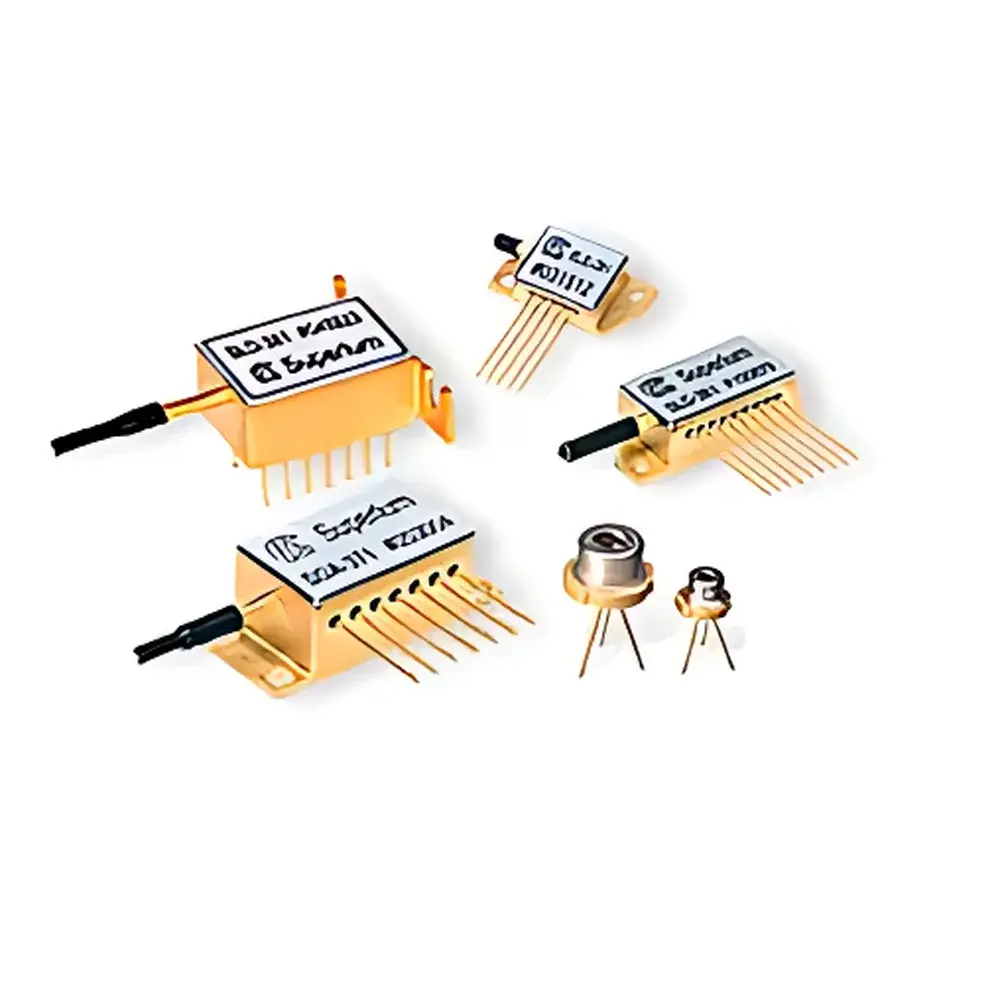
Superlum SLD-HP-SM High-Power Superluminescent Diode Module
| Brand | Superlum |
|---|---|
| Origin | Ireland |
| Model | SLD-HP-SM |
| Wavelength Range | 670–1610 nm |
| Output Power (SM) | up to 20 mW |
| Spectral Bandwidth (FWHM) | 50–200 nm |
| Coherence Length | <7 µm (T-series) to >10 µm (D-series) |
| Cooling | Thermoelectric (TEC) or uncooled options |
| Fiber Output | SM/PM/MM options available |
| Driver Compatibility | PILOT 4 DC/AC, PILOT WP2 dual-channel |
| Integrated Optical Isolator | S-series only |
| Compliance | RoHS, CE |
Overview
The Superlum SLD-HP-SM is a high-performance superluminescent diode (SLD) module engineered for applications demanding broadband, low-coherence, high-brightness optical emission with exceptional spectral stability and long-term reliability. Unlike conventional laser diodes or LEDs, SLDs operate under amplified spontaneous emission (ASE) principles—combining the spatial coherence of lasers with the broad spectral bandwidth characteristic of thermal sources. This unique emission profile enables high axial resolution in interferometric systems while minimizing speckle noise and parasitic interference effects. The SLD-HP-SM series spans wavelengths from 670 nm to 1610 nm, covering key telecom, biomedical, and industrial spectral windows—including 840 nm (OCT retinal imaging), 1300 nm (deeper tissue OCT), and 1550 nm (low-water-absorption fiber sensing). Modules are available in both thermoelectrically cooled (TEC) and uncooled configurations, with output coupling options including single-mode (SM), polarization-maintaining (PM), and multimode (MM) fiber pigtails.
Key Features
- High optical output power: up to 20 mW (SM-fiber-coupled) across multiple wavelength bands
- Ultra-broad spectral bandwidth: FWHM ranging from 50 nm (S-series) to 200 nm (Q-series), enabling sub-7 µm axial resolution in OCT systems
- Integrated TEC temperature stabilization for precise thermal control—critical for maintaining spectral centroid stability (<±0.02 nm/°C) and output power repeatability over time
- Low relative intensity noise (RIN) < −135 dB/Hz, optimized for phase-sensitive interferometry and low-noise photonic measurements
- Optional built-in optical isolator (S-series) to suppress back-reflection-induced instabilities—essential for integration into external cavity laser systems or fiber gyroscopes
- Modular mechanical design compliant with industry-standard 14-pin butterfly or DIL packages, supporting OEM integration into compact optical subsystems
- Driver-agnostic architecture compatible with Superlum’s PILOT family: PILOT 4 DC (constant-current, low-noise), PILOT 4 AC (modulated operation), and PILOT WP2 (dual-channel synchronized drive for multi-SLD setups)
Sample Compatibility & Compliance
The SLD-HP-SM supports a wide range of optical interfaces and experimental configurations. It is routinely deployed in fiber-pigtailed architectures for OCT engines, fiber-optic gyroscopes (FOGs), and component-level testing of isolators, circulators, and WDM filters. Free-space variants accommodate atomic force microscopy (AFM) illumination, white-light interferometry, and microspectroscopy platforms requiring collimated, broadband illumination. All modules comply with EU RoHS Directive 2011/65/EU and CE marking requirements for electromagnetic compatibility (EMC) and low-voltage safety (LVD). For regulated environments—including clinical OCT system development—the SLD-HP-SM meets essential performance criteria referenced in IEC 60825-1 (laser product safety) and supports traceable calibration protocols aligned with ISO/IEC 17025-accredited laboratories. When integrated with PILOT drivers featuring digital logging and analog monitoring outputs, the system supports audit-ready operation per FDA 21 CFR Part 11 requirements for electronic records and signatures.
Software & Data Management
While the SLD-HP-SM operates as a hardware-only light source, its performance is fully characterized and validated using Superlum’s proprietary SpectraScan™ test suite—a Windows-based application that automates spectral acquisition (via calibrated OSA), power stability logging, and thermal drift profiling over 24+ hour cycles. SpectraScan generates CSV- and XML-formatted reports compatible with MATLAB, Python (NumPy/Pandas), and LabVIEW for post-processing and statistical process control (SPC). For production-line integration, the PILOT driver family offers RS-232, USB, and analog voltage control interfaces, enabling synchronization with data acquisition systems (e.g., National Instruments PXI) and inclusion in automated test sequences governed by GLP/GMP documentation workflows. Firmware updates and configuration backups are managed via secure, password-protected firmware loader utilities—ensuring version control and revision traceability across instrument fleets.
Applications
- Optical Coherence Tomography (OCT): T-series and Q-series modules deliver the narrow coherence length (<7 µm) and high brightness required for ultra-high-resolution ophthalmic and dermatological imaging systems
- Fiber Optic Sensing: D-series modules serve as broadband sources in distributed strain/temperature sensing (BOTDA/BOTDR), fiber Bragg grating (FBG) interrogation, and interferometric hydrophone arrays
- Photonic Device Testing: Used for insertion loss, polarization-dependent loss (PDL), and chromatic dispersion characterization of passive and active components across C- and L-bands
- External Cavity Laser (ECL) Gain Media: 830 nm gain modules provide >60 nm tuning range in Littrow- or Littman-configured tunable lasers for spectroscopy and metrology
- White-Light Interferometry & Metrology: S-series modules enable sub-nanometer surface profilometry and thin-film thickness measurement through controlled coherence gating
- Biophotonics Research: Custom PM-fiber-coupled variants support polarization-resolved OCT, dynamic light scattering (DLS), and fluorescence lifetime imaging (FLIM) excitation pathways
FAQ
What distinguishes an SLD from a laser diode or LED?
SLDs combine the high spatial coherence and fiber-coupling efficiency of laser diodes with the broad spectral bandwidth and low temporal coherence of LEDs—making them ideal for interferometric applications where coherence length must be precisely controlled.
Why is current and temperature stability critical for SLD operation?
SLDs exhibit strong sensitivity to drive current ripple and junction temperature fluctuations—both causing spectral shift, power droop, and accelerated degradation. PILOT drivers incorporate low-noise current regulation and closed-loop TEC control to maintain stability within ±0.05 °C and ±10 µA.
Can the SLD-HP-SM be used in free-space optical setups?
Yes—Superlum offers collimated free-space variants with adjustable focus, AR-coated optics, and optional beam-shaping elements for AFM, confocal microscopy, and optical coherence elastography.
Is custom wavelength or packaging available?
Superlum provides full OEM customization—including non-standard center wavelengths, hybrid PM/SM pigtails, hermetic TO-can packaging, and integrated monitor photodiodes—with lead times aligned to ISO 9001-compliant manufacturing schedules.
How does the SLD-HP-SM support regulatory compliance in medical device development?
Modules are supplied with full traceable calibration certificates, material declarations (RoHS/REACH), and design history file (DHF) documentation packages upon request—facilitating integration into Class II/III OCT systems subject to FDA 510(k) or CE-IVDR submission requirements.





