
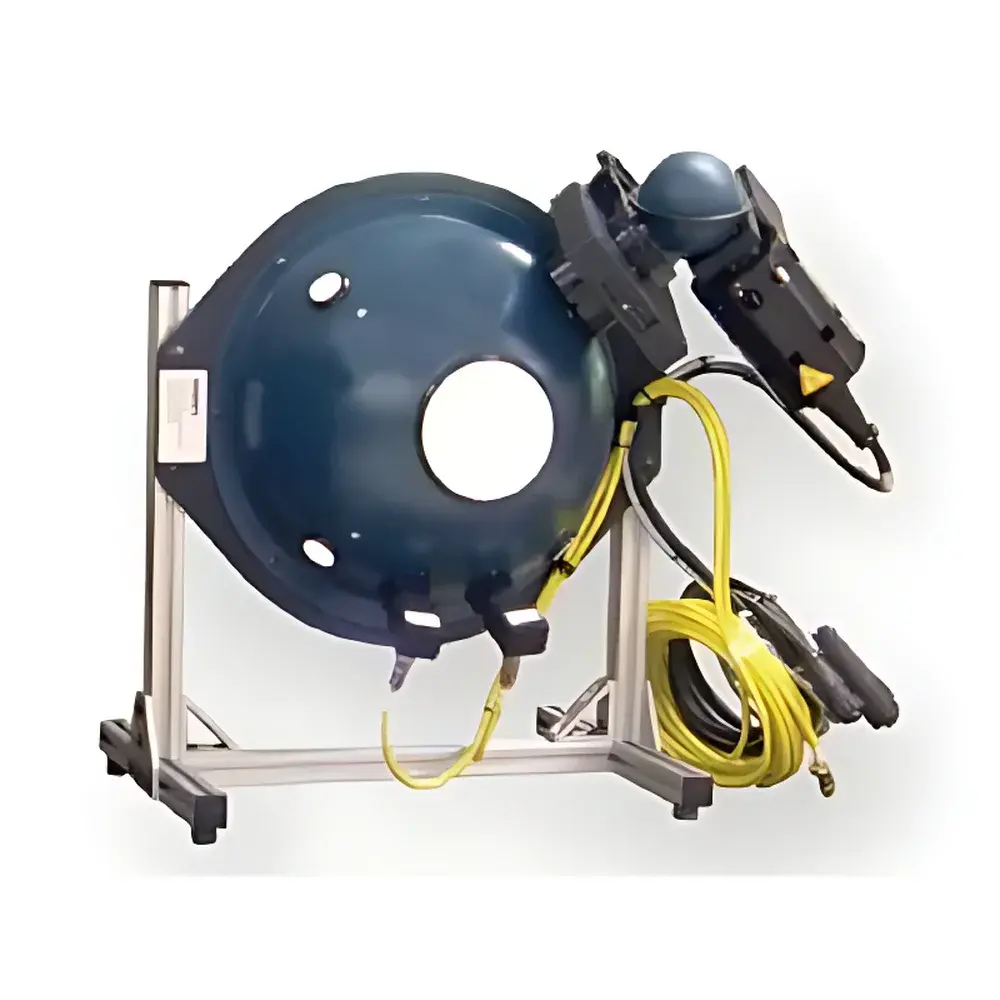
Labsphere USS-1200V-LL Low-Luminance Uniform Source System
| Brand | Labsphere |
|---|---|
| Origin | USA |
| Model | USS-1200V-LL |
| Component Type | Light Source |
| Integration Sphere Diameter | 12 in |
| Output Port Diameter | 4 in |
| Uniformity | >98% |
| Irradiance Dynamic Range | 8 decades |
| Calibrated Units | phot/(s·cm²) across 7 spectral bands |
| Spectral Coverage | UV–Vis–NIR |
| Star Magnitude Simulation | down to m = 0 |
| Real-time Radiance Monitoring | Yes |
| Motorized Filter Wheel Control | Software-integrated |
| Calibration Traceability | NIST-traceable irradiance responsivity, spectral radiance, and spectral irradiance |
Overview
The Labsphere USS-1200V-LL Low-Luminance Uniform Source System is a precision-engineered optical calibration platform designed for quantitative radiometric testing under extremely low-light conditions. Based on a 12-inch integrating sphere architecture with a 4-inch output port, the system generates spatially uniform, spectrally stable, and temporally reproducible radiant exitance—engineered to emulate astronomical starlight down to apparent visual magnitude m = 0 (≈2.54 × 10⁻⁹ W/cm² at 555 nm). Its core measurement principle relies on Lambertian scattering within a high-reflectance PTFE-coated sphere cavity, enabling highly repeatable irradiance delivery across UV (200 nm), visible (380–780 nm), and near-infrared (up to 1600 nm) spectral regions. The system’s 8-decade irradiance dynamic range—from sub-picoW/cm² to milliW/cm²—is achieved via programmable lamp dimming, calibrated neutral-density filtering, and synchronized shutter control—ensuring traceable, stepwise attenuation without spectral distortion.
Key Features
- High-spatial uniformity (>98% across full output port, per ISO 9050 and CIE S 023/E:2019)
- NIST-traceable factory calibration for spectral irradiance (W·nm⁻¹·cm⁻²·sr⁻¹), spectral radiance (W·nm⁻¹·cm⁻²·sr⁻¹), and irradiance responsivity (V/(W·cm⁻²))
- Integrated real-time radiance monitoring via calibrated silicon photodiode and lock-in amplifier architecture for closed-loop stability compensation
- Software-controlled motorized filter wheel supporting up to 8 user-defined bandpass, longpass, or ND filters—fully synchronized with acquisition timing
- Thermally stabilized halogen and deuterium lamp sources with active current regulation to minimize drift (<0.15% over 1 hr at constant setpoint)
- Compliant mechanical interface (CF-100 flange) for direct coupling to monochromators, spectroradiometers, or imaging sensors
Sample Compatibility & Compliance
The USS-1200V-LL accommodates detectors and optical systems requiring validated low-light characterization—including CCD/CMOS imagers, photomultiplier tubes (PMTs), avalanche photodiodes (APDs), and spaceborne star trackers. Its calibration suite supports ASTM E308-23 (computing CIE tristimulus values), ISO 15739:2013 (noise and dynamic range measurement for digital cameras), and USP (radiometric validation of analytical instrumentation). All calibrations are performed under controlled ambient temperature (23 ± 0.5 °C) and humidity (40–50% RH), with uncertainty budgets documented per ISO/IEC 17025:2017 requirements. The system meets electromagnetic compatibility (EMC) Class B limits per FCC Part 15 and CE EN 61326-1 for laboratory use.
Software & Data Management
Control and data acquisition are managed through Labsphere’s proprietary SourceMaster™ v4.2 software (Windows 10/11, 64-bit), which provides scriptable automation via Python API (PySource), time-stamped audit trails, and export to CSV, HDF5, or SI-units-compliant XML. All calibration coefficients—including wavelength-dependent responsivity curves and nonlinearity corrections—are embedded in instrument metadata and automatically applied during measurement. Software enforces 21 CFR Part 11-compliant user authentication, electronic signatures, and immutable audit logs for GxP-regulated environments. Raw and processed datasets retain full provenance: lamp hours, filter position, integration time, ambient sensor readings, and calibration certificate IDs.
Applications
- Radiometric validation of low-light scientific cameras used in adaptive optics, exoplanet transit photometry, and night-sky monitoring
- Linearity and dark-current characterization of photon-counting detectors operating below 10⁴ photons/s
- Spectral responsivity mapping of UV–Vis–NIR spectroradiometers per CIE Publication 220
- Testing and calibration of satellite-based Earth observation sensors requiring stellar reference illumination
- Development and verification of automatic exposure control (AEC) algorithms in autonomous vehicle vision systems
- GLP-compliant verification of optical safety interlocks in laser laboratories (IEC 60825-1 Annex D)
FAQ
What is the lowest measurable irradiance level supported by the USS-1200V-LL?
The system achieves stable, calibrated output down to ≈3 × 10⁻¹¹ W/cm² (at 555 nm), corresponding to m ≈ 0 visual magnitude under standard atmospheric transmission models.
Can the system be re-calibrated in-house or must it be returned to Labsphere?
Field recalibration is not supported; however, users may perform performance verification using the included reference photodiode and NIST-traceable transfer standards. Full recalibration requires return to an ISO/IEC 17025-accredited Labsphere Calibration Laboratory.
Is the spectral irradiance calibration valid across all filter positions?
Yes—each filter position is individually characterized during factory calibration, with full spectral irradiance matrices (λ × filter index) delivered in the calibration report.
Does the system support synchronization with external trigger signals for pulsed measurement?
Yes—the integrated shutter and filter wheel accept TTL-level external triggers with ≤10 µs jitter, enabling precise temporal alignment with frame-grabbers or oscilloscopes.
How is thermal drift mitigated during extended low-light measurements?
The system employs dual-stage thermal regulation: active lamp current feedback and Peltier-cooled detector housing for the monitoring photodiode—reducing irradiance drift to <0.08% over 2-hour continuous operation.






