
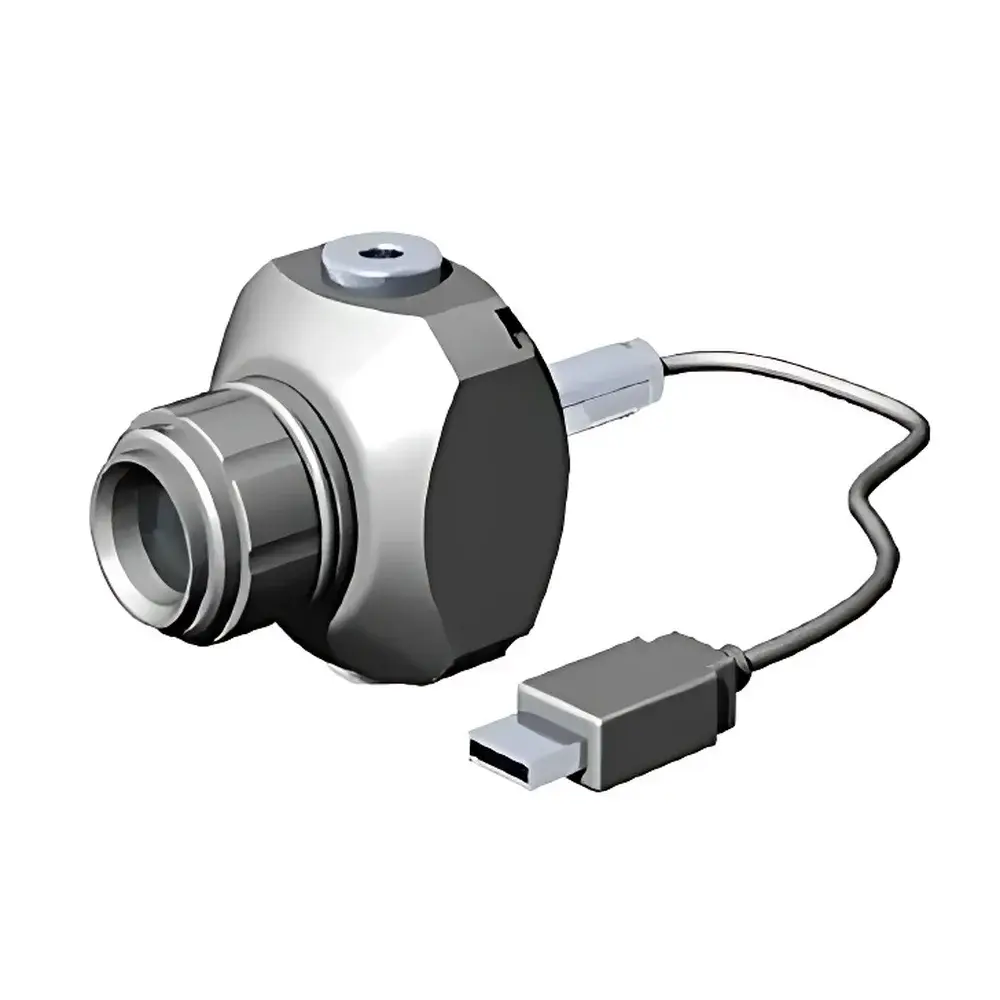
ElectroOptic CONTOUR-IR Digital CMOS Near-Infrared Camera
| Brand | ElectroOptic |
|---|---|
| Origin | Belarus |
| Model | CONTOUR-IR digital |
| Effective Pixels | 1280 × 1024 |
| Pixel Size | 3.75 µm × 3.75 µm |
| Spectral Range | 400–1700 nm |
| Lens | F1.4/26 mm, C-mount |
| FOV | 25° |
| SNR | 48 dB |
| Interface | USB 2.0 (480 Mbps) |
| Frame Rates | 15 Hz (1280×1024), 60 Hz (640×480) |
| Bit Depth | 8-bit |
| Power | USB bus-powered |
| Operating Temperature | 5–40 °C |
| Weight | 0.3 kg |
| Dimensions | 56 × 110 mm |
Overview
The ElectroOptic CONTOUR-IR Digital CMOS Near-Infrared Camera is a high-sensitivity, USB 2.0–enabled imaging instrument engineered for quantitative near-infrared (NIR) radiometry and visualization across scientific, industrial, and biomedical applications. Unlike conventional visible-light cameras, the CONTOUR-IR leverages a back-illuminated CMOS sensor with integrated microlens arrays and cascaded gain enhancement to achieve extended spectral responsivity from 400 nm to 1700 nm — covering the critical NIR-I (700–900 nm), NIR-II (1000–1350 nm), and NIR-III (1350–1700 nm) windows. Its optical architecture supports C-mount lens compatibility and delivers calibrated irradiance response down to 5 µW/mm² at 1310 nm, enabling precise detection of low-flux infrared sources such as GaAs LEDs, InGaAs laser diodes, and DPSS lasers. Designed for integration into optical alignment stations, laser beam profiling setups, and NIR microscopy interfaces, the camera operates without external power supplies—drawing full functionality from standard USB 2.0 bus power—while maintaining stable thermal behavior across ambient laboratory conditions (5–40 °C).
Key Features
- True 1280 × 1024 resolution CMOS sensor with 3.75 µm pixel pitch, optimized for diffraction-limited NIR imaging
- Wide spectral response (400–1700 nm) validated against NIST-traceable calibration sources
- USB 2.0 interface supporting real-time streaming at up to 480 Mbps, enabling lossless acquisition at full resolution (15 Hz) or high-speed operation (60 Hz at 640 × 480)
- On-sensor gain control, auto-exposure, and digital white balance algorithms compliant with IEEE 1785.1 guidelines for NIR image uniformity
- 8-bit linear output with fixed-pattern noise correction applied in firmware, ensuring reproducible photometric linearity over time
- C-mount mechanical interface compatible with industry-standard NIR lenses, filter holders, and microscope couplers
- Embedded WDM driver stack enabling seamless integration with third-party software platforms including MATLAB Image Acquisition Toolbox, LabVIEW IMAQ, and Python OpenCV
Sample Compatibility & Compliance
The CONTOUR-IR is routinely deployed in environments requiring traceable NIR measurement under controlled illumination conditions. It supports standardized test targets per ISO 15739 (image sensor noise measurement) and ASTM E2534 (NIR camera performance evaluation). While not certified for medical device use under FDA 21 CFR Part 820, its firmware implements audit-ready exposure logging and timestamped frame metadata—facilitating GLP-compliant documentation in R&D laboratories. The camera meets CE marking requirements for electromagnetic compatibility (EN 61326-1) and low-voltage safety (EN 61010-1), and its housing conforms to IP40 ingress protection for dust resistance during benchtop operation.
Software & Data Management
The camera ships with cross-platform SDKs (Windows/Linux/macOS) supporting both native API access and standardized UVC (USB Video Class) enumeration—allowing plug-and-play compatibility with video capture utilities and custom GUI applications. All acquired frames include embedded EXIF-like metadata: exposure duration, analog gain setting, sensor temperature (monitored via on-die thermal diode), and spectral band identifier. Raw data export is supported in TIFF and HDF5 formats, preserving bit-perfect fidelity for post-acquisition radiometric analysis. Optional firmware updates enable user-defined LUTs for non-linear intensity mapping and ROI-based histogram equalization—critical for dynamic range extension in laser spot profiling and thermal contrast imaging.
Applications
- Laser beam characterization (M² measurement, centroid tracking, and spatial mode analysis at 1064 nm, 1310 nm, and 1550 nm)
- NIR fluorescence imaging in preclinical research using indocyanine green (ICG) and other NIR-II fluorophores
- Industrial machine vision tasks including silicon wafer inspection, solder joint verification, and polymer layer thickness assessment
- Optical system alignment and collimation validation for fiber-coupled NIR spectrometers and OCT light sources
- Education and training in photonics labs where students require affordable, robust NIR imaging platforms compatible with standard optics benches
- Non-destructive testing (NDT) of composite materials using pulsed NIR reflectance and time-resolved transmission
FAQ
Is the CONTOUR-IR suitable for quantitative radiometric measurements?
Yes—when paired with calibrated neutral density filters and reference sources traceable to NIST SRM 2241 or equivalent, the camera supports relative irradiance measurements with ±5% uncertainty across its operational spectral band.
Does the camera support synchronized multi-camera triggering?
No—USB 2.0 does not provide hardware trigger lines; however, software-synchronized acquisition is achievable within ±2 ms jitter using shared system clocks and PTP-enabled hosts.
Can I replace the default lens with an objective for NIR microscopy?
Yes—the C-mount interface allows direct coupling to infinity-corrected NIR objectives (e.g., Mitutoyo M Plan Apo NIR series) when used with appropriate tube lenses and adapter rings.
What is the maximum sustained frame rate at full resolution?
15 Hz at 1280 × 1024 pixels with full 8-bit depth and no subsampling; higher rates require binning or region-of-interest readout.
Is there built-in cooling or thermoelectric stabilization?
No—the sensor operates passively at ambient temperature; dark current remains below 0.5 e⁻/pixel/s at 25 °C, validated per EMVA 1288 methodology.





