
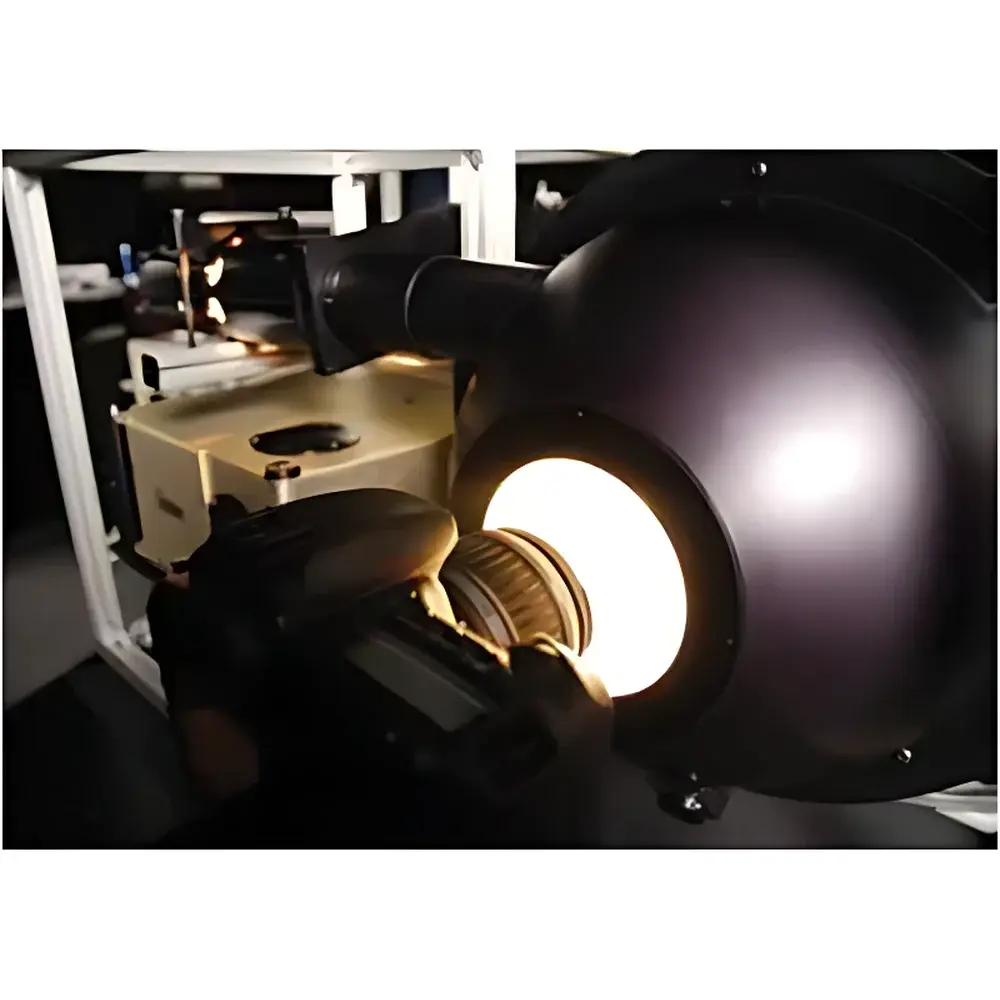
Ocean Optics XTH-1200 Solar Spectrum Simulation Uniform Light Source
| Brand | Ocean Optics |
|---|---|
| Origin | USA |
| Model | XTH-1200 |
| Component Type | Light Source |
| Spectral Range | 300–2500 nm (typical for tungsten/Xe hybrid system) |
| CCT Range | 2800–5900 K |
| Output Control | Independent dimming of tungsten and filtered xenon channels |
| Radiometric Traceability | NIST-traceable luminance (cd/m²) and illuminance (lux) calibration |
| Diffuse Uniformity | ≥99% Lambertian distribution |
| Compliance | ASTM E927-23, ASTM G173-22, IEC 60904-9 Ed. 3 |
| Application Domain | PV calibration, remote sensing validation, optical sensor characterization, space imaging testing |
Overview
The Ocean Optics XTH-1200 Solar Spectrum Simulation Uniform Light Source is an engineered radiometric reference system designed to replicate the spectral irradiance and spatial uniformity of natural sunlight under controlled laboratory conditions. It operates on a hybrid illumination principle: combining thermally stable tungsten-halogen emission (dominant in NIR and visible) with spectrally filtered xenon arc output (enhanced UV–visible contribution), enabling precise synthesis of solar-spectrum-weighted irradiance across 300–2500 nm. Unlike monochromatic or LED-based simulators, the XTH-1200 achieves high-fidelity spectral matching to ASTM G173-22 Global Reference Spectrum and ASTM E927-23 Class AAA requirements through real-time spectral shaping via independent analog control of both lamp channels. Its core architecture centers on a precision-machined, BaSO₄-coated integrating sphere (≥99% reflectance at 350–1800 nm), ensuring spatially uniform, near-Lambertian radiant exitance—critical for calibrating area-sensitive detectors, focal plane arrays, and full-aperture optical systems.
Key Features
- Hybrid dual-lamp spectral synthesis: independently adjustable tungsten-halogen and filtered xenon sources enable continuous CCT tuning from 2800 K to 5900 K, supporting both terrestrial and extraterrestrial solar reference conditions.
- NIST-traceable radiometric calibration: factory-certified luminance (cd/m²), illuminance (lux), and spectral irradiance (W·m⁻²·nm⁻¹) values are traceable to National Institute of Standards and Technology standards, with documented uncertainty budgets per ISO/IEC 17025.
- ≥99% spatial uniformity across defined output port: verified per ASTM E927-23 Annex A3 using calibrated CCD-based uniformity mapping; suitable for full-field calibration of imaging radiometers and multispectral sensors.
- Stable thermal management: active air-cooling and thermal feedback loops maintain lamp junction temperature within ±0.5°C over 8-hour operation, minimizing spectral drift (<0.3% ΔE* over 4 h).
- Modular mechanical interface: standard 100 mm output port with kinematic mounting flange (CF-100 compatible) enables integration into vacuum chambers, environmental test enclosures, or optical benches without alignment compromise.
Sample Compatibility & Compliance
The XTH-1200 is validated for use with photovoltaic reference cells (Si, GaAs, CIGS, perovskite), space-grade CMOS/CCD imagers, radiometric broadband sensors (e.g., ILT950, SPECTRA Pro), and quantum efficiency measurement platforms. It meets the spectral match, temporal stability, and spatial uniformity criteria defined in IEC 60904-9 Ed. 3 (Class AAA), ASTM E927-23 (Class A), and ISO 9001:2015-compliant calibration workflows. All delivered calibration reports include full spectral data files (CSV/NIST .spc format), uncertainty analysis per GUM (JCGM 100:2018), and traceability statements compliant with FDA 21 CFR Part 11 audit requirements when used in regulated GLP/GMP environments.
Software & Data Management
Control is executed via Ocean Insight’s OceanView Spectral Suite v4.5+ (Windows/Linux), supporting synchronized lamp intensity ramping, spectral preview, and automated uniformity sweeps. The system interfaces natively with LabVIEW™ via IVI drivers and Python (PyOcean) for custom automation. All radiometric measurements embed EXIF-style metadata—including lamp hours, ambient temperature, calibration date, and NIST certificate ID—and export to HDF5 or SI-structured CSV for long-term archival in LIMS or ELN platforms. Audit trails log all parameter changes, user authentication events, and calibration updates in accordance with ISO/IEC 17025 Clause 7.7.
Applications
- Calibration of satellite Earth observation sensors (e.g., VIIRS, OLI, MSI) requiring full-aperture solar-spectrum radiance validation.
- Quantum efficiency and external quantum efficiency (EQE) mapping of next-generation photovoltaic devices under standardized AM1.5G illumination.
- Performance verification of high-speed imaging systems (≥1000 fps) used in aerospace telemetry and combustion diagnostics.
- Characterization of optical coatings, diffusers, and étendue-matching components under spectrally resolved irradiance conditions.
- Validation of hyperspectral push-broom scanners and snapshot spectral imagers against known spectral radiance targets.
FAQ
What spectral standards does the XTH-1200 meet?
It conforms to ASTM G173-22 (Global Tilted Irradiance), ASTM E927-23 (Solar Simulator Classification), and IEC 60904-9 Ed. 3 (Photovoltaic Device Testing).
Is NIST traceability provided with each unit?
Yes—each system ships with a certificate of calibration listing measured spectral irradiance, luminance, and illuminance values, all directly traceable to NIST Standard Reference Materials (SRMs) 1930, 2030, and 2032.
Can the XTH-1200 be integrated into automated test stands?
Fully supported via Ethernet (TCP/IP) and USB 2.0 interfaces; SDKs available for Python, MATLAB, and C++.
What maintenance is required for long-term spectral stability?
Annual recalibration recommended; tungsten lamps rated for 2,000 hours, xenon lamps for 1,000 hours; cleaning of integrating sphere coating only with certified BaSO₄ reapplication kits.
Does the system support dynamic spectral shaping during acquisition?
Yes—real-time spectral interpolation between stored lamp profiles is enabled via OceanView’s scripting engine, allowing programmable spectral transients (e.g., sunrise/sunset simulation).




