
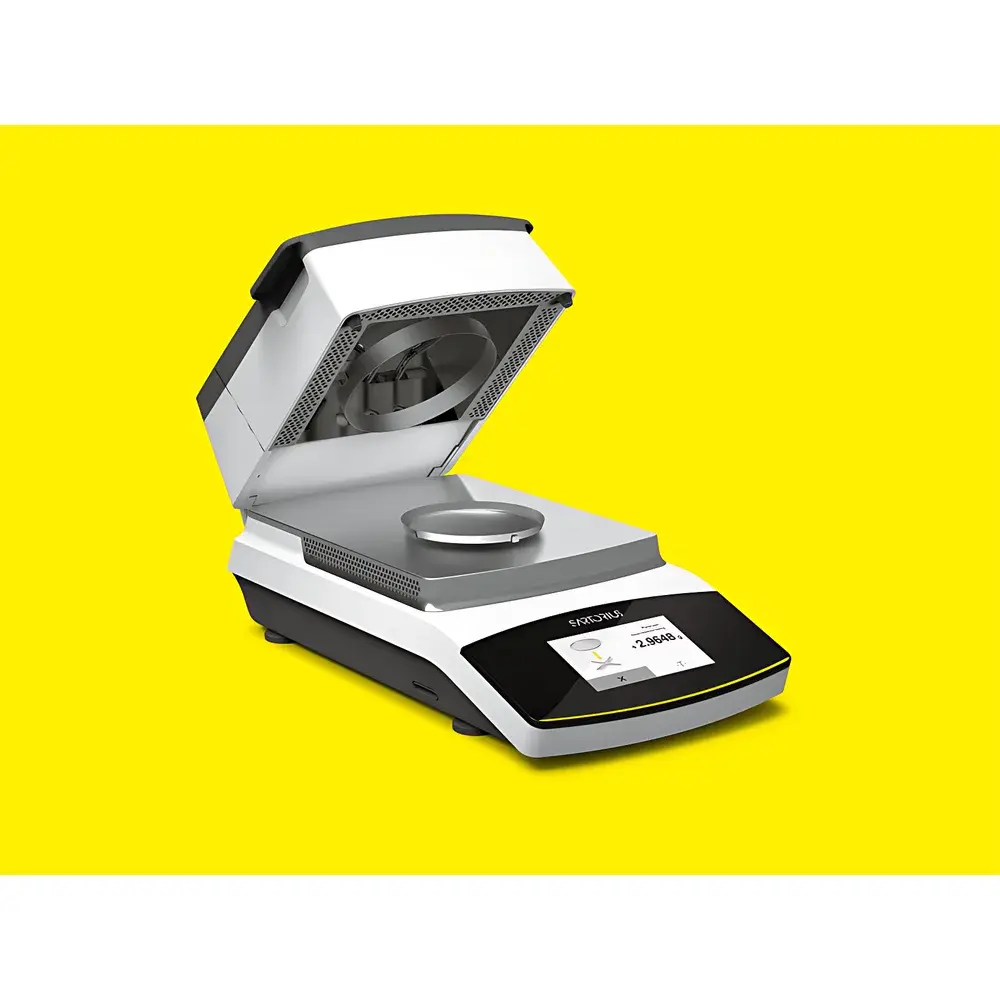
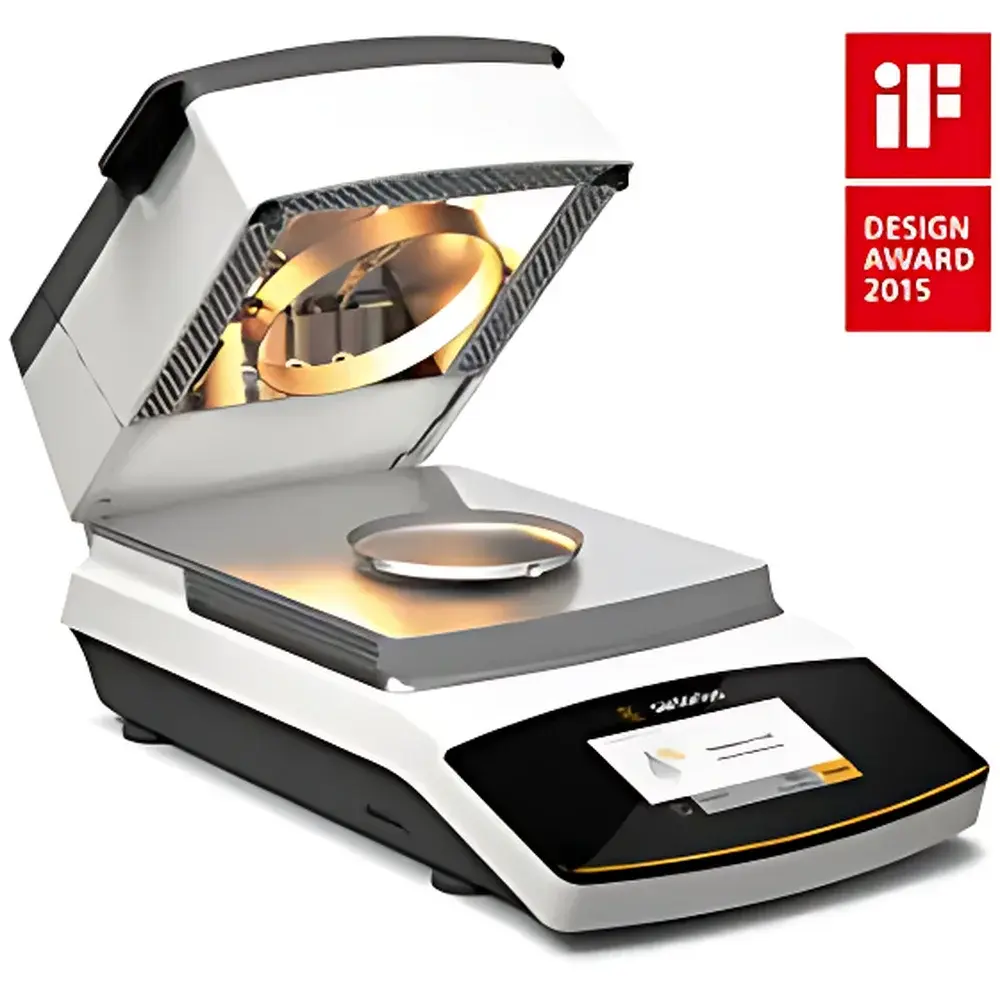
Sartorius MA160 Infrared Moisture Analyzer
| Brand | Sartorius |
|---|---|
| Origin | Germany |
| Model | MA160 |
| Heating Method | Infrared |
| Application Scope | Laboratory & QC Environment |
| Method Storage Capacity | 100 methods |
| Cleaning Design | Removable heated module and sample chamber base plate (dishwasher-safe) |
| Status Indication | Visual status LED array |
| Method Development Time | ≤45 minutes (3-step guided workflow) |
| Performance Verification | Integrated test routine with ReproEasy reference pads |
| Compliance Context | Designed to support GLP/GMP workflows, audit-ready method documentation, and traceable instrument qualification |
Overview
The Sartorius MA160 Infrared Moisture Analyzer is a precision-engineered thermogravimetric instrument designed for rapid, reproducible moisture content determination across diverse solid and semi-solid samples. It operates on the principle of infrared halogen heating combined with high-resolution mass measurement—applying controlled radiant energy to accelerate sample drying while continuously monitoring mass loss in real time via an integrated analytical balance (0.1 mg readability). Unlike conventional oven-drying methods requiring hours, the MA160 delivers validated moisture results in minutes, making it suitable for high-throughput quality control laboratories, raw material release testing, and R&D environments where speed, inter-instrument method transferability, and regulatory traceability are critical. Its architecture reflects Sartorius’ long-standing expertise in metrology and laboratory instrumentation, with hardware and firmware co-developed in Germany to meet stringent ISO/IEC 17025 and ASTM D4457 (for moisture by loss-on-drying) alignment requirements.
Key Features
- Infrared halogen heating system with uniform thermal distribution and programmable ramp/hold profiles—optimized for consistent drying kinetics without surface charring or thermal degradation.
- Ergonomic, tool-free removable heated module and dishwasher-safe sample chamber base plate—reducing cleaning time by >70% compared to fixed-chamber analyzers and minimizing cross-contamination risk.
- Integrated visual status LED array providing at-a-glance feedback on analysis phase (preheat, drying, cooling, end), visible up to 10 meters—enabling efficient multitasking in shared lab spaces.
- Guided 3-step method development wizard: users define sample type, target endpoint criteria (e.g., mass change rate ≤0.1 mg/min over 60 s), and validation parameters—all within ≤45 minutes without programming knowledge.
- Built-in performance verification protocol using certified ReproEasy reference pads (traceable to NIST-traceable standards), supporting daily instrument qualification per internal SOPs or FDA 21 CFR Part 11-compliant workflows.
- 100-method local storage capacity with secure USB export/import functionality—facilitating standardized method deployment across multiple MA160 units or integration into centralized LIMS environments.
Sample Compatibility & Compliance
The MA160 accommodates samples ranging from fine powders (e.g., pharmaceutical excipients, catalysts) to granular solids (e.g., food ingredients, polymers), pastes (e.g., slurries, adhesives), and thin films (e.g., coated tablets, battery electrode layers), provided they exhibit measurable mass loss below 300 °C. Sample pans are compatible with standard 90 mm aluminum or stainless-steel dishes. The analyzer supports compliance-critical workflows through encrypted method logs, user-access controls, electronic signatures (when paired with Sartorius LabX software), and full audit trail generation—fully aligned with GLP, GMP, and ISO 9001 documentation expectations. All calibration and verification records adhere to ISO/IEC 17025 clause 6.4.10 (equipment verification) and USP guidelines for moisture analysis instrumentation.
Software & Data Management
While the MA160 operates as a standalone instrument with intuitive front-panel navigation, its data management capabilities scale seamlessly via optional connectivity to Sartorius LabX software. LabX enables centralized method distribution, automated report generation (PDF/CSV), electronic signature enforcement, and 21 CFR Part 11 compliance—including role-based access, audit trail archiving, and electronic record retention. Raw mass-vs.-time datasets are exportable for secondary statistical analysis (e.g., drying curve modeling, Arrhenius parameter extraction). All method files include embedded metadata: operator ID, timestamp, environmental conditions (optional external sensor input), and verification status—ensuring full traceability from analysis initiation to final report sign-off.
Applications
- Pharmaceutical QC: Water content verification of active pharmaceutical ingredients (APIs), excipients, and finished dosage forms per USP and Ph. Eur. 2.5.12.
- Food & Beverage: Moisture determination in cereals, dairy powders, spices, and pet food—aligned with AOAC 950.46 and ISO 712.
- Chemicals & Polymers: Residual solvent quantification in resins, monomer purity assessment, and hygroscopicity profiling of catalysts and fillers.
- Academic & Materials Research: Kinetic drying studies, thermal stability screening, and comparative moisture sorption isotherm generation.
- Contract Laboratories: Multi-client method harmonization with cross-site reproducibility confirmed via ReproEasy pad testing and inter-laboratory round-robin validation.
FAQ
Does the MA160 require external calibration weights for routine operation?
No—internal automatic calibration is triggered upon power-up and temperature stabilization. External weights are only required for periodic verification (e.g., quarterly) per ISO/IEC 17025 clause 6.5.2.
Can methods developed on older Sartorius moisture analyzers be imported into the MA160?
Yes—backward-compatible method file formats enable direct import from MA150 and M365 platforms, preserving historical method integrity and reducing revalidation burden.
Is the ReproEasy reference pad certified for ISO 17025 accredited laboratories?
ReproEasy pads are supplied with individual CoA referencing NIST SRM 1994; full accreditation eligibility depends on the user’s documented verification procedure and uncertainty budgeting per ILAC-G8:2022.
What environmental conditions affect MA160 measurement accuracy?
Ambient temperature fluctuations >±2 °C/hour or drafts exceeding 0.2 m/s at the sample chamber opening may impact drying kinetics; installation in a draft-free, climate-stabilized environment is recommended.
How does the MA160 handle samples that decompose before reaching constant mass?
The instrument allows endpoint definition via dynamic rate thresholds (e.g., Δm/Δt ≤0.05 mg/min) rather than strict “constant mass” criteria—enabling robust endpoint detection for thermally sensitive materials.






