
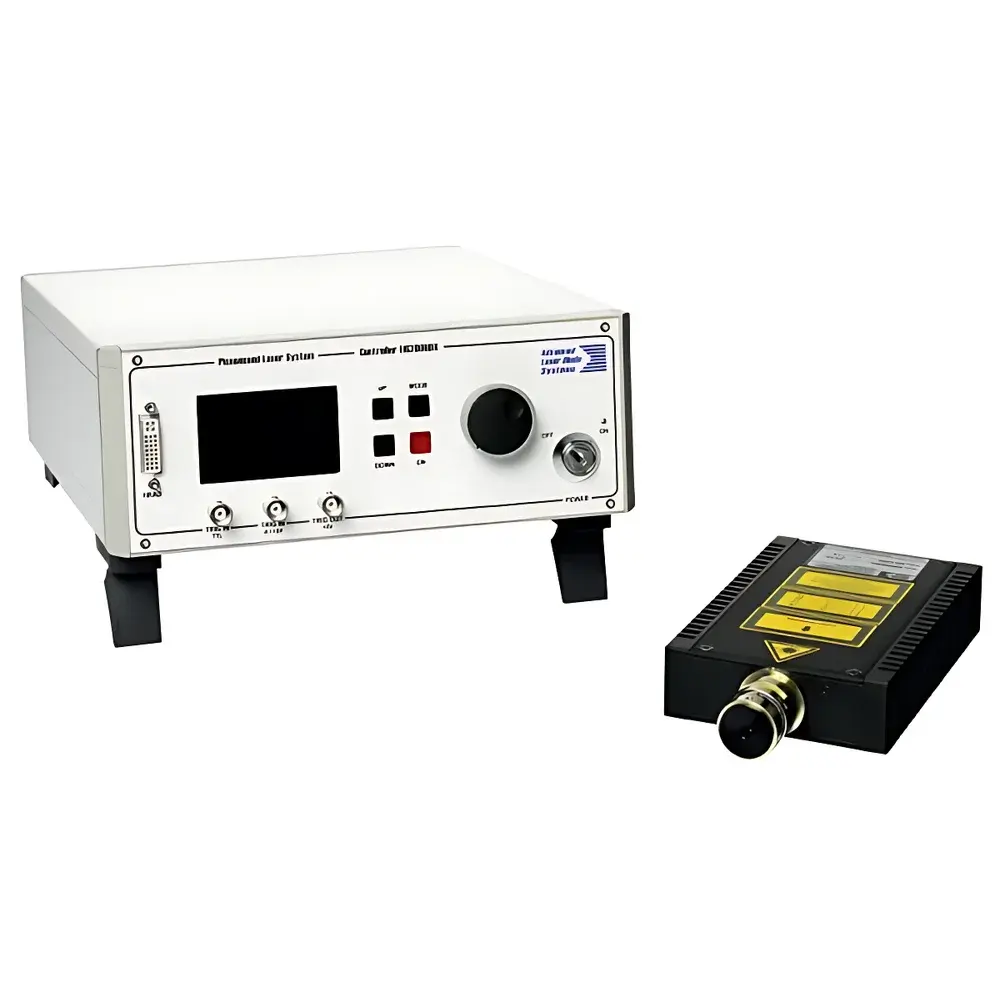
ALS+ PiLas Series Picosecond Semiconductor Laser System
| Origin | Germany |
|---|---|
| Manufacturer Type | Authorized Distributor |
| Origin Category | Imported |
| Model | PiLas |
| Core Components | Semiconductor Laser Diode Module with Integrated Driver and Cooling |
Overview
The ALS+ PiLas Series is a high-performance, turnkey picosecond semiconductor laser system engineered for precision time-resolved optical measurements and ultrafast photonic applications. Based on monolithic gain-switched laser diode technology, the PiLas delivers transform-limited optical pulses with sub-15 ps pulse widths and timing jitter below 3 ps (RMS), enabling reliable synchronization in pump-probe experiments, time-of-flight measurements, and single-photon timing applications. Unlike mode-locked lasers requiring complex cavity alignment, the PiLas operates without external cavity stabilization—offering exceptional long-term amplitude and temporal stability while maintaining full electronic control over repetition rate, trigger mode, and pulse selection. Its compact OEM-grade chassis (235 × 88 × 326 mm) integrates thermoelectric cooling (TEC), precision current driver, and low-noise triggering electronics, making it suitable for integration into automated test benches, fiber-optic characterization platforms, and laboratory-based ultrafast spectroscopy setups.
Key Features
- Pulse width as low as 12 ps (FWHM), with typical jitter < 3 ps (RMS) relative to internal or external trigger
- Wavelength coverage from 375 nm to 1550 nm across 16 standard models—including DFB variants at 850 nm, 1310 nm, and 1550 nm with spectral linewidth < 0.1 nm
- Repetition rate flexibility: fixed 1 MHz or 100 MHz operation; adjustable rates from single-shot up to 110 MHz (custom configurations available)
- Peak output power up to 1000 mW (collimated free-space beam); average power up to 0.5 mW at 100 MHz (dependent on wavelength and configuration)
- Dual triggering architecture: internal oscillator with programmable division ratios, plus external TTL/NIM-compatible input with ±5% frequency tolerance
- Integrated pre-trigger output (TTL or 2 V @ 50 Ω) with < 4 ns pulse width at 100 MHz, enabling precise synchronization with oscilloscopes, streak cameras, or time-correlated single-photon counting (TCSPC) systems
- Thermally stabilized platform with optional TEC control—critical for maintaining wavelength accuracy (< ±15 nm deviation) and pulse-to-pulse reproducibility over extended operation
Sample Compatibility & Compliance
The PiLas series is designed for compatibility with standard optical breadboards, fiber-coupled measurement systems (FC/PC, FC/APC connectors optional), and vacuum-compatible ultrafast diagnostics. All models comply with IEC 60825-1:2014 Class 4 laser safety requirements when operated with appropriate beam enclosures. The integrated EIG1000D (1 MHz) and EIG1000AF (100 MHz) controller modules support configurable trigger delay (70 ns nominal), pre-trigger skew compensation, and user-defined pulse gating—enabling seamless integration into GLP- and GMP-aligned validation workflows. While not certified under FDA 21 CFR Part 11, the system’s deterministic digital control architecture and non-volatile parameter storage facilitate audit-ready documentation for ISO/IEC 17025-accredited laboratories conducting traceable ultrafast optical calibration.
Software & Data Management
The PiLas operates via front-panel controls or RS-232/USB interface using ASCII command protocol. No proprietary runtime environment is required—configuration scripts can be embedded directly into LabVIEW, Python (PySerial), MATLAB, or C++ automation frameworks. Trigger latency, repetition rate division, and pulse enable/disable states are fully scriptable, supporting unattended multi-wavelength sweep sequences. All operational parameters—including actual measured pulse width, peak power (via calibrated photodiode feedback), and thermal sensor readings—are accessible in real time. For traceability, timestamped log files record every configuration change, enabling full experimental reproducibility and compliance with ISO 9001 process documentation standards.
Applications
- High-speed device testing: Characterization of photodetectors, avalanche photodiodes (APDs), and silicon photomultipliers (SiPMs) with sub-10 ps resolution
- Ultrafast circuit analysis: Time-domain reflectometry (TDR) and jitter analysis in high-speed serial links (e.g., PCIe Gen6, USB4)
- Fiber-optic component testing: Dispersion measurement, Brillouin scattering excitation, and distributed acoustic sensing (DAS) seed source
- Time-resolved fluorescence and phosphorescence lifetime imaging (FLIM/PLIM): With DFB variants offering narrow linewidth for selective excitation
- Optical time-domain reflectometry (OTDR) and LIDAR seed sources: Leveraging high peak power and low timing jitter for improved signal-to-noise ratio
- Seed source for fiber and solid-state amplifiers: Compatible with chirped-pulse amplification (CPA) front-ends requiring clean, low-noise picosecond pulses
FAQ
What is the minimum achievable pulse width across the PiLas wavelength range?
The shortest specified pulse width is 12 ps (FWHM), achieved at selected wavelengths including 408 nm (PIL040) and 850 nm DFB variants. Pulse width varies slightly by model and operating temperature.
Can the repetition rate be adjusted in real time during an experiment?
Yes—the internal oscillator supports discrete step-down division (e.g., 100 MHz → 50 MHz → 25 MHz), and external triggering allows arbitrary rate modulation within the 1 Hz–110 MHz range, subject to custom firmware configuration.
Is fiber coupling available as a factory option?
Free-space collimated output is standard; FC/PC or FC/APC fiber pigtailed versions are available upon request with specified coupling efficiency and polarization extinction ratio.
Does the system include built-in power monitoring?
While not equipped with an integrated power meter, each PiLas model features a calibrated photodiode monitor port (BNC) providing analog voltage proportional to optical output, enabling closed-loop power stabilization in external control loops.
What thermal management is required for continuous operation?
All models incorporate thermoelectric coolers (TEC); ambient air cooling suffices for most configurations. For >8-hour continuous use at maximum output, forced-air cooling or water-cooled heat sinks are recommended to maintain spectral stability and pulse fidelity.





