
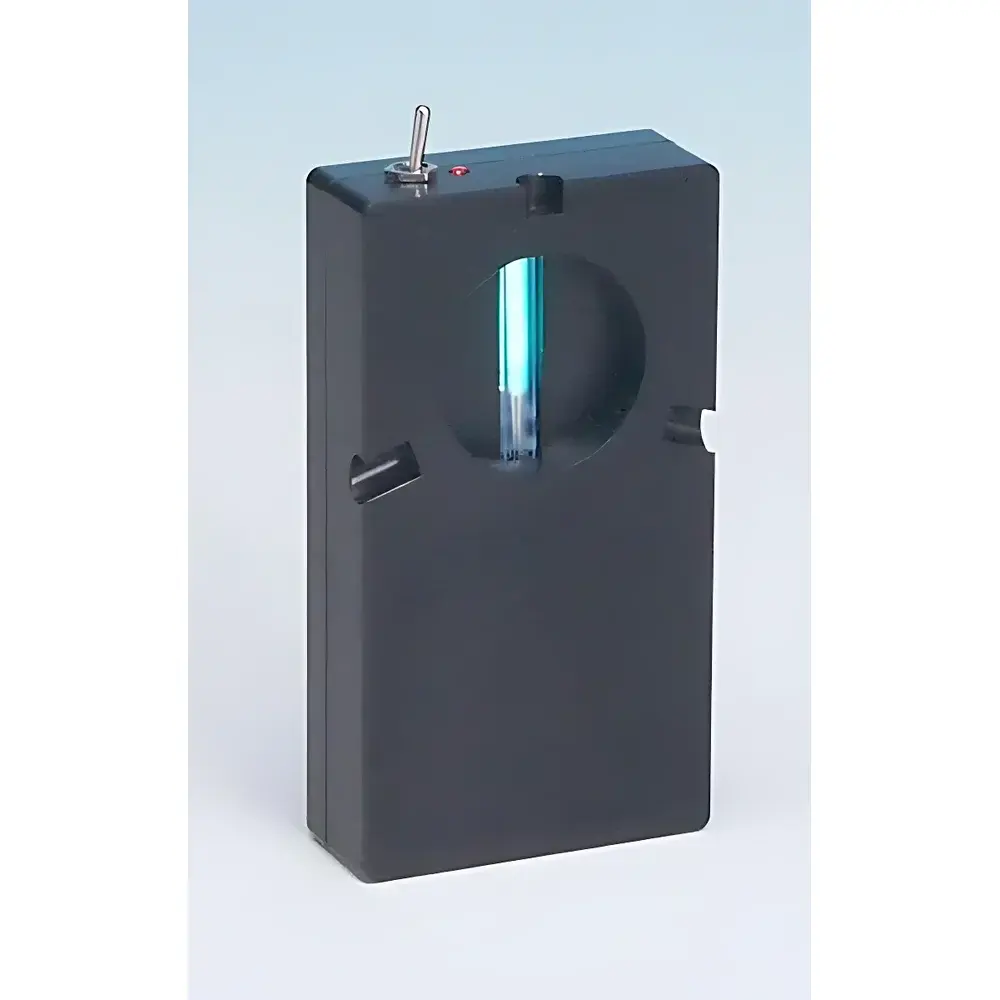
ASC-DC Portable Wavelength Calibration Light Source with Atomic Emission Lamps
| Origin | USA |
|---|---|
| Manufacturer Type | Distributor |
| Origin Category | Imported |
| Model | ASC-DC |
| Price | Upon Request |
| Component Category | Light Source |
Overview
The ASC-DC Portable Wavelength Calibration Light Source is an engineered atomic emission standard designed for high-accuracy spectral calibration and resolution verification of optical instrumentation. It operates on the principle of low-pressure gas discharge, generating discrete, narrow-linewidth emission spectra from excited atomic species—mercury (Hg), neon (Ne), xenon (Xe), argon (Ar), and krypton (Kr). Each lamp emits well-documented spectral lines with certified wavelengths traceable to NIST standards, enabling traceable wavelength calibration across UV–VIS–NIR spectral regions (190 nm to 3500 nm). The system is optimized for use with monochromators, spectrophotometers, spectrographs, array detectors, and fiber-optic sensor systems—particularly in environments requiring field-deployable, battery-operated calibration without reliance on mains power.
Key Features
- Five interchangeable atomic emission lamps: Hg (strong lines from 253.7 nm to 579 nm), Ne (high-intensity lines from 800 nm to 3400 nm, ideal for NIR resolution testing), Xe (moderate-intensity lines between 800–3500 nm, widely used in telecom-band calibration), Ar (dense line spacing <1 nm in 700–1000 nm region, optimal for resolving power assessment), and Kr (supplementary lines for extended spectral coverage)
- Hermetically sealed, dual-aperture fused silica envelope ensuring long-term spectral stability and minimal drift
- Compact pen-style form factor (104.8 mm × 31.8 mm × 22.2 mm) with black anodized aluminum housing for EMI shielding and thermal management
- Dual-power operation: AC-powered mode (110–230 VAC, 50/60 Hz) via integrated transformer; DC-powered mode using a 9 V alkaline battery (25–45 min runtime per cell) with optional AC adapter for continuous field use
- Integrated mechanical shutter option for precise temporal control of light output during automated calibration routines
- Polarized female connector output (16″ / 40.6 cm cable) compatible with SP AF-series fiber optic couplers and standard monochromator input mounts
Sample Compatibility & Compliance
The ASC-DC supports calibration of optical components and instruments compliant with ISO/IEC 17025 requirements for measurement traceability. Its emission lines align with reference data specified in ASTM E334 (Standard Practice for Calibration of Spectrometers), ISO 6944 (Optical radiation—Calibration of spectral irradiance meters), and USP (Spectrophotometric Absorbance Measurements). The lamp’s spectral stability (±0.005 nm wavelength repeatability over 5000 h lifetime for Hg/Ar/Xe variants; 500 h for Ne) meets GLP/GMP validation criteria for routine QC in regulated laboratories. All lamps are RoHS-compliant and manufactured under controlled cleanroom conditions to ensure absence of contaminant spectral artifacts.
Software & Data Management
While the ASC-DC operates as a hardware-only calibration standard, its spectral output integrates seamlessly into existing instrument control ecosystems. Full spectral line databases—including exact vacuum wavelengths, relative intensities, FWHM values, and uncertainty budgets—are provided in CSV and XML formats for import into LabVIEW, MATLAB, Python-based spectral analysis pipelines, or vendor-specific software (e.g., Ocean Insight OceanView, Horiba LabSpec, Thermo Fisher OMNIC). Audit trails for lamp usage, warm-up cycles, and operational hours can be logged manually or via external DAQ systems supporting TTL-triggered shutter control. No embedded firmware or cloud connectivity is included—ensuring compliance with air-gapped network policies common in defense, aerospace, and pharmaceutical QA labs.
Applications
- Wavelength calibration of Czerny–Turner and Ebert–Fastie monochromators used in Raman, fluorescence, and absorption spectroscopy
- Resolution verification of imaging spectrographs and hyperspectral cameras via slit-function analysis using Ar’s sub-nanometer line spacing
- Fiber-optic component testing—including FBG interrogators, WDM filters, and photodetector responsivity mapping—using Xe and Ne lines aligned to ITU-T G.694.1 grid wavelengths
- UV–VIS spectrophotometer validation per USP and Ph. Eur. 2.2.25, leveraging Hg’s 253.7 nm, 365.0 nm, and 435.8 nm primary lines
- Field-deployable calibration of portable NIR analyzers in agriculture, environmental monitoring, and on-site material identification
- Teaching laboratories for atomic physics experiments demonstrating Bohr model predictions and fine-structure splitting
FAQ
What is the warm-up time required before spectral measurements?
A stable discharge is achieved within 2–4 minutes after ignition, with wavelength repeatability stabilizing to ±0.005 nm after 3 minutes.
Can the ASC-DC be used for radiometric calibration?
No—it is a wavelength reference standard only. Intensity calibration requires separate NIST-traceable radiometric sources (e.g., tungsten-halogen or LED-based standards).
Are spectral line data sheets provided with each unit?
Yes—each lamp includes a certificate of conformance listing all major emission lines, their nominal vacuum wavelengths (±0.002 nm), relative intensities, and FWHM specifications.
Is the ASC-DC compatible with fiber-coupled instruments?
Yes—via optional AF2-series SMA-905 or FC/PC fiber adapters, supporting core diameters from 50 µm to 600 µm with coupling efficiency >75% at 500–1000 nm.
How is lamp aging monitored in routine use?
Lamp operating hours are tracked externally; intensity degradation is typically <5% over 5000 h for Hg/Ar/Xe lamps, with no measurable wavelength shift under normal ambient conditions (15–35 °C).




