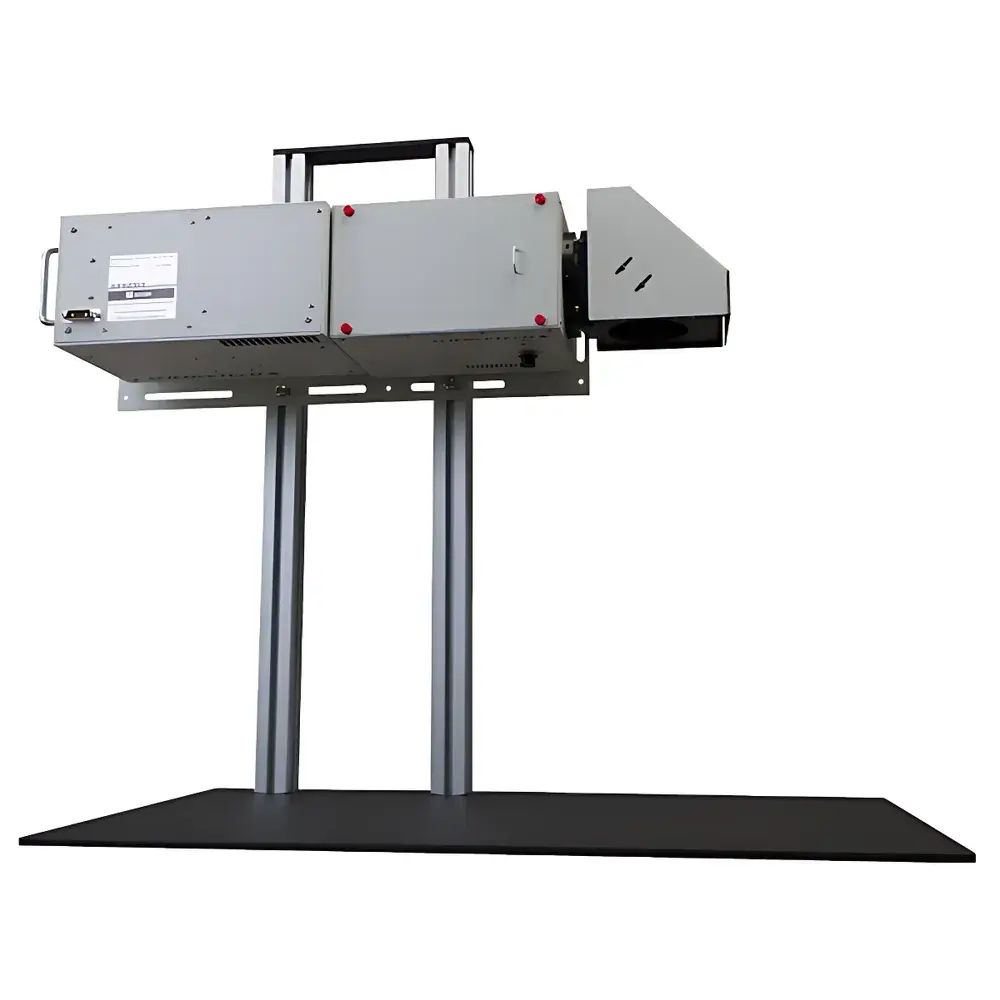
Sciencetech SF300A Compact Low-Cost Solar Simulator
| Brand | Sciencetech |
|---|---|
| Origin | Canada |
| Model | SF300A |
| Spectral Range | 250–2000 nm |
| Irradiance Area | 25 mm Ø |
| Irradiance Level | 1–2 suns (AM1.5G) |
| Spatial Uniformity | ASTM E927-10 Class A (≤2%) or Class B (≤5%) selectable |
| Temporal Instability | ≤2% (Class A) or ≤5% (Class B) |
| Beam Collimation | ~1° half-angle (SF series) |
| Working Distance | 100–130 mm |
| Power Input | 110–240 V, 50/60 Hz, 450 W |
| Output Power | 180–300 W |
| Dimensions (H×W×L) | 305 × 205 × 276 mm |
| Weight | 6 kg (unit only) |
| Compliance | ASTM E927-10, IEC 60904-9 Ed. 3, JIS C 8912 |
Overview
The Sciencetech SF300A is a compact, entry-level solar simulator engineered for laboratory-scale photovoltaic (PV) device characterization, material photoresponse testing, and accelerated aging studies where high irradiance uniformity and spectral fidelity are required—but large-footprint, high-power systems are impractical. Based on a stabilized xenon short-arc lamp with precision optical collimation, the SF300A delivers a highly parallel beam (±0.5° full divergence) optimized for space-environment simulation and optical alignment-sensitive applications. Its spectral output spans 250–2000 nm, covering UV-B through near-infrared, and is configurable via interchangeable bandpass filters to meet AM1.5G (IEC 60904-3), AM0 (space), or custom spectral targets. The system adheres strictly to ASTM E927-10 classification criteria, supporting Class A or Class B certification for spectral match, spatial uniformity, and temporal stability—enabling traceable, standards-compliant measurements without requiring dedicated cleanroom integration.
Key Features
- Compact footprint (305 × 205 × 276 mm) and low mass (6 kg unit-only) facilitate benchtop deployment in shared labs, gloveboxes, or optical tables.
- Xenon arc lamp with integrated igniter and touch-screen power supply ensures stable ignition, real-time lamp voltage/current monitoring, and programmable ramp-up/down profiles.
- Collimated output beam (1° half-angle) minimizes angular spread—critical for reflectance calibration, concentrator PV testing, and multi-junction cell alignment.
- Selectively certified to ASTM E927-10 Class A (spectral match 0.75–1.25, uniformity ≤2%, instability ≤2%) or Class B (spectral match 0.6–1.4, uniformity ≤5%, instability ≤5%), with factory-issued test report included.
- Modular filter holder accepts standard 25 mm diameter interference or broadband filters for spectral tailoring (e.g., UV-cut, IR-cut, or AM1.5G correction).
- Adjustable optical height (137 mm nominal) and standardized mounting interface (M6/M8 threaded holes + 1/4″-20 feet) support rigid integration with translation stages, sample holders, or environmental chambers.
Sample Compatibility & Compliance
The SF300A is designed for small-area samples up to 25 mm diameter, making it ideal for single-junction silicon, perovskite, organic PV cells, quantum dot films, and photoelectrochemical electrodes. Its collimated beam enables precise illumination of masked apertures, micro-patterned substrates, or fiber-coupled detectors. All units ship with full compliance documentation aligned to international photovoltaic testing standards: IEC 60904-9 Ed. 3 (2020) for solar simulator classification, ASTM E927-10 for performance verification, and ISO/IEC 17025 traceable irradiance calibration (NIST-traceable reference cell included). For regulated environments, the system supports GLP-compliant operation when paired with external data loggers meeting FDA 21 CFR Part 11 audit trail requirements.
Software & Data Management
While the SF300A operates as a stand-alone instrument via its integrated touchscreen controller, Sciencetech provides optional LabVIEW™ and Python API drivers for automated irradiance sequencing, time-series stability logging, and synchronization with source meters (e.g., Keithley 2400/2450) or quantum efficiency systems. All measurement metadata—including lamp hours, operating voltage, ambient temperature, and filter ID—is timestamped and exportable in CSV format. Factory calibration certificates include spectral irradiance curves (W/m²/nm), spatial uniformity maps, and temporal stability histograms—fully compliant with internal QA protocols and third-party accreditation audits.
Applications
- Primary and secondary calibration of reference cells and pyranometers under controlled spectral conditions.
- Efficiency mapping and J-V curve acquisition for lab-scale PV devices using compact probe stations.
- UV-induced degradation studies on encapsulation materials, anti-reflective coatings, and perovskite absorbers.
- Photoelectrochemical (PEC) water-splitting experiments requiring stable, spectrally defined illumination within electrochemical cells.
- Educational demonstrations of solar energy conversion principles, including spectral response analysis and fill factor optimization.
- Pre-screening of novel photoactive materials prior to deployment in larger-class simulators or outdoor testing facilities.
FAQ
Does the SF300A require external cooling or ventilation?
No—the integrated fan-cooled lamp housing and thermal management design enable continuous operation at rated power without external chillers or ducted exhaust, provided ambient temperature remains below 30°C and airflow around the unit is unobstructed.
Can the SF300A be upgraded to Class A performance after purchase?
Yes—Class A certification is determined by factory-measured optical performance; users may request re-certification with updated filter sets or recalibration if lamp aging exceeds 10% output drift (typically after ~500 lamp-hours).
Is the output beam polarized?
No—the xenon arc source produces unpolarized light; polarization must be introduced externally using wire-grid or Rochon prisms mounted in the beam path.
What maintenance is required for long-term stability?
Lamp replacement every 500–1000 hours (depending on duty cycle), periodic cleaning of filter surfaces with spectroscopic-grade solvents, and annual verification of irradiance output using the supplied NIST-traceable reference cell.
How is spectral match validated across the 250–2000 nm range?
Each unit undergoes full-range spectroradiometric characterization using a calibrated CCD-based spectrometer (Ocean Insight QE Pro) with cosine-corrected input optic; raw data and interpolated AM1.5G match ratios are provided in the test report.