
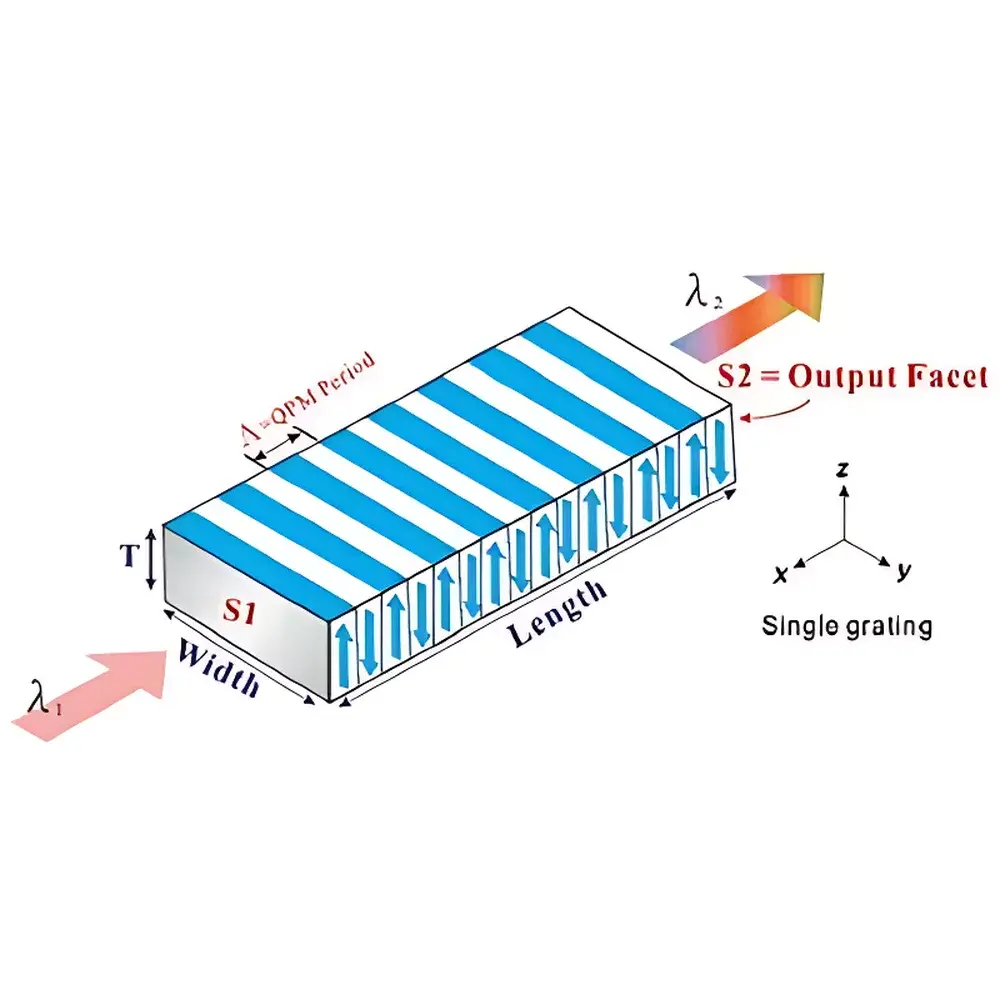
HCP PPLN Crystal – Periodically Poled Lithium Niobate Bulk Crystal
| Brand | HCP |
|---|---|
| Origin | Taiwan |
| Manufacturer Type | Authorized Distributor |
| Product Category | Domestic (PRC Market) |
| Model | PPLN-HCP |
| Price | USD 2,800 (FOB Taiwan) |
Overview
The HCP PPLN Crystal is a high-performance periodically poled lithium niobate (LiNbO₃) bulk nonlinear optical crystal engineered for precise quasi-phase-matched (QPM) frequency conversion across ultraviolet, visible, and infrared spectral ranges. Fabricated using proprietary electric-field poling technology in ISO Class 5 cleanroom facilities, each crystal features uniform domain inversion periodicity with sub-micron positional accuracy and low domain wall roughness—critical for achieving high conversion efficiency and long-term thermal/photonic stability. Designed for use in optical parametric oscillators (OPOs), difference-frequency generation (DFG), second-harmonic generation (SHG), and optical rectification systems, the HCP PPLN crystal operates under standard oven-controlled temperature environments (typically 30–200 °C) to maintain phase-matching conditions. Its stoichiometric or near-stoichiometric composition minimizes photorefractive damage at high peak-power pulsed laser operation (e.g., ns- or ps-pulsed Nd:YAG, Ti:sapphire, or fiber lasers), ensuring reproducible performance in both laboratory and industrial laser systems.
Key Features
- High-fidelity periodic poling with grating period tolerance ≤ ±0.1 µm across full aperture (up to 10 × 10 mm² active area)
- Low propagation loss: < 0.15 dB/cm @ 1550 nm (measured via cut-edge transmission method)
- AR-coated surfaces (R < 0.25% per surface) optimized for dual-band operation (e.g., 1064 nm + 1550 nm or 780 nm + 1560 nm)
- Thermal tuning coefficient: ~0.32 nm/°C near 1550 nm signal wavelength (enabling fine-tuning of output wavelength via oven control)
- Robust mechanical architecture: polished to λ/10 surface flatness, parallelism < 10 arcsec, and e-beam deposited dielectric coatings qualified to MIL-C-48497A
- Traceable metrology: each crystal supplied with individual domain mapping report (via etch-and-imaging verification) and spectral response data sheet
Sample Compatibility & Compliance
The HCP PPLN crystal is compatible with standard optomechanical mounts (e.g., Thorlabs KCB1, Newport UMB1) and integrates seamlessly into commercial OPO platforms (e.g., Spectra-Physics Inspire, Coherent Chameleon OPO). It supports common pump sources including Q-switched Nd:YAG (1064 nm, 532 nm), Ti:sapphire (700–1000 nm), and fiber lasers (1550 nm, 780 nm). All crystals are manufactured and tested in accordance with ISO 9001:2015 quality management standards. Final inspection includes interferometric surface verification (Zygo GPI), spectral transmission profiling (PerkinElmer Lambda 1050+), and accelerated aging tests per Telcordia GR-1221-CORE. Documentation complies with GLP audit requirements for traceability, including lot-specific poling log files, environmental exposure records, and calibration certificate references.
Software & Data Management
HCP provides a downloadable Crystal Design Toolkit (CDT v3.2), a MATLAB-based application enabling users to calculate optimal poling period, temperature setpoint, and acceptance bandwidth for custom wavelength pairs (e.g., SHG of 1550 nm → 775 nm; DFG of 1064 nm + 1550 nm → 3450 nm). The toolkit incorporates Sellmeier coefficients validated against NIST-traceable refractive index measurements and includes built-in thermal dispersion models for LiNbO₃. Exportable outputs include CSV-formatted phase-matching curves, walk-off angle tables, and thermal tuning sensitivity matrices. Raw test data (transmission spectra, domain imaging TIFFs, interferograms) are archived in FAIR-compliant format (Findable, Accessible, Interoperable, Reusable) and supplied on encrypted USB drive with SHA-256 checksum verification.
Applications
- Mid-IR spectroscopy light sources (3–5 µm) via DFG in compact OPO configurations
- Quantum optics experiments requiring high-fidelity photon-pair generation (SPDC at telecom wavelengths)
- UV laser generation (266 nm, 213 nm) through cascaded SHG + SFG in multi-stage PPLN modules
- Industrial process monitoring using tunable narrow-linewidth IR output for gas sensing (CH₄, CO₂, NH₃)
- Ultrafast pulse characterization via autocorrelation or FROG using PPLN-based nonlinear crystals
- Frequency comb stabilization and offset detection in metrology-grade laser systems
FAQ
What is the typical damage threshold for HCP PPLN crystals under nanosecond pulsed operation?
For 10 ns pulses at 1064 nm, the specified LIDT is ≥ 500 MW/cm² (tested per ISO 21254-2); actual performance depends on beam quality, spot size, and thermal management.
Can HCP supply custom poling periods outside standard catalog options?
Yes—custom grating periods from 3.5 µm to 35 µm are available with lead time of 8–12 weeks; minimum order quantity applies.
Is AR coating included by default, and can it be customized?
All standard crystals include dual-wavelength broadband AR coating; single-band, ultra-low-GDD, or polarization-selective coatings are offered as optional upgrades.
Do you provide temperature controllers compatible with HCP PPLN ovens?
HCP recommends integration with commercially available PID controllers (e.g., Thorlabs TED4015, Lakeshore 336) and supplies detailed thermal interface specifications and mounting templates.
Are measurement reports and domain verification images provided with each shipment?
Yes—each unit ships with a Certificate of Conformance, spectral transmission report, domain etch image (50× magnification), and interferometric surface map (Zernike polynomial fit summary).




