
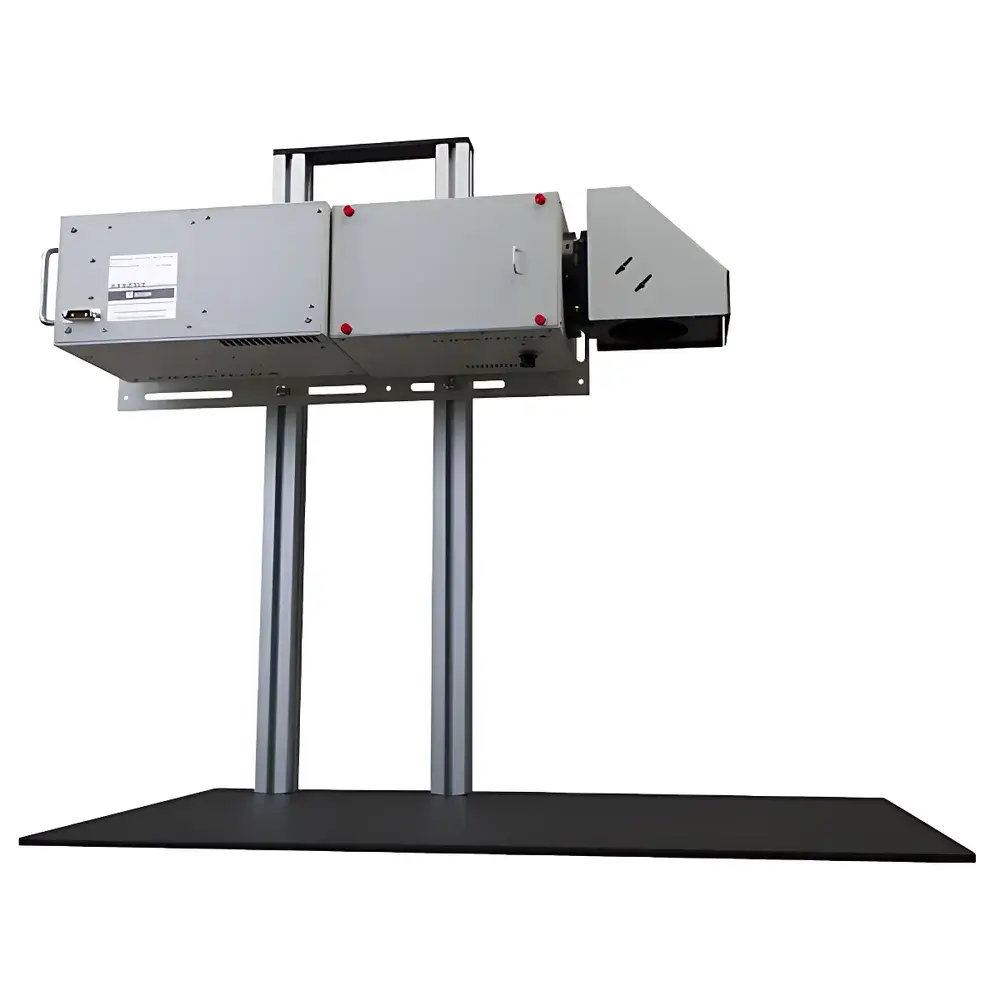
Sciencetech UHE-NL-300 High-Power AAA-Class Solar Simulator
| Brand | Sciencetech |
|---|---|
| Origin | Canada |
| Model | UHE-NL-300 |
| Spectral Range | 300–1800 nm |
| Irradiance Uniformity Class | A (<2%) |
| Temporal Instability Class | A+ (<1% over 10 s), A (<2% over 20 min) |
| Spectral Match Class | A per IEC 60904-9 & ASTM E927 |
| Collimation Half-Angle | 8° |
| AM1.5G Illuminated Area | 300 × 300 mm |
| AM0 Illuminated Area | 200 × 200 mm |
| Working Distance | 650 ± 10% mm |
| Lamp Type | Xenon, 1600 W |
| Power Supply | 220–240 V / 50 Hz, 10 A |
| Linear Regulation | <0.2% |
Overview
The Sciencetech UHE-NL-300 is a high-power, all-in-one AAA-class solar simulator engineered for precision photovoltaic (PV) device characterization, accelerated aging studies, and optoelectronic material testing under standardized terrestrial and extraterrestrial illumination conditions. Based on a stabilized, short-arc xenon lamp with integrated spectral filtering, the system delivers spectrally matched irradiance compliant with IEC 60904-9 (Edition 3, 2020) and ASTM E927-19 Class A requirements across the 300–1800 nm range. Its optical architecture employs reflective collimation and multi-element homogenization to achieve A-class spatial uniformity (<2% variation over the full 300 × 300 mm AM1.5G test plane) and A+-class temporal stability (<1% deviation over 10 seconds, <2% over 20 minutes). Unlike modular or benchtop configurations, the UHE-NL-300 integrates lamp power supply, cooling management, filter wheel actuation, shutter control, and real-time irradiance monitoring within a single thermally and mechanically stable enclosure—eliminating inter-unit alignment drift and reducing operational complexity in regulated laboratory environments.
Key Features
- AAA-class certification: Simultaneous Class A spectral match, Class A spatial uniformity, and Class A+ temporal stability per IEC 60904-9 and ASTM E927.
- High-efficiency optical design: Optimized reflector geometry and broadband dichroic coatings yield >65% effective optical throughput from lamp to target plane, enabling extended working distances (650 ± 65 mm) without compromising irradiance intensity or collimation.
- AM-filter versatility: Interchangeable air-mass filters (AM0, AM1.5G, AM1.5D) mounted on motorized filter wheel allow rapid reconfiguration for space-cell qualification (AM0), terrestrial PV module testing (AM1.5G), or spectral sensitivity mapping (custom filter sets).
- Integrated control architecture: Unified 10.1-inch capacitive touchscreen interface provides real-time access to lamp status, irradiance feedback, filter position, shutter state, thermal diagnostics, and calibration history—no external PC required for routine operation.
- Robust thermal management: Closed-loop liquid-cooled lamp housing and forced-air heat exchangers maintain lamp arc stability and spectral repeatability across continuous 8-hour operation cycles at full power (1600 W).
- Electromechanical safety compliance: Built-in interlocks include door-open shutdown, overtemperature cutoff, lamp end-of-life detection, and emergency stop circuitry meeting IEC 61000-6-2/6-4 EMC standards.
Sample Compatibility & Compliance
The UHE-NL-300 accommodates standard PV reference cells (e.g., KG5-filtered Si, GaAs, or multijunction references traceable to NREL or PTB), commercial solar modules up to 250 × 250 mm active area, and thin-film substrates requiring large-area, low-divergence illumination. Its 8° collimation half-angle ensures minimal angular dependence during quantum efficiency (QE) or external quantum efficiency (EQE) measurements. The system supports GLP-compliant workflows through hardware-enforced audit trails: all parameter changes, filter selections, irradiance calibrations, and session logs are timestamped and stored internally with SHA-256 hashing. Data export formats include CSV, HDF5, and XML, compatible with LIMS integration and FDA 21 CFR Part 11 electronic record validation when deployed with Sciencetech’s optional Validation Support Package (VSP).
Software & Data Management
Sciencetech’s SolarSim Control Suite (v4.2+) runs natively on the embedded industrial PC and offers both local touchscreen and remote Ethernet (TCP/IP) operation. Core functions include automated J-V sweep synchronization with source meters (Keysight B2900, Keithley 2450), real-time irradiance normalization using calibrated reference diodes, spectral mismatch correction per IEC 60904-7, and batch-mode calibration certificate generation (ISO/IEC 17025–traceable templates available). Raw sensor data—including photodiode voltage, lamp current/voltage, filter wheel encoder position, and thermal sensor readings—is logged at 100 Hz with nanosecond-precision hardware timestamps. Exported datasets include metadata headers specifying lamp hours, calibration date, filter ID, ambient temperature/humidity, and operator ID—enabling full traceability in ISO 17025-accredited laboratories.
Applications
- Primary and secondary calibration of reference solar cells per IEC 60904-2 and IEC 60904-4.
- Performance evaluation of perovskite, organic, and tandem solar cells under controlled AM1.5G or AM0 spectra.
- Light-induced degradation (LID) and UV-induced degradation (UVID) testing per IEC 61215-2 MQT 10/11.
- Spectral response and EQE mapping using monochromator-coupled setups.
- Thermal cycling and damp heat preconditioning illumination per IEC 61646 and UL 1703.
- Space solar array qualification under AM0 spectrum with vacuum-compatible mounting options (optional).
FAQ
What calibration standards does the UHE-NL-300 support?
It supports NIST-traceable calibration via integrated KG5-filtered silicon reference cells, with optional PTB- or NREL-certified cell sets available for primary calibration.
Can the system operate continuously for reliability testing?
Yes—the lamp power supply and thermal management subsystems are rated for uninterrupted 1000-hour operation at nominal output, with automatic duty-cycle limiting to extend lamp life beyond 1,200 hours.
Is remote operation and monitoring supported?
Yes—Ethernet-based SCPI command set enables integration into LabVIEW, Python (PyVISA), or MATLAB automation frameworks; TLS-secured web interface allows browser-based status monitoring.
How is spectral match verified and documented?
Pre-installed spectroradiometer (Ocean Insight QE Pro) performs automated spectral scans before each session; reports include IEC-defined match ratios (300–400 nm, 400–500 nm, etc.) and deviation plots referenced to AM1.5G reference spectra.
Does the system meet regulatory requirements for GMP or ISO 13485 environments?
With optional 21 CFR Part 11 compliance package (electronic signatures, role-based access control, immutable audit logs), it satisfies documentation rigor for medical device photobiomodulation testing and IVD light-source validation.




