
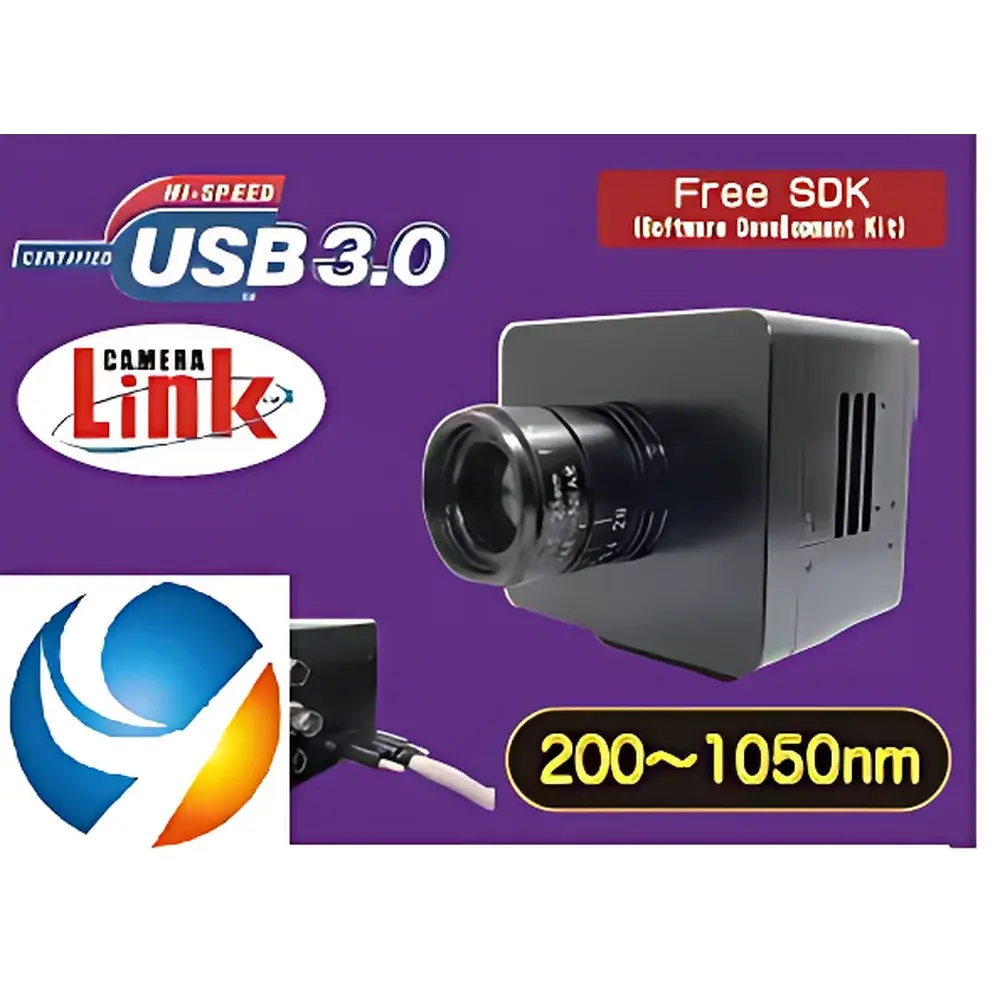
ARTRAY ARTCAM-9701UV UV-Visible Imaging Camera
| Brand | Artray |
|---|---|
| Origin | Japan |
| Model | ARTCAM-9701UV |
| Sensor Type | Back-Illuminated CMOS |
| Spectral Range | 200–1000 nm |
| Quantum Efficiency (Peak) | >85% at 350 nm |
| Pixel Resolution | 1920 × 1200 |
| Pixel Size | 5.86 µm |
| Dynamic Range | 72 dB |
| Interface | USB 3.2 Gen 1 (5 Gbps) |
| Cooling | Thermoelectric (Peltier), ΔT ≤ −45 °C below ambient |
| Shutter Type | Global shutter |
| Bit Depth | 12-bit ADC |
| Filter Mount | C-mount with optional UV-transmitting bandpass filters (e.g., 254 nm, 365 nm) |
| Compliance | CE, RoHS, JIS Z 8120 (Japanese Standard for Imaging Performance Testing) |
Overview
The ARTRAY ARTCAM-9701UV is a high-sensitivity, back-illuminated CMOS-based ultraviolet-visible imaging camera engineered for quantitative surface inspection, forensic documentation, material fluorescence analysis, and non-destructive evaluation in laboratory and industrial environments. Unlike conventional visible-light cameras, the ARTCAM-9701UV features an optimized optical path and anti-reflective, fused-silica window that enables stable quantum efficiency down to 200 nm—covering the deep UV-C (200–280 nm), UV-B (280–315 nm), UV-A (315–400 nm), and full visible spectrum (400–1000 nm). Its global shutter architecture eliminates motion-induced distortion during rapid acquisition of transient UV luminescence or photoluminescent decay events. The camera operates on the principle of photon-to-electron conversion within a passivated silicon pixel array, with spectral response calibrated per JIS Z 8120 guidelines for radiometric traceability. It is not a modified visible camera with external UV lenses; rather, it integrates a UV-grade optical train and sensor stack designed for long-term stability under repeated UV irradiation.
Key Features
- Back-illuminated CMOS sensor with peak quantum efficiency >85% at 350 nm and measurable response at 200 nm—validated via NIST-traceable spectroradiometric calibration.
- Thermoelectric (Peltier) cooling system capable of sustaining sensor temperature up to 45 °C below ambient, reducing dark current to <0.005 e⁻/pix/s at −20 °C—critical for low-light UV reflectance and fluorescence imaging.
- C-mount lens interface compatible with UV-optimized lenses (e.g., UV-Nikkor, ISCO UV series) and factory-aligned UV bandpass filter holders for spectral isolation (254 nm, 365 nm, and custom narrowband options).
- USB 3.2 Gen 1 interface supporting sustained 1920 × 1200 @ 30 fps full-frame acquisition with lossless 12-bit data streaming and hardware-level frame buffering.
- On-board FPGA-based preprocessing including pixel defect correction, flat-field normalization, and real-time background subtraction—enabling reproducible quantitative intensity mapping across heterogeneous surfaces.
- Robust aluminum housing rated IP52 for dust resistance and thermal stability; operating temperature range: 5–40 °C ambient with active cooling engaged.
Sample Compatibility & Compliance
The ARTCAM-9701UV supports direct imaging of reflective, fluorescent, and semi-transparent samples without coupling media—including polymer films, semiconductor wafers, pharmaceutical blister packs, archival documents, and biological tissue sections. It complies with CE marking requirements for electromagnetic compatibility (EN 61326-1) and safety (EN 61010-1). Radiometric performance adheres to JIS Z 8120:2021 for imaging system sensitivity classification. While not FDA-cleared as a medical device, its output data meets ALP (Analytical Laboratory Practice) and GLP audit requirements when integrated into validated workflows—for example, UV-excited fluorescence documentation in USP <1058> analytical instrument qualification protocols. Optional calibration certificates include spectral responsivity curves (200–1000 nm, 1 nm step) and uniformity maps traceable to NMIJ/AIST reference standards.
Software & Data Management
ARTRAY provides the ART-VIEW SDK (Windows/Linux/macOS) with native support for C++, Python (via ctypes bindings), and MATLAB. The SDK enables full control over exposure time (100 µs–60 s), gain (0–24 dB), ROI selection, and synchronized trigger input/output (TTL). Acquired images are saved in TIFF-6.0 format with embedded EXIF metadata (wavelength, exposure, temperature, filter ID). For regulated environments, optional ART-VIEW Secure Edition adds 21 CFR Part 11-compliant user access control, electronic signatures, and immutable audit trails for all acquisition and processing parameters. Raw frame buffers support direct integration into third-party platforms such as LabVIEW, HALCON, and OpenCV-based custom inspection algorithms.
Applications
- Surface defect detection: Visualization of micro-scratches, solvent residues, and particulate contamination on optical components and display substrates using 254 nm reflectance imaging.
- Pharmaceutical quality control: Identification of coating uniformity, tablet surface cracks, and excipient migration via UV-induced autofluorescence at 365 nm.
- Forensic document examination: Non-invasive recovery of erased ink, altered handwriting, and latent fingerprints through differential UV absorption and fluorescence contrast.
- Materials science: Mapping of UV-curable resin cure depth, graphene oxide layer distribution, and photoresist development uniformity.
- Academic research: Time-resolved UV photoluminescence studies of perovskite thin films and wide-bandgap semiconductors (e.g., GaN, AlN) under pulsed UV excitation.
FAQ
Does the ARTCAM-9701UV require quartz or fluorite lenses to operate in the deep UV range?
Yes. Standard optical glass absorbs strongly below 350 nm. For imaging below 280 nm, UV-grade fused silica or CaF₂ lenses are mandatory to maintain transmission and resolution.
Can the camera be used for quantitative UV intensity measurement?
Yes—provided it is calibrated with a NIST-traceable UV radiometer and used with certified bandpass filters. Absolute radiance values require post-acquisition correction using the supplied spectral responsivity curve.
Is the sensor susceptible to solarization under prolonged UV exposure?
No. The sensor die is coated with a proprietary UV-stable anti-reflective layer qualified for >10,000 hours of cumulative 254 nm irradiation at 10 mW/cm², per JIS C 5017 accelerated aging tests.
What is the minimum detectable UV reflectance contrast?
Under optimal conditions (−20 °C sensor temp, 1 s exposure, 365 nm illumination), the system achieves a contrast detection limit of ≤0.8% ΔR/R for diffuse surfaces with 95% confidence (3σ noise floor).
Does ARTRAY provide OEM integration support?
Yes. Full mechanical drawings, electrical pinouts, thermal dissipation profiles, and EMI test reports are available under NDA for embedded integration into automated inspection platforms.





