
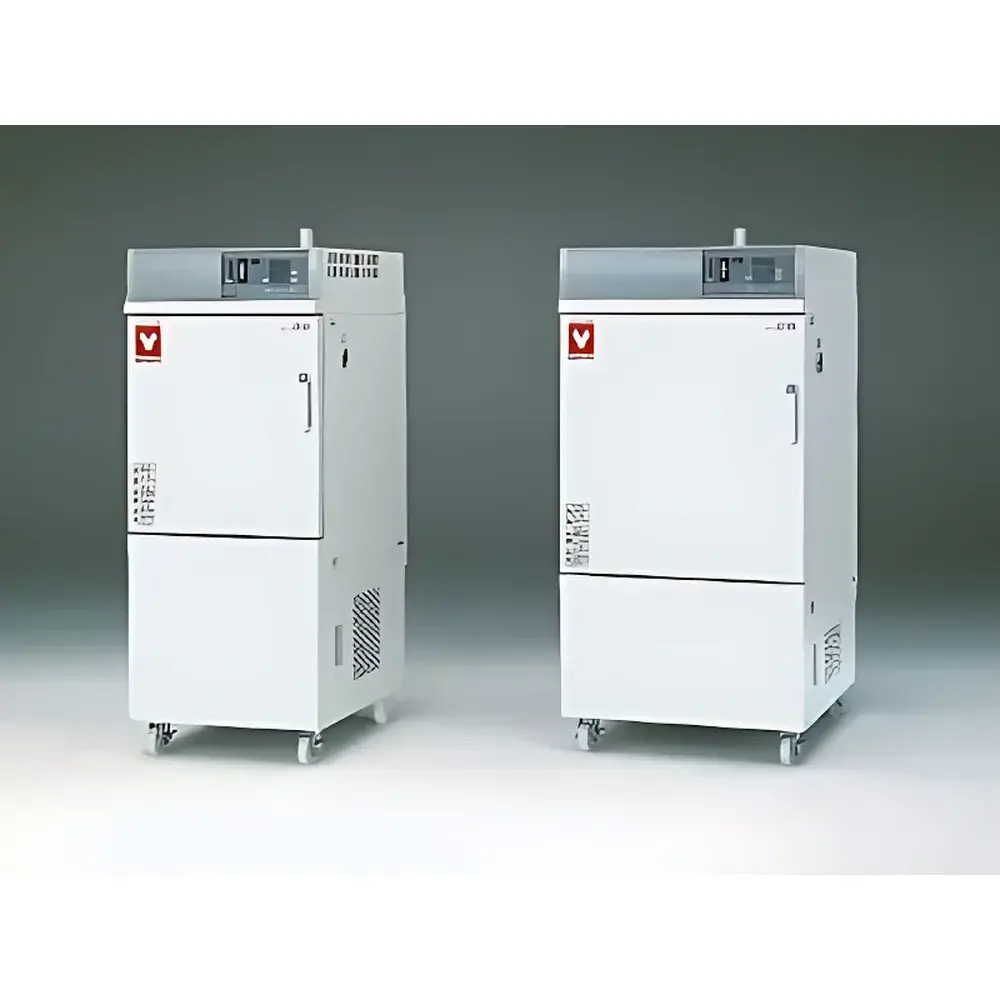
Yamato DE430C/630C & DT430C/630C Cleanroom-Grade Forced-Convection Constant-Temperature Oven
| Brand | Yamato |
|---|---|
| Origin | Japan |
| Model | DE430C / DE630C / DT430C / DT630C |
| Temperature Range | Ambient +30°C to 260°C (DE series) or 360°C (DT series) |
| Temp. Control Accuracy | ±0.3°C at setpoint |
| Temp. Uniformity | ±2.5°C (at 260°C) / ±4.0°C (at 360°C) |
| Cleanliness Class | ISO Class 5 (100 cleanroom grade, maintained during steady-state operation) |
| Construction | Stainless steel interior, powder-coated cold-rolled steel exterior |
| Insulation | Glass fiber + rock wool |
| Heating | Stainless steel sheathed heaters (2.5–5.2 kW) |
| Airflow | Horizontal forced convection with high-temp HEPA filter (≥99.97% @ 0.3 µm) |
| Controller | 3-segment PID with digital LED display (green for PV, red for SV), 30-step programmable ramp-soak profiles |
| Safety | Dual independent overtemperature protection (PID controller + mechanical overtemp limiter), heater open-circuit detection, SSR short-circuit monitoring, earth-leakage circuit breaker, key lock, power-loss recovery |
| Power Supply | 3-phase AC 380 V, 50/60 Hz |
| Internal Volume | 91 L (DE/DT430C) or 216 L (DE/DT630C) |
| Weight | ~220–270 kg |
Overview
The Yamato DE430C, DE630C, DT430C, and DT630C series are precision-engineered cleanroom-compatible forced-convection ovens designed for thermal processing under particle-controlled environments. Unlike standard drying ovens, these models integrate horizontal laminar airflow with high-temperature-rated HEPA filtration (rated ≥99.97% efficiency for 0.3 µm particles) to maintain ISO Class 5 (formerly Federal Standard 209E Class 100) cleanliness during both temperature stabilization and dynamic thermal cycling. The core architecture employs a dual-sensor strategy: one K-type thermocouple embedded within the HEPA filter housing enables proximity-based temperature feedback near the sample zone, while a second sensor supports independent overtemperature safety cutoff. This configuration ensures accurate thermal control without compromising particulate integrity—critical for semiconductor wafer baking, LCD alignment layer curing, MEMS packaging, and high-reliability electronic component aging tests where outgassing, surface oxidation, or airborne contamination must be rigorously minimized.
Key Features
- Horizontal forced-air circulation with integrated high-temperature HEPA filter (operational up to 360°C), enabling sustained ISO Class 5 cleanliness during static and dynamic temperature conditions.
- Dual-sensor temperature management: primary PID-controlled thermocouple mounted adjacent to the filter outlet for sample-zone-referenced control; secondary independent thermocouple feeding a dedicated mechanical overtemperature limiter (compliant with IEC 61000-4-11 and EN 61010-1 safety requirements).
- Three-segment PID controller with full programmability—supporting up to 30-step thermal profiles (configurable as 30×1, 15×2, or 10×3 steps), timer-based start/stop, auto-recovery after power interruption, and user-adjustable deviation compensation.
- Robust thermal insulation combining glass fiber and rock wool layers, minimizing external surface temperature rise and improving energy efficiency during extended high-temperature holds.
- Front-access design with optimized door seal geometry and low-turbulence opening mechanism to suppress particle ingress during loading/unloading—validated per ISO 14644-3 Annex B protocols for cleanroom equipment qualification.
- Comprehensive self-diagnostic system continuously monitors heater continuity, thermocouple integrity, SSR functionality, and supply voltage stability—logging fault codes accessible via controller interface for GLP-compliant troubleshooting.
Sample Compatibility & Compliance
These ovens accommodate a broad range of substrates including silicon wafers (up to 300 mm), TFT-LCD panels, ceramic packages, optical lenses, and medical-grade polymer components. Interior chamber construction uses electropolished stainless steel (SUS304), ensuring low metal ion leaching and resistance to halogenated cleaning agents used in microfabrication facilities. All electrical and thermal subsystems comply with IEC 61010-1:2010 (Safety Requirements for Electrical Equipment for Measurement, Control, and Laboratory Use) and meet CE marking requirements for EMC immunity (IEC 61326-1) and low-voltage directive (2014/35/EU). Optional RS485 communication enables integration into centralized facility monitoring systems compliant with FDA 21 CFR Part 11 for electronic record integrity and audit trail generation.
Software & Data Management
While the base unit operates via an embedded microcontroller with no PC dependency, optional RS485 interface supports Modbus RTU protocol for real-time temperature logging, remote parameter setting, and alarm status polling. When paired with validated third-party SCADA or LIMS platforms (e.g., Siemens Desigo CC, LabVantage), the oven satisfies ALCOA+ data integrity principles—including attributable, legible, contemporaneous, original, accurate, complete, consistent, enduring, and available records. Built-in timer functions (1 min–999 h 50 min) with “wait-on-timer-expiry” logic support unattended overnight runs, and all operational events—including program execution, manual overrides, and safety interventions—are timestamped and retained in non-volatile memory for post-run review.
Applications
- Semiconductor manufacturing: pre-bake and post-apply cure of photoresists, hard bake of spin-on dielectrics, and wafer-level stress relief annealing.
- Flat-panel display production: polyimide alignment layer curing, color filter matrix baking, and encapsulant crosslinking under inert nitrogen atmosphere (via standard 8 mm barbed N₂ inlet).
- Advanced packaging: moisture removal from molded IC carriers prior to hermetic sealing; flux residue volatilization in SMT reflow simulation studies.
- Research & development: thermal aging of aerospace composites, catalyst activation under controlled oxidative environments, and polymer degradation kinetics under ISO 5 particle constraints.
- Quality assurance labs: stability testing per ICH Q1A(R2) guidelines for pharmaceutical excipients requiring dry-heat sterilization validation (e.g., anhydrous lactose, microcrystalline cellulose).
FAQ
What cleanroom classification is maintained during temperature ramping?
ISO Class 5 (100) cleanliness is verified and sustained only during steady-state operation. During ramp phases, particle counts may transiently exceed Class 5 due to convective turbulence—however, the horizontal HEPA-filtered airflow architecture minimizes peak excursions relative to vertical-flow alternatives.
Can nitrogen purging be automated?
The standard N₂ inlet (8 mm barbed fitting) supports manual flow regulation via external rotameter. For closed-loop inert gas control, optional mass flow controllers (MFCs) with 4–20 mA analog input can be integrated using the available temperature output terminal.
Is the oven suitable for GMP-regulated environments?
Yes—when equipped with RS485 + audit trail-capable software and operated under documented SOPs, the system meets core GMP requirements for equipment qualification (IQ/OQ/PQ), calibration traceability (NIST-traceable K-type thermocouples), and data integrity per Annex 11.
How many shelf levels are configurable without compromising airflow uniformity?
Maximum recommended load is 12 shelves (DE/DT430C) or 17 shelves (DE/DT630C) at 30 mm spacing. Additional shelves beyond these limits degrade horizontal velocity profile consistency and may impact temperature uniformity beyond specified ±2.5°C/±4.0°C tolerances.
Does the controller support validation documentation packages?
Yamato provides Factory Acceptance Test (FAT) reports, calibration certificates for included thermocouples, and electrical safety test records. Full 3Q documentation (including URS, DQ/IQ/OQ templates) is available upon request for regulated installations.



