
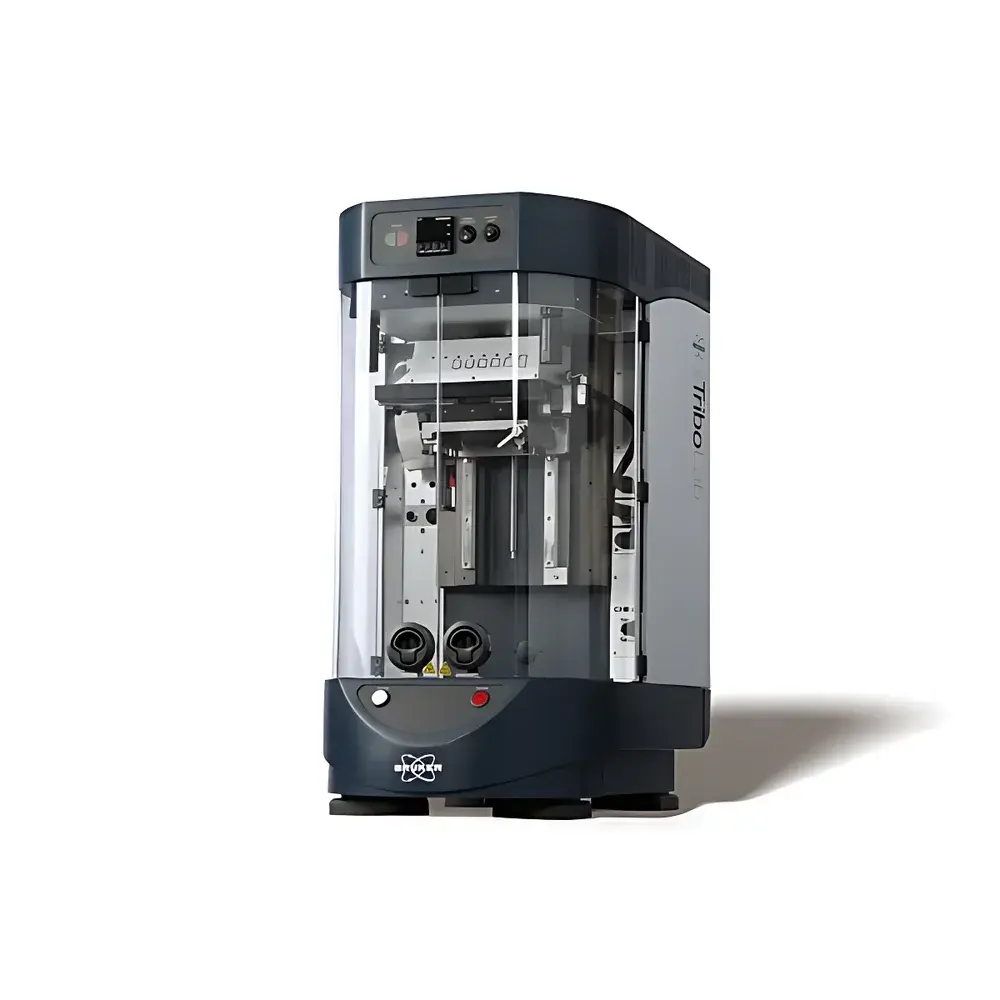
Bruker UMT TriboLab Universal Tribological Tester
| Brand | Bruker |
|---|---|
| Origin | Germany |
| Model | UMT TriboLab |
| Instrument Type | Multifunctional Tribological Tester |
| Maximum Friction Force | 2000 N |
| Force Resolution | 1 mN |
| Temperature Range | –30 °C to 1000 °C (configurable via thermal modules) |
| Vertical Travel | 150 mm (0.5 µm resolution, 0.002–10 mm/s) |
| Horizontal Travel | 75 mm (0.25 µm resolution, 0.002–10 mm/s) |
| Rotational Speed | 0.1–5000 rpm |
| Reciprocating Frequency | 0.1–60 Hz |
| Torque Capacity | 5 N·m @ 100 rpm / 2.5 N·m @ 5000 rpm |
| Data Acquisition | 16-bit, up to 200 kHz (8 standard channels, expandable to 16) |
| Power Requirement | 200 V AC, 8 kW recommended |
Overview
The Bruker UMT TriboLab is a high-precision, modular universal tribological tester engineered for quantitative mechanical and surface interaction analysis under controlled environmental and dynamic loading conditions. Based on Bruker’s proven UMT platform—introduced in 2000 and continuously refined for over two decades—the TriboLab represents the current state-of-the-art in contact mechanics instrumentation. It operates on fundamental principles of tribosystem characterization: simultaneous measurement of normal load, friction force, displacement, velocity, torque, temperature, and (optionally) acoustic emission, electrical contact resistance, and lubricant flow. Its architecture supports standardized test geometries—including pin-on-disk, ball-on-flat, ring-on-disk, block-on-ring, and three-point bending—and accommodates both static and dynamic loading protocols across sliding, rolling, reciprocating, and oscillatory motion regimes. Designed for research laboratories, R&D centers, and quality control facilities in automotive, aerospace, biomedical, energy, and materials science sectors, the UMT TriboLab delivers traceable, reproducible data compliant with international test standards.
Key Features
- Modular Drive Architecture: Tool-free interchangeable drive units (rotary, linear, reciprocating, ring-on-disk) enable rapid reconfiguration without recalibration; blind-mate connectors auto-configure power, cooling, and signal interfaces via embedded Tribo ID chips.
- High-Fidelity Sensing System: Eleven calibrated “Gold Series” load cells spanning 1 mN to 2000 N, featuring <0.02% full-scale noise floor and optimized analog front-end circuitry for minimal signal drift and thermal artifact.
- Precision Motion Control: Dual-axis servo-controlled Z-stage (150 mm travel, 0.5 µm resolution) and horizontal stage (75 mm, 0.25 µm resolution); rotational drives support 0.1–5000 rpm with torque capacity up to 5 N·m at low speed.
- Environmental Flexibility: Integrated temperature control from –30 °C to 1000 °C using application-specific chambers (e.g., cryogenic, inert gas, vacuum-compatible, high-temperature furnace); optional humidity control (5–85% RH) and optical microscopy (5×/10×/25× objectives + 1280 × 1024 digital camera).
- Real-Time Multi-Channel Acquisition: 16-bit DAQ system sampling at up to 200 kHz across 8 standard channels (expandable to 16), synchronized with motion commands and environmental parameters for time-correlated event analysis.
Sample Compatibility & Compliance
The UMT TriboLab accepts specimens ranging from sub-millimeter coatings on silicon wafers to macro-scale brake pads (up to 100 mm diameter). Sample holders are mechanically indexed and thermally stabilized to ensure repeatable positioning and thermal equilibrium. The system complies with ASTM G99 (pin-on-disk wear), ASTM D3702 (thrust washer friction), ASTM D2625 (lubricant film strength), ISO 7148-2 (tribocorrosion), DIN 50324 (rolling contact fatigue), and JIS H 8602 (hardness and wear testing). Optional hardware and software modules support GLP/GMP workflows, including FDA 21 CFR Part 11-compliant audit trails, electronic signatures, and secure user-role management within TriboScript.
Software & Data Management
TriboScript is a graphical, icon-driven scripting environment that eliminates syntax-based programming barriers. Users construct test sequences by dragging validated icons (e.g., “Ramp Load”, “Hold Temp”, “Acquire AE”) into a workflow canvas; only physically and logically compatible icons connect, and required parameters (e.g., ramp rate, dwell time, threshold values) are prompted contextually. Preloaded templates cover ASTM D3702, ASTM G133, ISO 20808, and OEM-specific protocols (e.g., SAE J2527 for clutch materials). Post-test, the Viewer module enables synchronized multi-channel visualization, statistical wear volume calculation (via profilometry integration), coefficient-of-friction trend analysis, and automated report generation with embedded metadata (operator, timestamp, calibration ID, environmental logs). All raw data is stored in open HDF5 format for third-party analysis interoperability.
Applications
- Development and qualification of automotive brake and clutch friction materials under thermal fade and recovery conditions
- High-frequency reciprocating rig (HFRR) testing per ASTM D6079 for lubricant anti-wear performance
- Tribocorrosion studies of biomedical alloys (e.g., CoCrMo, Ti6Al4V) in simulated physiological fluids
- High-temperature wear mapping of ceramic matrix composites (CMCs) and thermal barrier coatings
- Microscale adhesion and shear failure analysis of thin-film coatings using nano- and micro-indentation-integrated modes
- Electrical contact resistance monitoring during fretting wear of connector alloys (Cu–Sn, Ag–Ni)
- Three-point bending fatigue combined with in-situ friction monitoring for structural polymer evaluation
FAQ
What environmental conditions can the UMT TriboLab accommodate during testing?
The system supports temperature ranges from –30 °C to 1000 °C using interchangeable thermal modules; optional humidity control (5–85% RH) and inert/vacuum environments are available via chamber add-ons.
Is the UMT TriboLab compatible with existing Bruker UMT legacy hardware?
Tribo ID chip-based auto-recognition ensures backward compatibility with most UMT-2/UMT-3 transducers and fixtures; however, firmware and driver updates may be required for full feature parity.
How does TriboScript ensure method reproducibility across operators and sites?
Each script embeds hardware configuration, calibration constants, and environmental setpoints; execution logs include timestamps, operator IDs, and versioned software/firmware identifiers—enabling full traceability and cross-laboratory validation.
Can the system perform real-time wear volume quantification?
Yes—when integrated with Bruker’s optical profilometers or stylus-based surface analyzers, TriboScript triggers pre- and post-test topography scans and computes volumetric wear loss using ISO 25178-compliant algorithms.
What safety and regulatory certifications does the instrument carry?
The UMT TriboLab conforms to IEC 61000-6-2 (EMC immunity) and IEC 61000-6-4 (EMC emissions); CE marking is applied per Machinery Directive 2006/42/EC; optional configurations meet ATEX Zone 2/22 requirements for explosive atmospheres.



