
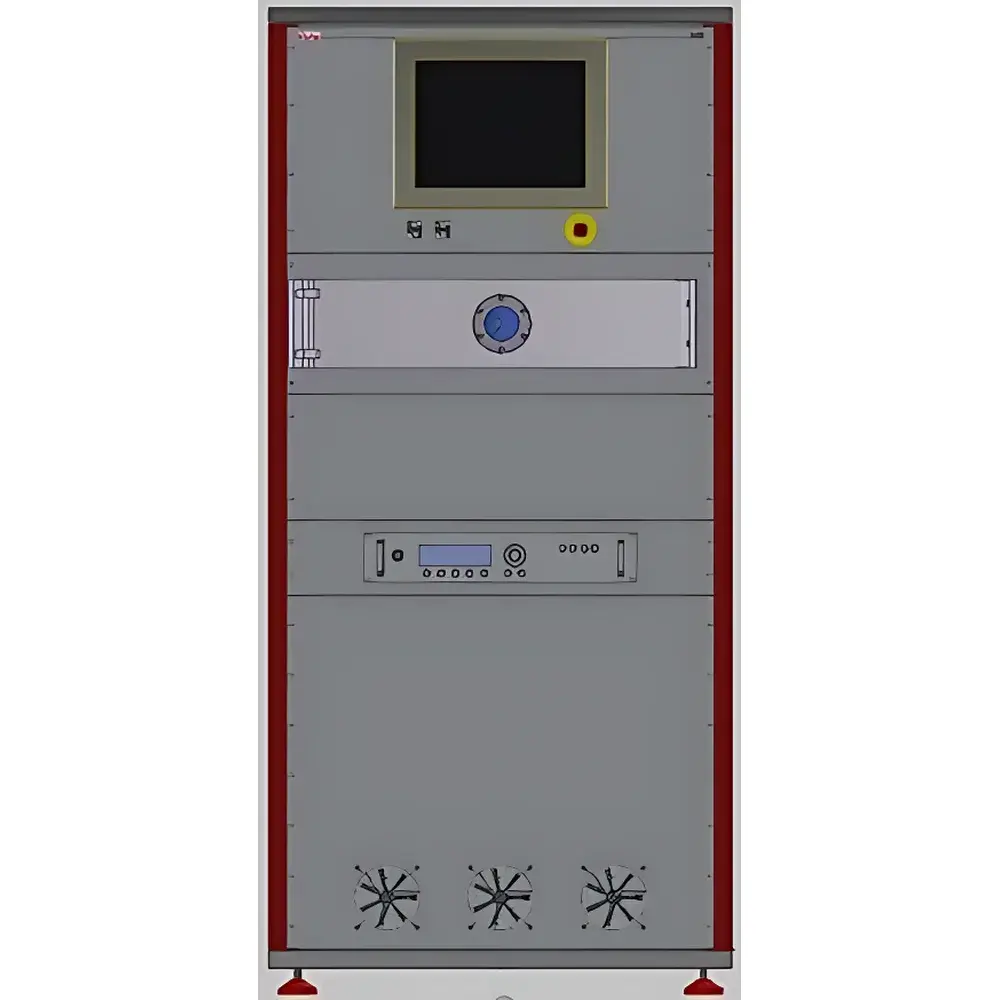
Diener Tetra45 Low-Pressure Plasma Surface Treater
| Brand | Diener |
|---|---|
| Origin | Germany |
| Model | Tetra45 |
| RF Frequency | 13.56 MHz |
| Power Output | 0–600 W |
| Chamber Volume | 45 L |
| Chamber Material | Anodized Aluminum Alloy |
| Process Gas Inlets | 2 MFC-Controlled Lines (O₂, Ar, N₂, He) |
| Purge & Vent Lines | 1 each |
| Control System | Full PC-Based Automation with PID-Controlled Vacuum Monitoring |
| Display | Optional 7″ or 15″ TFT Touch Interface |
| Vacuum Gauge Range | 0–9.99 mbar (digital PID readout) |
| Rotating Sample Tray | Ø ≤ 550 mm |
| Dimensions (Chamber) | 572 × 650 × 125 mm (W×D×H) |
| Overall Footprint | 850 × 800 × 1700 mm (W×D×H) |
| Electrical Supply | 3-Phase AC 400 V, 16 A |
| Standard Vacuum Pump | Leybold D65C (oil-sealed rotary vane) |
| Optional RF Generators | 2.45 GHz (0–850 W) or 100 kHz (0–500 W) |
| Optional Dry Pump | Kashiyama NEODRY36E |
Overview
The Diener Tetra45 is a precision-engineered low-pressure plasma surface treater designed for reproducible, residue-free surface activation, cleaning, and functionalization in R&D and pilot-scale production environments. Operating on the principle of capacitively coupled radiofrequency (CCP) plasma generation at 13.56 MHz, the system ionizes process gases—such as oxygen, argon, nitrogen, or helium—within a controlled vacuum environment to produce reactive species (ions, radicals, UV photons) that interact physically and chemically with substrate surfaces. This non-thermal, dry processing method enables nanoscale removal of organic contaminants (e.g., photoresist residuals, oils, adhesives), selective etching of thin films, and covalent modification of surface chemistry—without altering bulk material properties. The Tetra45’s 45-liter aluminum chamber—optimized for uniform field distribution and thermal stability—is particularly suited for semiconductor packaging, microelectronics interconnect preparation, and high-value optical component treatment where particle control, process repeatability, and traceable parameter logging are critical.
Key Features
- Robust anodized aluminum chamber (572 × 650 × 125 mm) engineered for electromagnetic shielding, thermal uniformity, and long-term vacuum integrity—compatible with cleanroom Class 1000 and ISO 14644-1 environments.
- Full PC-based control architecture (Diener PCCE Soft / Full PC software) enabling precise, repeatable recipe management—including real-time monitoring of RF power, forward/reflected power, pressure (0–9.99 mbar), gas flow rates, and process time.
- Dual mass flow controllers (MFCs) supporting independent, calibrated delivery of two process gases—enabling multi-step sequences (e.g., O₂ ashing followed by Ar sputtering) without manual intervention.
- Integrated rotating sample tray (max. Ø 550 mm) ensuring homogeneous plasma exposure across irregular or multi-part substrates; rotation speed and dwell time programmable per recipe.
- PID-regulated vacuum control with digital pressure feedback, minimizing overshoot and drift during pump-down and process stabilization phases.
- Modular RF generator options: standard 13.56 MHz (0–600 W), optional 2.45 GHz (0–850 W) for higher electron density, or 100 kHz (0–500 W) for enhanced ion bombardment—selected based on application-specific plasma kinetics requirements.
Sample Compatibility & Compliance
The Tetra45 accommodates substrates ranging from wafers (up to 8″), PCBs, ceramic packages (BGA, CSP, COB), optical lenses, polymer films, and medical device components. Its aluminum chamber and inert gas compatibility ensure no metallic contamination—a prerequisite for semiconductor front-end-of-line (FEOL) and MEMS fabrication. The system supports compliance with ASTM F209 (standard practice for cleanliness of aerospace hardware), ISO 15730 (plasma cleaning of metallic surfaces), and IEC 61000-4-3 (EMC immunity). When operated with full audit-trail-enabled software and connected to a validated networked PC, the platform meets GLP/GMP documentation requirements per FDA 21 CFR Part 11 for regulated QC laboratories.
Software & Data Management
Diener’s Full PC software provides a Windows-based interface for complete system orchestration: recipe creation, execution scheduling, real-time parameter visualization, and automated data export (CSV/Excel). All process events—including vacuum ramp profiles, RF ignition timing, gas valve actuation, and fault logs—are timestamped and stored locally with user-accessible backups. The software supports password-protected user roles (Operator, Engineer, Administrator), electronic signatures, and configurable alarm thresholds. Optional integration with laboratory information management systems (LIMS) via OPC UA or TCP/IP enables centralized data aggregation for statistical process control (SPC) and quality reporting.
Applications
- Wafer-level resist stripping and post-etch residue removal prior to metallization.
- Surface activation of polyimide, PTFE, and silicone elastomers to improve adhesion in wire bonding and encapsulation.
- Cleaning and hydrophilization of glass and fused silica optics prior to anti-reflective coating deposition.
- Removal of native oxides and carbon contamination from Cu/Ni/Au bond pads in advanced packaging.
- Functionalization of PET, PP, and PE films for improved ink adhesion in printed electronics.
- Pre-treatment of ceramic and alumina substrates to enhance solder wettability and underfill flow in power modules.
FAQ
What vacuum level is required for stable plasma ignition?
Stable plasma ignition typically occurs between 0.1–5 mbar, depending on gas type and power setting. The integrated PID-controlled vacuum system maintains setpoint accuracy within ±0.02 mbar during operation.
Can the Tetra45 be used for atmospheric plasma processes?
No—the Tetra45 is a low-pressure (vacuum) plasma system requiring base pressure < 1 × 10⁻² mbar for reliable operation. Atmospheric plasma requires fundamentally different electrode design and power coupling.
Is remote diagnostics supported?
Yes—via secure RDP or VNC over LAN/WAN, provided network policies permit authenticated access to the host PC running Full PC software.
What maintenance intervals are recommended for the vacuum pump?
With standard Leybold D65C oil-sealed pump, oil change every 500 operating hours and filter replacement every 1,000 hours are advised; dry pump variants (e.g., Kashiyama NEODRY36E) eliminate oil service but require periodic diaphragm inspection.
Does the system support custom chamber depth configurations?
Yes—chamber depth can be extended up to 1200 mm (standard depth is 125 mm); custom dimensions require factory engineering review and lead-time adjustment.



