
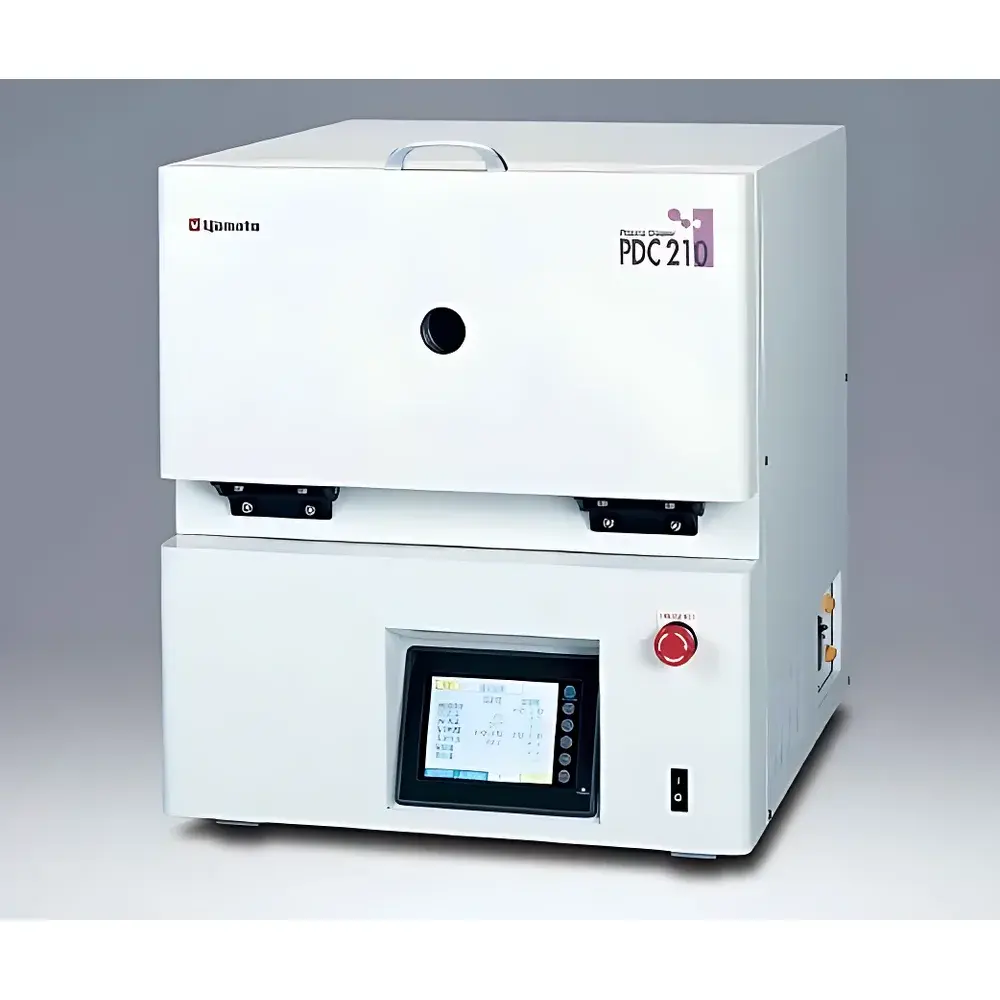
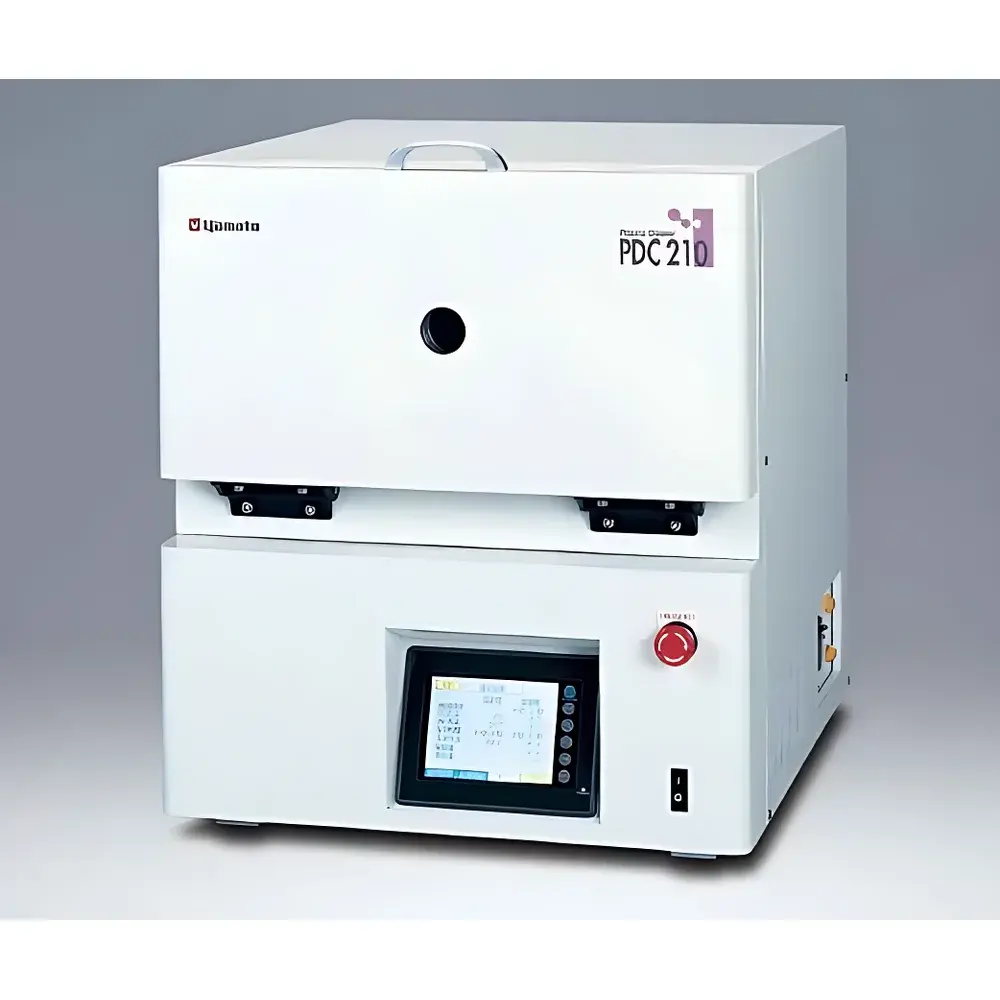
Yamato PDC200 / PDC210 / PDC510 Plasma Etching and Cleaning System
| Brand | Yamato |
|---|---|
| Origin | Japan |
| Model | PDC200 / PDC210 / PDC510 |
| RF Frequency | 13.56 MHz |
| RF Power Output | up to 300 W (PDC200), up to 500 W (PDC210 & PDC510) |
| Electrode Configuration | Parallel-plate, fixed |
| Chamber Dimensions | 400 × 250 × 150 mm (PDC200), 500 × 300 × 200 mm (PDC210), 700 × 700 × 700 mm (PDC510) |
| Electrode Size | 250 × 170 mm (PDC200), 400 × 200 mm (PDC210 & PDC510) |
| Chamber Material | Monolithic anodized aluminum (CF₄-compatible, corrosion-resistant) |
| Gas Inlets | 2 reactive gas lines (Ar/O₂), 1 purge/fill line (N₂ or dry air) |
| Gas Flow Control | Analog mass flow meters |
| Vacuum Interface | Compatible with Kashiyama Neodry30E dry pump (500 L/min) |
| Control System | Integrated LCD touchscreen with automated sequence logic |
| Operating Modes | RIE (Reactive Ion Etching) standard |
| Power Supply | Single-phase AC 100 V, 15 A, 50/60 Hz (PDC200) |
Overview
The Yamato PDC200, PDC210, and PDC510 series are laboratory-scale plasma surface treatment systems engineered for precision dry etching and surface activation in microelectronics, advanced packaging, and materials R&D environments. These instruments operate on the principle of low-pressure radiofrequency (RF) plasma generation at 13.56 MHz — a frequency designated for industrial, scientific, and medical (ISM) use and widely adopted for its stable coupling into reactive gas discharges. The systems utilize parallel-plate capacitive coupling to generate uniform, controllable plasma within a sealed, corrosion-resistant aluminum chamber. Unlike atmospheric plasma tools, these vacuum-based systems enable reproducible, residue-free removal of organic contaminants (e.g., photoresist residues, epoxies, fluxes) and native metal oxides (e.g., CuO, Al₂O₃) from substrates such as CSB, BGA, and COB interposers — critical for improving wire bond adhesion, underfill wettability, and solder mask reliability. The PDC platform supports both Reactive Ion Etching (RIE) mode — delivering directional ion bombardment for anisotropic etch profiles — and optional Downstream Plasma (DP) mode, which provides radical-dominated, low-damage surface functionalization ideal for polymer activation without substrate sputtering.
Key Features
- Monolithic anodized aluminum reaction chamber with integrated CF₄ resistance — eliminates galvanic corrosion and ensures long-term vacuum integrity during aggressive fluorine-based process chemistries.
- High-uniformity parallel-plate electrode architecture with fixed spacing, optimized for consistent plasma density distribution across full wafer or panel-scale samples (up to 400 × 200 mm).
- Digitally synchronized RF power delivery (300 W max for PDC200; 500 W max for PDC210/PDC510) with real-time impedance matching feedback for stable plasma ignition and sustained operation under varying gas load conditions.
- Intuitive 7-inch LCD touchscreen interface with pre-programmable process recipes, stepwise time/power/gas sequencing, and password-protected parameter locking — compliant with GLP documentation requirements.
- Dual-gas manifold supporting independent Ar/O₂ reactive gas control plus N₂ or dry air purge/fill capability — enabling oxidation, reduction, and inert passivation protocols within a single run.
- Modular design accommodating optional DP mode upgrade — physically decoupling plasma generation from the sample zone to minimize ion-induced damage while retaining high radical flux for surface hydrophilization or amine grafting.
Sample Compatibility & Compliance
The PDC series accommodates rigid and flexible substrates up to 25 mm thick, including FR-4, polyimide, silicon wafers, ceramic packages, and metal-coated flex circuits. Sample loading is manual via front-access door with pneumatic sealing; no robotic handling is required. All models meet IEC 61000-6-3 (EMC emission) and IEC 61000-6-4 (industrial immunity) standards. Vacuum integrity complies with ISO 2859-1 sampling plans for leak-rate verification (<1 × 10⁻⁶ Pa·m³/s He). For regulated environments, the touchscreen control system supports audit-trail logging (user ID, timestamp, parameter changes) — aligning with FDA 21 CFR Part 11 expectations when paired with networked data archiving solutions. Gas handling conforms to ISO 8573-1 Class 2 compressed air purity specifications for purge lines.
Software & Data Management
Process execution is governed by embedded firmware with non-volatile memory for ≥100 user-defined recipes. Each recipe stores RF power ramp profiles, gas flow setpoints (Ar/O₂ ratio, total flow), pressure setpoints (via optional capacitance manometer), and stage dwell times per step. Real-time monitoring includes forward/reflected RF power, chamber pressure (via Pirani gauge), and gas line status indicators. Data export is supported via USB 2.0 to CSV format — compatible with LIMS integration and statistical process control (SPC) platforms. Optional Ethernet module enables remote diagnostics, SNMP-based alarm notification, and OPC UA server compatibility for MES-level connectivity.
Applications
- Pre-wire-bond cleaning of Au/Al pads on flip-chip substrates to eliminate carbonaceous contamination and restore surface stoichiometry.
- Removal of epoxy mold compound (EMC) flash and silicone release agents from package exteriors prior to conformal coating.
- Surface activation of polyimide flex circuits to increase surface energy (>72 mN/m) for improved adhesive bonding and solder mask adhesion.
- Controlled oxide thinning on copper traces to reduce interfacial resistance in high-frequency RF modules.
- Plasma ashing of residual photoresist after lithographic patterning in MEMS and sensor fabrication workflows.
- Functionalization of PDMS microfluidic channels with carboxyl or amine groups for covalent biomolecule immobilization.
FAQ
What vacuum pump is recommended for optimal performance?
The Kashiyama Neodry30E dry scroll pump (500 L/min pumping speed) is factory-qualified and supplied as the reference configuration. Alternative pumps must provide ≤1 × 10⁻² Pa base pressure and be chemically compatible with O₂/Ar/CF₄ mixtures.
Can the system operate with gases other than Ar and O₂?
Yes — the dual-gas manifold supports any non-corrosive, non-toxic process gas compatible with aluminum wetted parts (e.g., N₂, H₂, CHF₃, SF₆), subject to external gas cabinet safety certification and chamber material compatibility review.
Is remote service access available?
Standard models include RS-232 and USB service ports. Optional Ethernet expansion enables secure remote diagnostics via TLS-encrypted VNC session — requires customer-provided firewall whitelisting and VLAN segmentation.
How is process repeatability validated?
Yamato provides a certified calibration protocol using XPS surface analysis of SiO₂/Si reference wafers, correlating O/C atomic ratio shift with RF power and exposure time. Users may perform in-house verification using contact angle goniometry or FTIR-ATR spectroscopy.
Does the system support automated batch processing?
No — the PDC series is designed for manual single-chamber R&D use. For high-throughput production, Yamato offers the PDC-PRO series with load-lock chambers and SECS/GEM interface support.



