
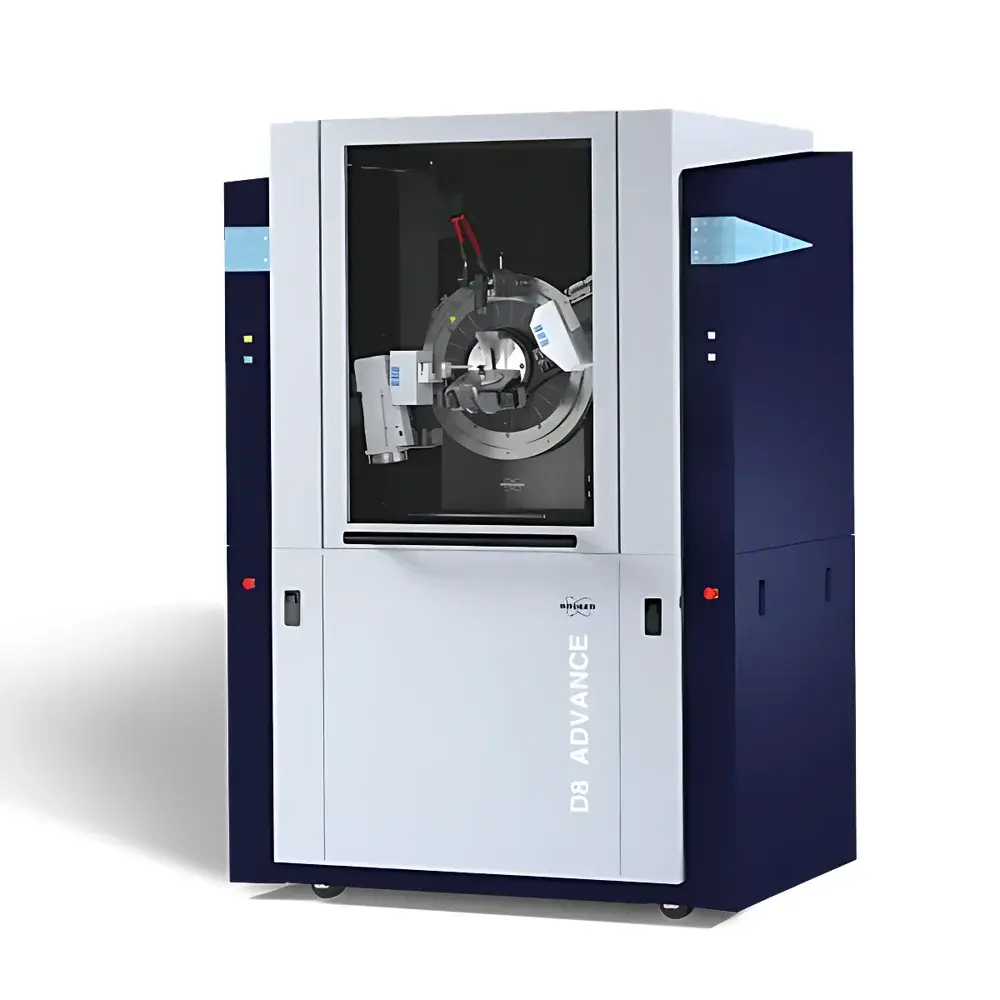
Bruker D8 ADVANCE X-ray Diffractometer
| Brand | Bruker |
|---|---|
| Origin | USA |
| Manufacturer Type | Authorized Distributor |
| Origin Category | Imported |
| Model | D8 ADVANCE |
| Instrument Type | Powder and Multi-Mode X-ray Diffractometer |
| Beam Geometry Options | BB (Bragg–Brentano), Parallel-Beam, TWIN, TRIO, Göbel Mirror, Johansson Monochromator |
| Radiation Sources Supported | Cr, Co, Cu, Mo, Ag |
| Detector | EIGER2 R 500K Hybrid Photon Counting Detector |
| Energy Resolution | <380 eV @ 8 keV |
| Detection Modes | 0D, 1D, 2D |
| Angular Range (2θ) | <1° to >150° |
| Sample Environment Compatibility | Temperature: 85 K – 2500 K |
| Pressure | 10⁻⁴ mbar – 100 bar |
| Humidity | 5% – 95% RH |
| Automation | FLIPSTICK (9-position), AUTOCHANGER (90-position) |
| Software Suite | DIFFRAC.SUITE (including DIFFRAC.EVA, DIFFRAC.TOPAS, DIFFRAC.LEPTOS, DIFFRAC.TEXTURE, DIFFRAC.SAXS, DIFFRAC.WIZARD) |
Overview
The Bruker D8 ADVANCE is a high-performance, multi-mode X-ray diffractometer engineered for precision powder X-ray diffraction (XRD), small-angle X-ray scattering (SAXS), wide-angle X-ray scattering (WAXS), X-ray reflectivity (XRR), and non-ambient structural characterization. Based on Bragg’s law and constructive interference of monochromatic X-rays scattered by crystalline lattices, the system delivers quantitative phase identification, crystallite size and strain analysis, residual stress mapping, thin-film metrology, and pair distribution function (PDF) analysis. Its modular DA VINCI (Design for Automatic Verification, Integration, and Configuration) architecture enables rapid, tool-free reconfiguration between optical geometries—including Bragg–Brentano (BB), parallel-beam, TWIN, and TRIO—without manual realignment or component disassembly. This eliminates configuration drift and ensures long-term angular accuracy traceable to NIST-traceable standards.
Key Features
- TRIO and TWIN optical path switching via software-controlled motorized beam optics, enabling seamless transition among up to six distinct beam geometries (BB, parallel-beam, Göbel mirror, Johansson monochromator, etc.)
- Motorized divergence slits and anti-scatter plates for dynamic beam optimization and real-time synchronization during scanning
- EIGER2 R 500K hybrid photon-counting detector with <380 eV energy resolution at 8 keV, supporting simultaneous 0D point detection, 1D line scans, and full-frame 2D area detection
- BRAGG 2D mode for efficient collection of 2D diffraction patterns using divergent primary beams—ideal for texture analysis and anisotropic materials
- DAVINCI-integrated goniometer with dual-circle design, independent stepper motors, and high-resolution optical encoders ensuring angular reproducibility better than ±0.0001°
- Rotatable X-ray tube with on-the-fly switching between line-focus and point-focus configurations—no cable or coolant disconnect required
- FLIPSTICK (9-sample) and AUTOCHANGER (90-sample) automated sample handling systems compatible with reflection and transmission geometries
- Full-range variable detector positioning (γ and 2θ) with panoramic, tool-free adjustment—maximizing either angular coverage or resolution per application requirement
Sample Compatibility & Compliance
The D8 ADVANCE accommodates diverse sample forms: powders, bulk solids, fibers, thin films, coatings, liquids, and amorphous or partially crystalline materials. Its non-ambient capabilities support in situ and operando studies under controlled temperature (85 K–2500 K), pressure (10⁻⁴ mbar–100 bar), and humidity (5–95% RH) conditions. All hardware and software modules comply with international regulatory frameworks relevant to analytical instrumentation, including ISO/IEC 17025:2017 for testing laboratories, ASTM E975 (standard practice for XRD phase analysis), and USP for residual solvent quantification in pharmaceuticals. Data acquisition and processing workflows are fully audit-trail enabled and support 21 CFR Part 11 compliance when deployed in GLP/GMP environments.
Software & Data Management
DIFFRAC.SUITE provides an integrated, modular software environment for instrument control, data reduction, and advanced analysis. DIFFRAC.WIZARD guides users through method setup—including non-ambient ramp profiles synchronized with data collection. DIFFRAC.EVA enables rapid phase identification and semi-quantitative analysis via ICDD PDF-4+ database matching. DIFFRAC.TOPAS implements Rietveld refinement and whole-pattern fitting for quantitative phase analysis and microstructural modeling. DIFFRAC.LEPTOS performs residual stress evaluation (sin²ψ method) and XRR modeling for multilayer thickness, interfacial roughness, and electron density profiling. DIFFRAC.TEXTURE supports pole figure generation, orientation distribution function (ODF) calculation, and volume fraction quantification using spherical harmonics. All software modules maintain native HDF5-based data storage, ensuring metadata-rich, FAIR-compliant (Findable, Accessible, Interoperable, Reusable) file handling.
Applications
- Phase identification and PMI (Positive Material Identification) for metallurgical QA/QC, where lattice-level sensitivity distinguishes polymorphs and solid solutions undetectable by elemental techniques
- Quantitative phase analysis in cement, pharmaceuticals, catalysts, and battery materials using area-normalized, Rietveld, or internal standard methods
- In situ thermal expansion, phase transformation, and decomposition kinetics monitored across programmable temperature ramps
- Thin-film characterization—including layer thickness, density, and interfacial quality—via XRR and grazing-incidence XRD (GIXRD)
- Nanoscale structure analysis via SAXS/WAXS coupling, validated using NIST SRM 8011 (9 nm Au nanoparticles)
- Crystallographic texture and preferred orientation mapping in rolled metals, additive-manufactured alloys, and piezoelectric ceramics
- Residual stress mapping in aerospace components and weld joints using Cr Kα radiation and sin²ψ methodology
FAQ
Is the D8 ADVANCE suitable for both routine QC and advanced research applications?
Yes—the system’s modular beam optics, automated sample handling, and intuitive DIFFRAC.WIZARD interface support walk-up operation for production labs, while its full 2D detection capability, non-ambient flexibility, and TOPAS integration meet rigorous academic and industrial R&D requirements.
Can the EIGER2 detector operate in all three detection modes simultaneously during a single scan?
No—0D, 1D, and 2D modes are selected per measurement task; however, the detector seamlessly switches between them within the same experimental session without hardware intervention.
Does the D8 ADVANCE support GADDS-style geometry for GISAXS or GIWAXS?
Yes—when configured with appropriate incident-angle stages and collimation optics, the platform supports grazing-incidence geometries essential for surface-sensitive scattering studies.
What level of angular accuracy is guaranteed after factory calibration?
Bruker guarantees angular accuracy better than ±0.002° 2θ over the full range, verified using certified reference materials (e.g., NIST SRM 660c LaB₆) and maintained via optical encoder feedback and DA VINCI self-validation routines.
Are software licenses perpetual or subscription-based?
DIFFRAC.SUITE licenses are perpetual with optional annual maintenance contracts covering updates, technical support, and regulatory compliance documentation.






