
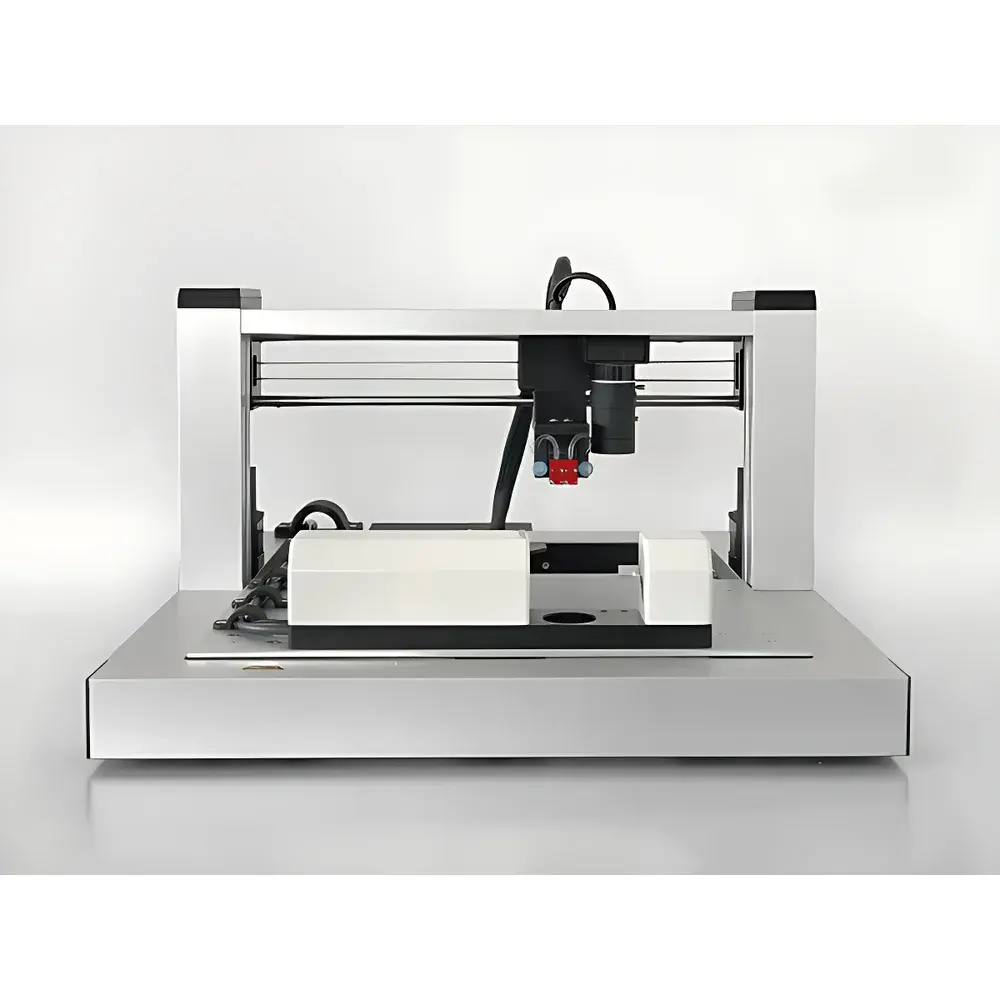
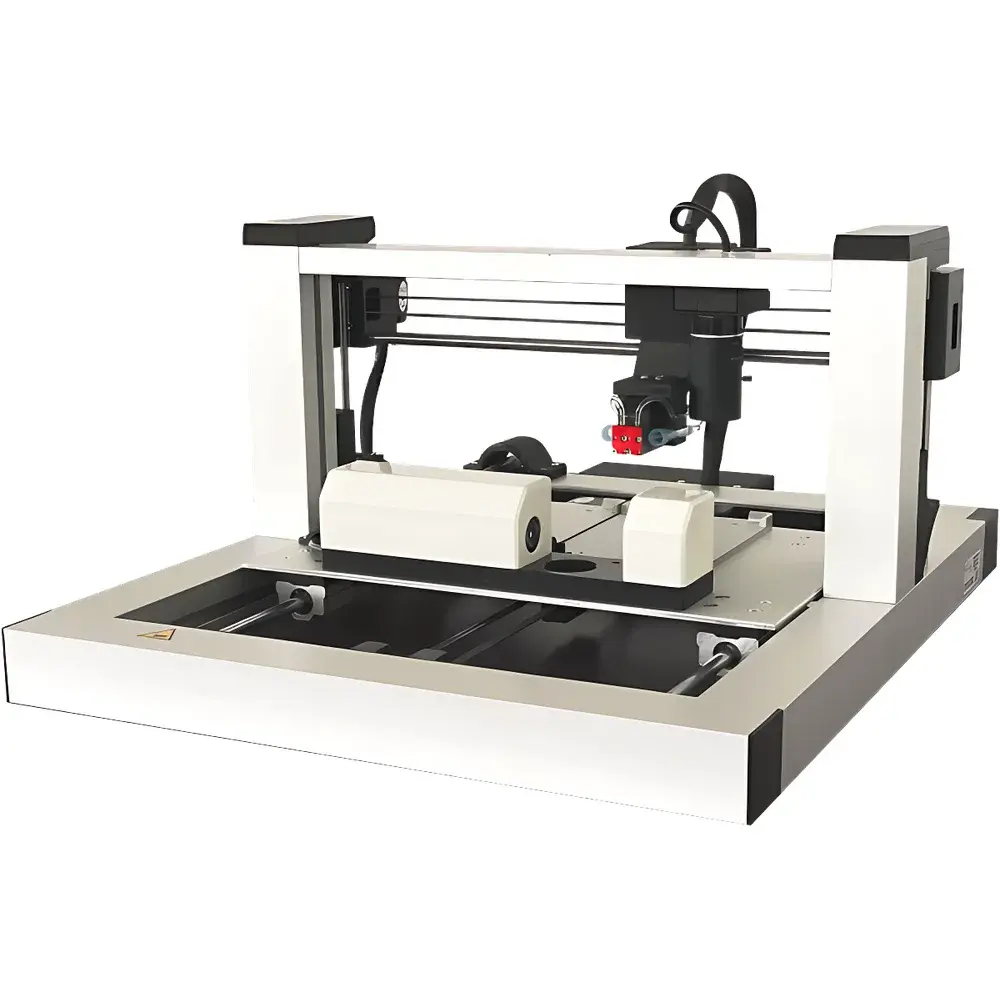
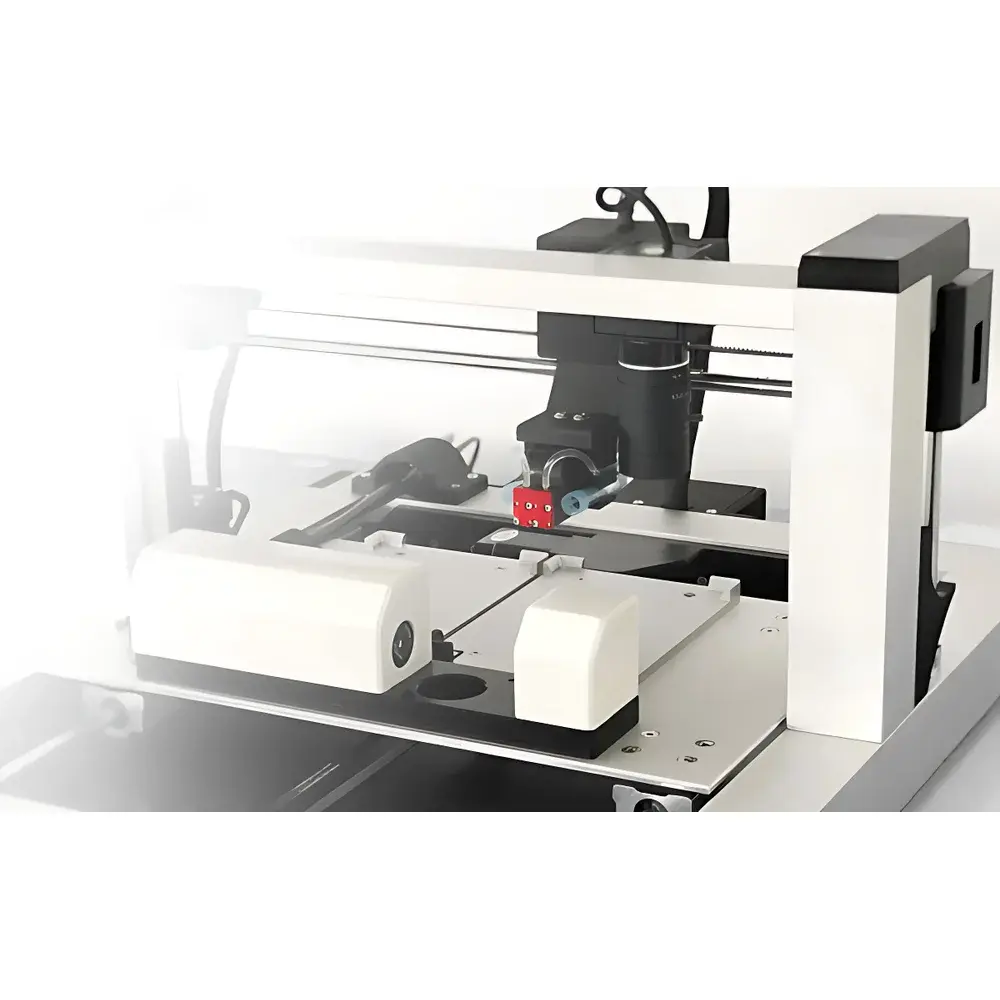
BioFluidix BioSpot Arc Non-Contact Picoliter/Nanoliter Dispensing Workstation
| Brand | BioFluidix |
|---|---|
| Origin | Germany |
| Model | BioSpot Arc |
| Instrument Type | Microarray Chip System |
| Dispensing Technologies | SiJet (pL) & PipeJet (nL) |
| Precision | CV < 1–3% |
| Integrated Modules | TopView Camera (real-time imaging), SmartDrop (automated droplet volume calibration) |
| Operating Modes | Standard & Flight Mode |
| Compliance | Designed for GLP/GMP-aligned workflows, supports audit-trail-ready data logging per FDA 21 CFR Part 11 requirements |
Overview
The BioFluidix BioSpot Arc is a high-precision, non-contact liquid handling workstation engineered for microarray fabrication, assay development, and miniaturized life science applications requiring picoliter (pL) and nanoliter (nL) dispensing accuracy. Unlike contact-based piezoelectric or pressure-driven systems, the BioSpot Arc employs proprietary acoustic ejection and jetting technologies—SiJet for sub-nanoliter dispensing (down to 0.5 pL) and PipeJet for robust nL-range delivery (1–500 nL)—enabling true drop-on-demand functionality without tip carryover, surface wetting, or cross-contamination. Its core architecture integrates real-time optical monitoring and closed-loop volume feedback, making it suitable for low-volume, high-value biological samples including oligonucleotides, antibodies, enzymes, viscous glycerol stocks, and even non-aqueous solvents used in material science applications such as fuel cell catalyst ink deposition.
Key Features
- Modular dispensing platform supporting simultaneous integration of SiJet (pL) and PipeJet (nL) modules on a single gantry—enabling seamless transition between ultra-low-volume spotting and higher-throughput nL dispensing.
- TopView Camera system: A high-resolution, telecentric imaging module mounted above the dispensing zone provides real-time, in-situ visualization of droplet formation, trajectory, and impact morphology at up to 10,000 fps—critical for validating dispensing fidelity across diverse surface chemistries and liquid properties.
- SmartDrop technology: An automated, image-based volumetric calibration routine that quantifies actual droplet size and volume directly from captured images, eliminating reliance on theoretical fluidic models or manual gravimetric validation. Calibration updates are applied dynamically to subsequent dispensing protocols.
- Flying dispensing mode: Enables continuous motion during ejection, significantly increasing throughput for large-area microarray printing (e.g., 96- or 384-spot patterns per second) while maintaining positional accuracy within ±5 µm.
- CV < 1–3% across defined volume ranges: Achieved through temperature-stabilized fluidics, pressure-compensated reservoirs, and adaptive waveform tuning—validated per ISO 8655-7 for volumetric performance under variable environmental conditions.
- Open API and scriptable control interface: Compatible with third-party LIMS and ELN systems; supports Python- and LabVIEW-based protocol automation for reproducible method transfer across labs.
Sample Compatibility & Compliance
The BioSpot Arc accommodates a broad spectrum of sample types—including aqueous buffers, DMSO-based compound libraries, polymer solutions (e.g., PDMS prepolymers), nanoparticle suspensions, and lyophilized reagent formulations—without requiring nozzle cleaning or priming between runs. Surface compatibility extends to functionalized glass slides, nitrocellulose membranes, silicon wafers, and hydrophobic/hydrophilic polymer substrates. The system meets essential design criteria aligned with ISO/IEC 17025 for testing laboratories and supports documentation frameworks required for GLP-compliant assay development and GMP-adjacent QC environments. Audit trail generation—including user actions, parameter changes, calibration events, and image metadata—is compliant with FDA 21 CFR Part 11 electronic records and signature requirements when deployed with validated software configurations.
Software & Data Management
BioSpot Control Suite provides a unified graphical interface for defining dispensing patterns (grid, custom ROI, serial dilution matrices), configuring jetting parameters (voltage, pulse width, delay), and managing camera-triggered acquisition sequences. All acquired images, droplet statistics (volume, circularity, centroid deviation), and raw dispensing logs are stored in vendor-neutral HDF5 format with embedded metadata (timestamp, operator ID, environmental sensor readings). Export options include CSV, TIFF, and JSON for integration into statistical analysis pipelines (e.g., R, Python pandas) or enterprise data lakes. Version-controlled protocol libraries ensure traceability across instrument deployments and facilitate multi-site method harmonization.
Applications
- Microarray manufacturing: High-density DNA, protein, carbohydrate, and antibody arrays for diagnostics and biomarker discovery.
- Microfluidic device priming: Precise deposition of reagents into microchannels, valves, and reaction chambers without clogging.
- qPCR/ddPCR setup: Accurate nL-scale distribution of master mix, primers, and templates into 384-well plates or digital PCR chips.
- High-throughput screening: Compound library dispensing onto cellular assays or enzymatic readout plates with minimal reagent consumption.
- Mass spectrometry sample preparation: Matrix-assisted laser desorption/ionization (MALDI) target spotting with controlled crystal homogeneity.
- Synthetic biology & materials science: Patterning of conductive inks, catalyst suspensions, and biohybrid hydrogels for electrochemical sensors and energy devices.
FAQ
What is the minimum dispensable volume supported by the BioSpot Arc?
The SiJet module achieves reliable, non-contact dispensing down to 0.5 pL per droplet, verified via calibrated imaging and statistical analysis of ≥100 consecutive droplets.
Can the system handle viscous or particulate-laden samples?
Yes—PipeJet’s positive-pressure jetting mechanism supports viscosities up to 50 mPa·s and suspended particles ≤5 µm in diameter, provided appropriate filtration and reservoir conditioning protocols are followed.
Is remote operation and monitoring supported?
The workstation includes Ethernet/IP connectivity and supports secure VNC-based remote access; all imaging and log data can be streamed to network-attached storage or cloud repositories via configurable SFTP endpoints.
How frequently must SmartDrop calibration be performed?
Calibration is recommended before each experimental batch and automatically triggered after fluid change, temperature shift >2°C, or mechanical maintenance—though stability studies show 8–12 hour validity under controlled lab conditions.
Does BioFluidix provide application-specific protocol development support?
Yes—application scientists offer collaborative method development services, including surface compatibility testing, liquid property characterization, and regulatory documentation packages for IVD or pharmaceutical use cases.





