
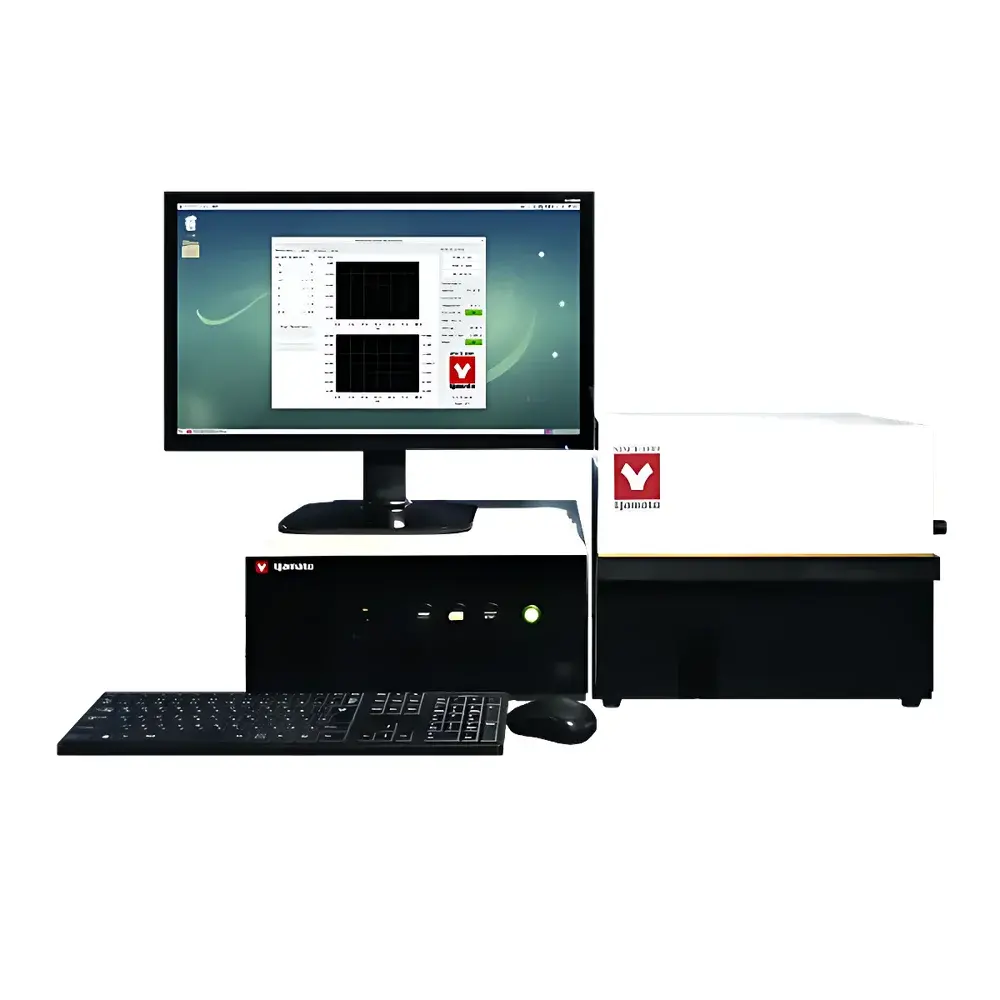
YAMATO TE100 Thermal Resistance Tester for Power Semiconductor Ceramic Substrates
| Brand | YAMATO |
|---|---|
| Origin | Japan |
| Model | TE100 |
| Compliance | ISO 4825-1:2023-01 |
| Sample Size | 30 × 30 mm |
| Load Force | 10 kg |
| Temperature Resolution | ≥0.01 °C |
| Electrical Resistance Measurement Error | ±0.1 mΩ (70–130 Ω) |
| Maximum Sampling Rate | 100 samples/sec |
| TEG Chip Dimensions | 5 × 5 × 0.35 mm |
| TEG Heat Generation Density | 1 kW/cm² |
| Max Input Power | ~250 W |
| Thermal Ramp Rate | 1.4 × 10⁴ K/sec |
| Controller Dimensions (W×D×H) | 380 × 470 × 180 mm |
| Measurement Unit Dimensions (W×D×H) | 380 × 400 × 320 mm |
| External Circulator | NeoCool CFA302 (Closed-loop, air-cooled) |
| Circulator Temp. Range | −10 to +60 °C |
| Circulator Power Supply | AC 100 V, 13.8 A |
| Circulator Dimensions (W×D×H) | 380 × 565 × 725 mm |
Overview
The YAMATO TE100 Thermal Resistance Tester is a precision metrology system engineered for the quantitative evaluation of thermal resistance (Rth) in ceramic substrates used in high-power semiconductor modules—particularly Al2O3, AlN, and Si3N4-based direct bonded copper (DBC) and active metal brazed (AMB) platforms. It implements the transient dual-sensor method per ISO 4825-1:2023-01, which defines standardized test conditions for thermal resistance measurement under controlled mechanical load and dynamic thermal excitation. The system couples a calibrated thermoelectric generator (TEG) chip—acting as both heat source and integrated temperature sensor—with high-fidelity, synchronized voltage and temperature acquisition to resolve transient thermal response with sub-millisecond temporal resolution. This architecture enables separation of interfacial thermal resistance (e.g., solder layer, interface voids) from bulk substrate conduction, supporting root-cause analysis of thermal bottlenecks in power electronics packaging.
Key Features
- ISO 4825-1:2023-01–compliant test methodology, ensuring traceability to international thermal metrology standards
- Integrated 5 × 5 × 0.35 mm TEG chip delivering up to 1 kW/cm² localized heating density and capable of thermal ramp rates exceeding 14,000 K/sec
- 10 kg programmable mechanical load applied via precision pneumatic actuator to replicate module-level clamping pressure and ensure consistent interfacial contact resistance
- Temperature resolution of ≥0.01 °C and electrical resistance measurement accuracy of ±0.1 mΩ (within 70–130 Ω range), enabling high-fidelity Rth calculation per Rth = ΔT / Q
- 100 Hz maximum sampling rate for simultaneous voltage, current, and dual-point temperature capture—critical for resolving early-time thermal transients
- Dedicated closed-loop external circulator (NeoCool CFA302) with −10 to +60 °C temperature control and air-cooled heat rejection, maintaining stable boundary conditions during repeated cycling
Sample Compatibility & Compliance
The TE100 accommodates standard 30 × 30 mm ceramic substrate specimens as defined in ISO 4825-1:2023-01. It supports bare substrates, metallized DBC/AMB wafers, and fully processed die-attach assemblies—enabling comparative assessment across process variations (e.g., solder reflow profiles, surface roughness, filler content). All measurements adhere to ISO/IEC 17025 principles for testing laboratories, and raw data logs include timestamped metadata required for GLP/GMP audit trails. The system’s hardware and firmware architecture are compatible with FDA 21 CFR Part 11–aligned software validation protocols when deployed in regulated environments.
Software & Data Management
The TE100 operates with YAMATO’s proprietary ThermalTest Suite, a Windows-based application providing real-time waveform visualization, automated Rth curve fitting (using exponential decay models), and batch report generation in PDF and CSV formats. Data files embed full instrument configuration, environmental parameters (ambient temp, circulator setpoint), and operator ID. Exported datasets retain native time-stamp resolution and support post-acquisition analysis in MATLAB, Python (NumPy/Pandas), or JMP. Audit logs record all user actions—including parameter changes, calibration events, and test initiation—ensuring full data integrity and reproducibility.
Applications
- Qualification of ceramic substrate suppliers against thermal performance specifications
- R&D evaluation of novel substrate materials (e.g., high-conductivity AlN composites, porous SiC hybrids)
- Process optimization of die-attach techniques (sintered Ag, transient liquid phase bonding)
- Failure analysis of thermal runaway mechanisms in IGBT and SiC MOSFET modules
- Validation of thermal interface material (TIM) efficacy under compression
- Supporting JEDEC JESD51-14 and JESD51-15 thermal characterization workflows for package-level modeling
FAQ
Does the TE100 measure junction-to-case (Rth,jc) or junction-to-ambient (Rth,ja) thermal resistance?
The TE100 measures substrate-level thermal resistance—primarily Rth,sub—between the TEG hot side and the cooled base plate. When used with representative module stacks, it provides boundary-condition data applicable to Rth,jc modeling but does not replace full-package transient dual-interface testing (TDI) per JESD51-14.
Can the system accommodate non-standard sample sizes?
Only 30 × 30 mm specimens comply with ISO 4825-1:2023-01; deviation requires method validation and documented deviation reporting for quality-controlled environments.
Is the TEG chip replaceable, and what is its expected service life?
Yes—the TEG module is field-replaceable. Under nominal operating conditions (≤250 W, ≤1000 thermal cycles), mean time between replacement is >5,000 hours, verified per YAMATO’s accelerated life testing protocol.
How is temperature calibration performed?
The system includes dual NIST-traceable Pt100 sensors calibrated at three points (−10 °C, 25 °C, 60 °C) using a certified dry-block calibrator; calibration certificates are provided with each unit and recommended annually.
Does the TE100 support automated pass/fail judgment against user-defined Rth limits?
Yes—ThermalTest Suite allows configurable acceptance thresholds and generates immediate visual alerts and summary reports upon test completion.



